

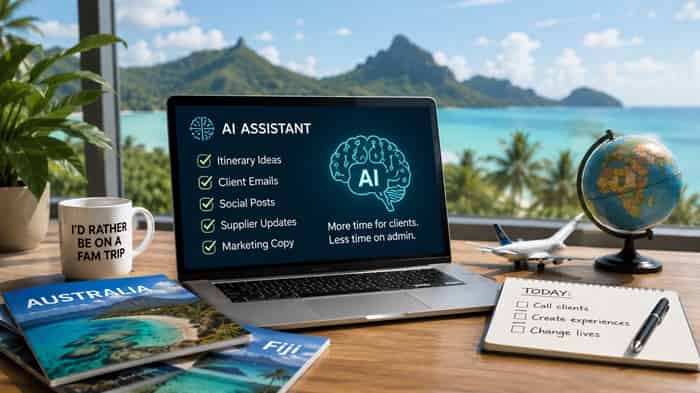
Artificial intelligence may not pour the champagne, inspect the hotel room or rescue a stranded client, but it can give travel advisors back the one thing they never have enough of: time.
Let’s begin with the good news.
Artificial intelligence is not about to steal a travel advisor’s seat in business class, drink the welcome cocktail or spend three agreeable days inspecting resorts in Fiji.
Nor can it return from a familiarisation trip and tell a client quietly and honestly that the hotel looks magnificent online but the pool is wedged beside a noisy road and the “ocean glimpse” requires considerable imagination.
For now, at least, the FAM is safe.
What artificial intelligence is coming for is the mountain of routine work that follows travel advisors everywhere: emails, quote follow-ups, newsletters, social posts, client notes, supplier summaries, destination copy and the blank computer screen that appears every time someone says, “We really should update the website.”
That may be no bad thing.
Australia’s travel distribution sector is dominated by smaller operators. The Australian Travel Industry Association says 92 per cent of its members are small businesses, meaning many agencies do not have the luxury of employing a full marketing department, copywriter, data analyst and administrative assistant.
In many businesses, one person is all four usually before lunch.
The newest junior in the office
AI is best treated as a fast, enthusiastic and occasionally unreliable junior employee.
Give it a clear brief, and it can be extraordinarily useful.
Leave it unsupervised, and it may confidently recommend a hotel that closed two years ago, misread a fare condition or invent a visa requirement with the swagger of a seasoned bureaucrat.
That distinction matters.
Used sensibly, AI can prepare the bones of an itinerary, turn rough supplier notes into readable copy, draft an email campaign, summarise a webinar, suggest social media posts and help produce different versions of an offer for different clients.
The advisor still needs to check the work.
No client should receive AI-generated advice about passports, visas, health requirements, insurance, entry rules or ticket conditions unless it has been verified against an authoritative source.
In other words, AI may hold the pen, but the travel professional remains the editor, publisher and person whose telephone rings when something goes wrong.
Where the hours disappear
Most advisors did not enter travel because of a lifelong passion for formatting newsletters.
They joined because they liked destinations, aircraft, hotels, ships, people and the agreeable possibility of seeing the world without paying the full brochure price.
Yet an alarming portion of the working week can disappear into jobs that have little to do with selling travel.
A supplier sends a three-page update.
A client wants a revised version of an itinerary.
The agency needs six Facebook posts.
A cruise promotion requires an email, a landing page and two follow-ups.
Someone must turn a pile of notes into a polished proposal.
None of these tasks is especially difficult. Together, they can swallow a day.
This is where AI earns its keep.
It can convert bullet points into a first draft, shorten an overlong supplier announcement, create several headline options, prepare a call script or turn one destination article into material for email, web and social media.
The result is not necessarily fewer staff.
For many agencies, it means the same staff can spend more time speaking to clients and less time wrestling with words.
And speaking to clients remains where the money usually begins.
Can AI genuinely increase revenue?
Possibly, but this is where the sales pitch needs a cold shower.
There is no credible industry-wide figure showing that every travel agency adopting AI will increase revenue by 20, 30 or 40 per cent.
Anyone offering such a guarantee should probably be asked whether the price includes a bridge in Sydney Harbour.
The commercial case is more straightforward.
If an advisor saves several hours each week and uses those hours to follow up quotes, contact past clients, respond faster to new enquiries or prepare better-targeted offers, the business has more opportunities to convert sales.
If the saved time is spent watching luggage videos on Instagram, revenue is unlikely to notice.
McKinsey has reported that businesses investing in AI across marketing and sales have recorded revenue uplifts of between three and 15 per cent and improvements in sales return on investment of 10 to 20 per cent. These are broad, cross-industry findings, not a promise to Australian travel agencies, but they do show that AI can create measurable commercial value when it is properly implemented.
The important words are “properly implemented”.
Buying a subscription and asking it to “make us more profitable” is not a strategy.
Marketing without the blank-page panic
For small travel businesses, marketing may be AI’s most useful contribution.
Most agencies already possess the raw material.
They have destination knowledge, supplier relationships, client stories, photographs, opinions and years of first-hand experience.
What they often lack is time to package it.
AI can help turn that knowledge into marketing people may actually read.
A travel advisor could feed it notes from a recent Japan trip and ask for the first draft of a family travel article, a cruise comparison, three social posts and an email for clients who previously visited Asia.
That is not replacing expertise.
It is putting existing expertise to work more efficiently.
The website should not resemble an abandoned terminal
Many agency websites have useful booking information, a staff photograph taken during a previous federal government, and a “latest news” section last updated when borders were closed.
That is not uncommon.
It is also not ideal.
AI can help agencies create destination pages, frequently asked questions, cruise guides, escorted-tour features and seasonal travel content.
However, publishing volume for its own sake is a mistake.
Google does not need another bland article titled “Ten Reasons to Visit Europe” containing advice that could apply equally to every continent except Antarctica.
Good travel content needs first-hand detail.
Which neighbourhood is best for a first visit?
Which river cruise cabin is worth paying more for?
Which property works for clients with mobility concerns?
Where does the transfer become inconvenient?
What would the advisor personally book and what would they avoid?
AI can structure those answers and improve readability, but the valuable material must still come from someone who knows the product.
That is also how agencies should approach search engine optimisation.
The purpose is not to stuff “cheap holidays”, “best travel agent” and “luxury travel deals” into every second paragraph until the English language files a complaint.
The purpose is to answer the questions prospective clients are genuinely typing into Google.
One database, several different clients
The old method of agency marketing was simple.
Create one newsletter.
Send it to everyone.
Hope the client interested in Antarctic expeditions does not mind three pages about Disneyland.
AI-assisted customer segmentation offers a better approach.
When used with a properly managed customer relationship system, it can help identify groups such as regular cruisers, luxury travellers, family holidaymakers, corporate clients, ski enthusiasts or customers who have not booked recently.
The agency can then adapt its message.
A cruise client receives a cruise offer.
A family receives school-holiday ideas.
A premium traveller receives a private touring proposal rather than a discount coach package accompanied by several exclamation marks.
This is not sinister surveillance.
It is the electronic version of a good advisor remembering that Mrs Thompson likes balcony cabins and refuses to fly before breakfast.
The difference is scale.
McKinsey identifies lead generation, marketing optimisation and personalised outreach among the areas where marketing and sales leaders expect generative AI to have substantial impact.
But the database must be clean, consent must be respected, and private information must be handled carefully.
The Australian Government’s National AI Centre warns that organisations remain responsible for privacy, consumer, copyright and other legal obligations even when an AI system is supplied by somebody else.
So, no, client passports, medical details and credit-card information should not be casually dropped into a public chatbot because it makes the itinerary easier to format.
Travel managers also have plenty to gain
Corporate travel managers may find AI particularly useful because their work produces enough reports to threaten a small forest.
AI can help summarise travel-spend data, draft traveller communications, compare policy language, identify recurring out-of-policy bookings and turn lengthy supplier updates into practical briefings.
It can also prepare initial management reports explaining where expenditure is moving and which routes, cabins or booking behaviours are driving costs.
Again, the tool should assist the analysis, not make the final decision.
Corporate travel involves duty of care, contractual commitments, traveller security and company policy. Those are not areas for creative guesswork.
A travel manager who uses AI well may become faster and better informed.
A travel manager who accepts every output without checking it may become available for employment elsewhere.
Marketing claims still need a human eyebrow
AI is very good at enthusiasm.
Every resort is breathtaking.
Every destination is unforgettable.
Every cruise is luxurious.
Every deal is exclusive, including the one being advertised by 900 other agencies.
That is why marketing still needs a human eyebrow.
The advisor must decide whether a claim is accurate, whether the offer is genuinely good and whether the language sounds like the agency or like a machine that has swallowed a tourism brochure.
AI can produce five subject lines in seconds.
A competent marketer still chooses the one that does not sound desperate.
It can draft a luxury campaign.
An experienced advisor knows that genuine luxury clients rarely respond well to twenty capital letters and a flashing “BOOK NOW”.
The technology supplies speed.
Judgement supplies credibility.
Will AI kill the FAM?
Almost certainly not.
It may, however, make poorly planned FAMs harder to justify.
Suppliers have always expected some return from familiarisation travel, whether through sales, education, coverage or stronger distribution relationships.
AI makes it easier for participants to research before departure, prepare better questions, record observations and produce useful follow-up content.
That should improve the value of the trip.
The advisor can arrive already knowing the room categories, restaurant hours and transfer times.
They can then concentrate on what cannot be gathered from a product sheet.
Is the service warm or merely efficient?
Does the hotel suit families, couples or neither?
Is the walk to the beach realistic for an older client?
Can a nervous traveller navigate the airport connection?
Does the destination feel safe after dark?
Would the advisor send a favourite client there?
These are not small details.
They are the reason clients still seek advice.
A machine can gather thousands of reviews, but it cannot stand in a hotel room, hear the nightclub next door and decide that the “vibrant location” may not suit a light sleeper.
FAMs are not disappearing because of AI.
If anything, first-hand experience becomes more valuable in a market flooded with machine-generated sameness.
The traveller is already using it
Advisors should also remember that their clients are not waiting for permission.
Deloitte reported that intended use of generative AI for holiday planning among surveyed travellers rose from eight per cent in 2023 to 16 per cent in 2024 and 24 per cent in 2025. Travellers were using it to research attractions, destinations and accommodation.
Deloitte’s 2026 travel outlook says generative AI use in trip planning tripled between 2023 and 2025.
That does not make the advisor irrelevant.
It changes the conversation.
Clients may arrive with an AI-generated itinerary, three hotel suggestions and absolute confidence that they can travel from one side of Italy to the other before lunch.
The advisor’s value lies in knowing which parts are sensible, which are technically possible and which will leave the client exhausted beside a railway platform wondering where it all went wrong.
Start small and keep an adult in charge
Agencies do not need an enterprise transformation committee, six consultants and a launch event featuring dry ice.
They need one useful problem.
Choose a repetitive task that consumes time.
It might be preparing quote follow-ups, turning supplier notes into client-friendly copy, drafting social posts or creating the first version of a monthly newsletter.
Measure how long the task takes now.
Use AI for the first draft.
Check the result.
Measure again.
Then decide whether the saved time is worth the cost and effort.
The National AI Centre recommends that businesses appoint responsibility for AI use and establish a clear policy covering how the technology may be used, who is accountable and what rules staff must follow.
For a small agency, that policy need not resemble the Treaty of Versailles.
It should state what information staff may enter, what must never be shared, which outputs require checking and who approves customer-facing material.
That alone will prevent a fair amount of grief.
The profession is not finished; it is being edited
Artificial intelligence will change travel agencies.
So did the fax machine, the internet, electronic ticketing and online booking.
The profession survived each change because good advisors continued to provide something technology could not supply on its own: judgement.
AI will write quicker emails.
It will produce more content.
It may help agencies find neglected clients and respond to enquiries before a competitor does.
Used properly, it should reduce drudgery and improve marketing.
Used badly, it will produce a torrent of inaccurate itineraries, identical newsletters and photographs of aeroplanes with seventeen engines.
The winners will not be the agencies that use the most AI.
They will be the ones that know where it is useful, where it is risky and when to turn it off.
And the FAM?
The FAM remains one of travel’s great educational institutions, particularly when conducted in a destination with good food, respectable wine and a supplier who understands that meaningful product research occasionally continues beside the pool.
AI can prepare the inspection checklist.
The advisor still has to make the journey.
By: Jill Walsh – © 2026.
Read Time: 12 minutes.
Author Bio:
 Jill Walsh has always kept a pen close and a suitcase closer. She started out on media releases, then learned the trade properly by escorting press trips around the world, discovering which stories travel well and which need a sharper edit.
Before long, she wasn’t just promoting destinations; she was representing them, translating civic ambition and local pride into words people actually wanted to read. These days, semi-retired and happily so, Jill has traded departure boards for deadlines, joining old friend and colleague Stephen at Global Travel Media on a casual basis.
Her patch is the business end of wanderlust: balance sheets, route maps, tender wins and the numbers that quietly decide where travellers go. She writes with dry humour, clean prose and an old-school respect for facts a steady voice when the market starts shouting.











