

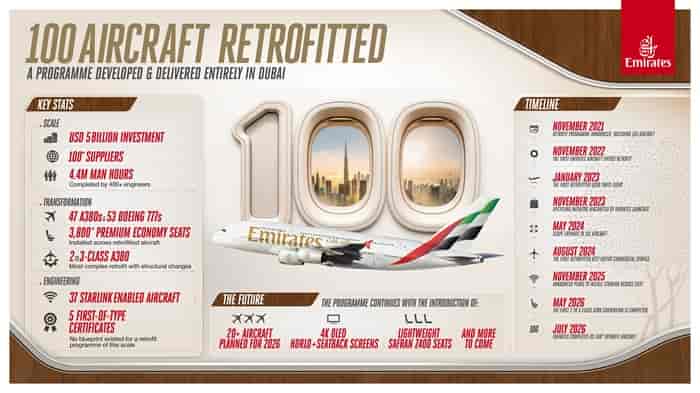
Emirates has completed the full cabin upgrade of its 100th wide-body aircraft. The landmark puts fresh lift under the Emirates retrofit programme, a vast US$5 billion exercise spanning 219 aircraft.
Since November 2022, the airline has renewed 47 Airbus A380s and 53 Boeing 777s. All work has taken place at the Emirates Engineering hangars in Dubai.
The project has taken 44 months so far. More than 400 engineers and technicians have given it a combined 4.4 million man-hours.
By the end of December 2026, Emirates expects to finish about 20 more aircraft. That will carry the programme well beyond its halfway point.
For a carrier that rarely thinks small, this is still a giant task. Changing a seat cover is easy. Rebuilding whole cabins while keeping a global fleet moving is another matter.
Premium Economy gains more ground
Every completed aircraft has received a new Premium Economy cabin. More than 3,800 Premium Economy seats have now joined the fleet.
The cabin gives travellers more room and comfort than Economy Class. It also costs less than Business Class. That makes it an appealing middle choice on long flights.
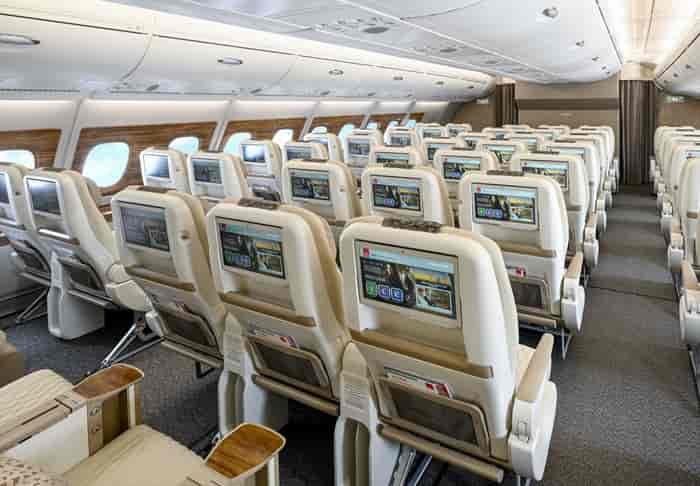
Premium Economy in the newly retrofitted A380 aircraft- converted from two class to three class
The work does not stop at the premium rows. Each aircraft receives new seats, finishes and cabin details from nose to tail.
Engineers first remove much of the cabin interior. They then inspect, renew and rebuild the space using thousands of parts.
An A380 needs more than 4,000 parts during its upgrade. A Boeing 777 needs more than 2,500. The team has finished about 28 aircraft each year since the work began.
Sir Tim Clark, President of Emirates Airlines, called the 100-aircraft result “a significant achievement”.
He said the investment would help customers “fly better”. The aim is greater comfort, luxury, and thoughtful details in every cabin.
The timetable is just as important as the new seats. Each aircraft must return to service on time and in fine condition. A gleaming cabin earns a few dollars while parked in a hangar.
The Dubai team keeps control of the job
Emirates Engineering manages and carries out the work in Dubai. This in-house model gives the airline close control over quality and timing.
It has also forced the team to solve unusual problems. Modified catering trucks now move large cabin parts inside the hangars. Yesterday’s meal truck has become today’s heavy lifter.
Staff have built special tools to reach tight spaces. New storage systems help teams find and move parts quickly.
Zonal tracking also shows how work is moving through each cabin. That helps managers spot delays before they become costly.
More than 100 suppliers support the project. Emirates Engineering, however, remains at the centre of the operation.
The task blends design, heavy engineering, testing and strict safety rules. It also involves careful fleet planning. Taking too many aircraft out of service would soon send the timetable into a holding pattern.
A plan that grew with demand
Emirates announced the first retrofit plan in November 2021. It then covered 105 aircraft.
The first A380 entered the Dubai hangars in November 2022. Strong demand for the new cabins soon changed the scale of the work.
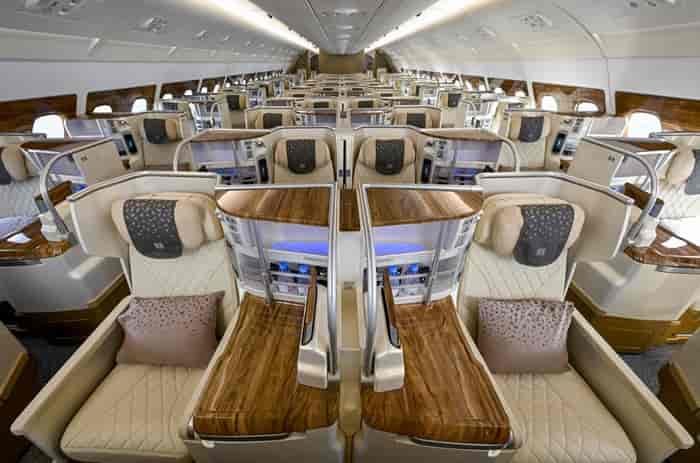
Business Class in the newly retrofitted A380 aircraft- converted from two-class to three-class
The plan grew to 191 aircraft in May 2024. It rose again to 219 aircraft by the end of that year.
The current list includes 110 Airbus A380s and 109 Boeing 777s. Emirates describes it as the world’s largest known airline retrofit programme.
The first Boeing 777 renewed in Dubai returned to commercial service in August 2024.
Another major step came in May 2026. Emirates changed its first two-class A380 into a three-class aircraft.
This was not a quick trim-and-polish. Engineers removed 120 Economy Class seats. They also changed galleys, storage areas, overhead bins, partitions, wiring and plumbing.
The finished aircraft had 76 Business Class seats. It also had 56 Premium Economy seats and 437 Economy Class seats.
For the first time, Premium Economy appeared on the A380’s upper deck. That required major changes to the aircraft’s internal layout.
The job illustrated why aircraft retrofits are not merely interior design projects. They demand structural skill, precise testing and strict attention to weight, balance, power and cabin systems.
In other words, there is considerably more to it than choosing an attractive shade of beige.
Sharper screens are coming next
The next phase starts in October 2026. Emirates plans to fit 4K OLED HDR10+ seatback screens.
New lightweight Safran Z400 seats will also arrive. Other cabin changes will follow as the programme moves ahead.
Passengers should experience sharper screens, newer seats, and a more consistent experience across the fleet.
For Emirates, the work protects the appeal of its largest aircraft. The A380 and Boeing 777 remain central to the airline’s international network.
A new cabin cannot make an older aircraft young. It can, however, make the trip feel current. Think of a grand hotel with newly renovated rooms, but the same famous ballroom.
The investment also helps Emirates offer a more consistent product. Passengers are less likely to find vastly different seats or cabin finishes when moving between aircraft.
That consistency matters to premium travellers, corporate travel buyers and travel advisers. Customers paying for a recognised product expect to receive it without consulting an aircraft registration number before breakfast.
Old cabin materials take a new route
Emirates is also reusing material removed from the aircraft. This includes leather, fabric and other high-grade items.
Thousands of kilograms are being turned into bags and limited-edition collector pieces. They are sold under the Aircrafted by Emirates range.
The airline has also made more than 4,000 backpacks from old Economy Class seat fabric. It has given them to children in 11 countries.
Upcycling does not erase aviation’s wider environmental cost. It does keep useful material out of waste streams. It also gives part of an old cabin a practical second journey.
The initiative adds a visible sustainability element to a programme largely driven by engineering, customer service and commercial goals.
Emirates retrofit marathon flies onwards
The 100-aircraft mark is not the finish line. Emirates still has 119 aircraft left on the programme’s list.
Even so, the milestone shows what its Dubai team can deliver. It has run a huge upgrade plan at speed, kept the work in-house and maintained close control over thousands of moving parts.
The result is also commercially significant. Emirates can extend the useful appeal of its existing aircraft while waiting for new jets, seats and onboard technologies to enter the fleet.
Passengers, meanwhile, gain access to more Premium Economy seats and refreshed cabins across a growing number of routes.
After 44 months, 4.4 million man-hours and thousands of new seats, the project is still climbing. Emirates has reached cruising height, but there is plenty of runway left.
By: Supaporn Pholrach – © 2026.
Read Time: 5 minutes.
Author Bio:
 Supaporn Pholrach came up in advertising when deals were sealed with a handshake, and deadlines lived on scraps of paper, not dashboards. She learned early that people mattered more than process, and it stuck. Armed with solid training and a stubborn work ethic, she built a reputation for getting results without turning hard or hollow.
Fifteen years at Bangkok Shuho would test anyone’s stamina. Supaporn stayed the distance. These days, as Sales Manager at Global Travel Media, she helps tourism brands cut through the noise with common sense, good humour and genuine warmth.
She doesn’t chase quick wins. She earns trust, builds loyalty and keeps her word. In an industry that rarely slows down, Supaporn is someone you’re quietly glad to have on your side.











