

Singapore tourism receipts rose sharply in early 2026, even as first-half visitor arrivals softened, leaving events, air capacity and value to shape the months ahead.
Singapore has pulled off the tourism industry’s favourite trick. Travellers are spending more, even as the headcount begins to thin.
Tourism receipts reached S$8.6 billion in the first quarter of 2026, a 6 per cent rise on the same period last year. International visitor arrivals for the quarter also nudged higher, up 3 per cent to 4.4 million.
Then came the softer landing. By the end of June, Singapore had welcomed 8.2 million international visitors, 2 per cent fewer than in the first half of 2025. June alone brought 1.2 million arrivals, down 5 per cent year on year. Singapore’s official tourism statistics are published through the Singapore Tourism Analytics Network.
For Singapore’s tourism mandarins, the more telling figure sits on the revenue line. The city-state is attracting travellers prepared to open their wallets. They are not merely passing through immigration and posing beside Marina Bay.
That is quality tourism in its most useful form: less obsession with the turnstile and more attention to what visitors actually contribute.
Retail puts some polish on the quarter
The lift in tourism receipts was driven by solid visitor spending, although the gains were anything but uniform.
Sightseeing, Entertainment and Gaming climbed 23 per cent compared with the first quarter of 2025. Shopping rose 7 per cent, while other tourism receipt components edged up 1 per cent.
Food and beverage spending slipped 2 per cent. Accommodation was flat.
That result carries a small but revealing message. Visitors may have been cautious about an extra course at dinner or another night in the hotel. Plenty still found room in the budget for a serious shopping bag.
Seven of Singapore’s 10 largest tourism-receipt markets recorded higher shopping expenditure during the quarter, led by spending on high-value retail categories.
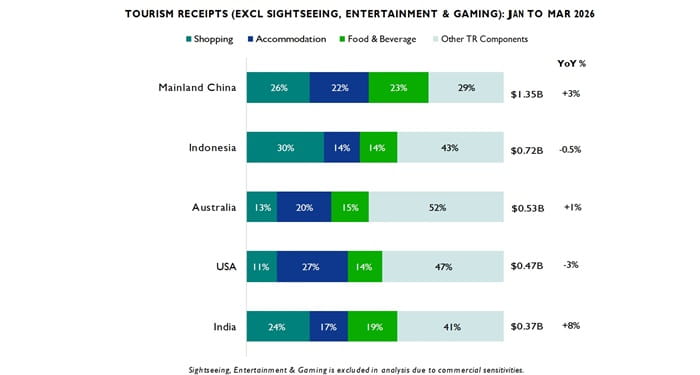
Mainland China again topped the receipts table, contributing S$1.35 billion, up 3 per cent. Indonesia followed with S$720 million, down a slender 0.5 per cent.
Australia placed third at S$533 million, one per cent ahead of last year. The United States generated S$466 million, down 3 per cent, while India generated S$374 million, up 8 per cent.
The country figures exclude Sightseeing, Entertainment and Gaming. That follows the Singapore Tourism Board’s practice and reflects the commercial sensitivities associated with the category.
Australia’s showing will be particularly welcome to the local trade. Singapore remains firmly in the Australian traveller’s consideration set. That is no small feat, especially as household budgets are squeezed, and rival destinations wave persuasive airfare deals.
Arrivals ease, but the market has hardly gone quiet
Mainland China was Singapore’s largest source of visitors during the first half, sending 1.5 million travellers, up 4 per cent.
Indonesia remained second with 1.1 million visitors, although that was 11 per cent below the corresponding period. Malaysia supplied 645,000 arrivals, up 2 per cent.
There is no disguising the Indonesian decline. It matters because of the market’s proximity, scale and long-standing importance to Singapore’s hotels, shops and attractions.
Yet the broader result is not a tale of tourism falling off a cliff. Demand has become patchier. Airline capacity is more decisive, and value matters more.
Singapore Tourism Board Chief Executive Melissa Ow struck that balance in her assessment of the half-year result.
“Singapore’s tourism performance in 1H 2026 reflects the continued appeal of Singapore as a destination and the strength of our sector, with positive TR growth in Q1 2026. We remain clear-eyed about the challenges ahead. As visitor arrivals from some source markets soften and global uncertainty persists, we are working closely with our partners to drive visitor demand. A strong pipeline of events and experiences, targeted promotions in key source markets and close collaboration with our partners are keeping Singapore top of mind for travellers.”
It is a sober reading, and probably the right one. Singapore has plenty to sell. It is not pretending that geopolitics, expensive airfares and nervous consumers can be brushed aside with a glossy campaign and a plate of chilli crab.
STB entered 2026 forecasting between 17 million and 18 million international arrivals and S$31 billion to S$32.5 billion in tourism receipts. The board acknowledged that economic and political uncertainty could influence global travel patterns.
New attractions give visitors another reason to stop
The first half was helped by a useful procession of new products and events.
Disney Cruise Line’s Disney Adventure arrived in Singapore. It expands the destination’s cruise appeal and gives families one more reason to build a holiday around the city.
Rainforest Wild Adventure East also opened at Mandai Wildlife Reserve. The new attraction strengthens a precinct that has become one of Singapore’s most substantial visitor draws.
Elsewhere, the Botero in Singapore exhibition, Cirque du Soleil’s KOOZA, the Elite Pickleball International Championship and the Children’s Festival broadened the leisure calendar.
That mix is important. Singapore has moved beyond the old stopover formula of shopping, eating and catching the next flight. Those pleasures remain, quite properly. The city now works much harder to create reasons for travellers to stay another night.
MICE remains Singapore’s dependable workhorse
If leisure events provide the sparkle, business events continue to pay a sizeable share of the bills.
Singapore Airshow 2026 welcomed a record 65,000 trade attendees from more than 130 countries and regions. More than 1,100 companies took part, reinforcing the event’s standing in the global aerospace and defence calendar.
Asia Pacific Maritime drew more than 19,400 trade attendees, an increase of over 20 per cent from its previous edition.
Food & Hospitality Asia brought together more than 70,000 attendees across four days. MTX, or Milipol TechX, attracted over 21,000 people from 76 countries in its largest edition yet.
Herbalife Extravaganza followed in June with more than 20,000 participants, making it the largest meeting and incentive event held in Singapore.
These are not simply impressive numbers for organisers to place in a post-event media release.
Business delegates fill aircraft cabins and occupy hotel rooms on valuable midweek nights. They book restaurants, hire venues and keep a considerable network of local suppliers busy.
They also tend to spend more than the average leisure visitor. That makes MICE central to Singapore’s pursuit of higher-value tourism.
Singapore retained its position as Asia-Pacific’s leading meetings city in the International Congress and Convention Association rankings for the 23rd consecutive year. That is the sort of record competitors would dearly like to borrow.
Support arrives before the weather turns
STB used the Tourism Industry Conference in May to announce additional support for the sector.
Measures included an enhanced Business Events in Singapore scheme, a widened Kickstart Fund and the new Market Access Fund.
The Market Access Fund will help Singapore tourism businesses enter emerging markets and secondary cities. It means the trade does not need to keep fishing in the same familiar ponds.
STB has also rolled out more than 25 trade partnerships across Mainland China, Malaysia, South Korea, Australia and the United Kingdom.
The approach is practical. When demand is uneven, destinations can either complain about the weather or move the deckchairs somewhere more useful. Singapore, unsurprisingly, has chosen the latter.
Australia remains steady, but competition is sharpening
STB expects travel demand to moderate in the second half of 2026. Economic uncertainty and capacity constraints are weighing on several source markets.
Mainland China, Australia and Malaysia are expected to remain relatively resilient.
Chinese arrivals could strengthen as additional air capacity enters the market from the third quarter. Malaysian performance should remain steady, although fluctuating capacity into Singapore presents a risk.
Australian outbound travel is also holding up despite cost-of-living pressure.
The snag is competition. More Middle Eastern airline services are returning to Australia. They give travellers affordable routes and tempting alternatives across Europe, the Gulf and beyond.
Singapore cannot assume that familiarity will always win. Airfare, hotel value and the strength of a specific reason to travel will increasingly decide the booking.
The outlook is more cautious for Indonesia and India.
Indonesia continues to face weaker economic conditions, softer consumer spending and reduced seat capacity. Connectivity should improve later in the year.
India’s underlying appetite for Singapore remains healthy. Yet elevated fares caused by tight airline capacity have taken some heat from the market. A recovery is expected as those constraints ease.
A second-half calendar built to fill rooms
Singapore is not short of reasons to travel during the remainder of the year.
The PPA Asia 500 Leapmotor Singapore Open runs from 23 to 26 July. It brings professional pickleball and US$70,000 in prize money to the Sports Arina at Singapore Expo.
The F1 Exhibition opens at Gardens by the Bay on 23 July and continues until 18 October. Formula One followers will get a close-up look at the sport’s cars, engineering and history.
The Singapore Tennis Open takes place from 21 to 27 September.
Then comes the Formula 1 Singapore Airlines Singapore Grand Prix from 9 to 11 October. The 2026 race weekend includes Singapore’s first Formula One Sprint. That means more competitive track action and less chance of an early night near Marina Bay.
December belongs to BTS.
The group’s four sold-out WORLD TOUR “ARIRANG” concerts will take over the National Stadium on 17, 19, 20 and 22 December. It is the tour’s longest Asian run outside Korea and Japan.
It is also a useful reminder that a major concert can be as potent a tourism campaign as anything devised in a boardroom.
The business events diary is equally weighty.
Medical Fair Asia runs from 9 to 11 September. The inaugural Asian edition of Passenger Terminal Expo Asia follows on 23 and 24 September at Sands Expo & Convention Centre.
The Milken Institute Asia Summit is scheduled for 7 to 9 October. The 23rd World Congress of Chinese Medicine will take place on 17 and 18 October, returning to Singapore after 19 years.
Fewer footsteps, heavier wallets
Singapore’s first-half figures are neither a victory lap nor a warning siren.
They show a destination extracting stronger value from its visitors while facing a modest decline in arrivals. That is a respectable position, particularly in a market unsettled by capacity shortages, economic caution and geopolitical risk.
But yield cannot do all the work forever. Singapore still needs volume. Hotels, attractions and smaller operators depend on a steady flow of people, not a handful of lavish shopping receipts.
The second half will therefore be a test of balance.
Singapore must hold on to its higher-spending visitors, rebuild weaker source markets, and keep the destination compelling enough to justify the airfare.
Disney is at sea. BTS is in the stadium. Formula One is under the lights, and the convention calendar shows little regard for empty hotel rooms. Singapore has given itself every chance.
The Lion City’s tourism machine may have changed gear, but it has certainly not stalled.
By: Soo James – © 2026.
Read Time: 8 minutes.
Author Bio:
 There’s nothing rehearsed about Soo James, and that’s precisely the point. Malaysian by heritage, Sydney-schooled, she arrived at UNSW to study Arts, then took a left turn into IT, not out of ambition but out of curiosity. Somewhere among systems and schedules, she worked out what really held her attention: people, language, and the quiet spaces between them.
Writing followed naturally. Travel and lifestyle gave her room to observe, to listen, to notice the details others rush past. Soo writes the way good travellers move, watching the room before admiring the view, catching the gesture before chasing the headline.
At Global Travel Media, her stories don’t shout or sell. They linger. They slow you down, open a door, and gently suggest there’s more to see if you’re willing to look.











