

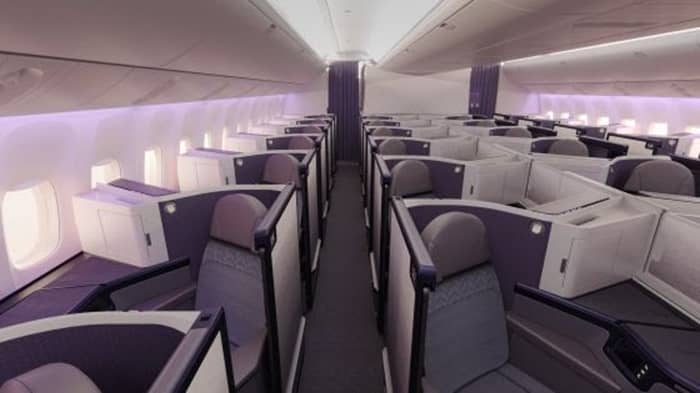
Air New Zealand has opened the cabin door on the next phase of its long-haul product. The airline has revealed a major Boeing 777-300ER cabin upgrade that will bring the veteran jet closer to its newly refreshed Dreamliners.
The first aircraft is due to enter the retrofit program in March 2027 and return to service by May 2027. Total capacity will stay at 342 seats. However, two Premium Economy seats will be removed, and two Economy seats will be added.
It is neat cabin maths. There will be more privacy at the pointy end, room for two more passengers down the back and no change to the total headcount.
For Air New Zealand, this is about far more than fresh trim and larger screens. The 777-300ER remains an important part of its international network. A modern cabin will help the airline keep the aircraft flying for longer. It should also reduce the maintenance work associated with an older interior.
Business Premier gains doors and a new direction
Business Premier is the headline act. Air New Zealand will fit 44 Collins Elevation seats in a forward-facing reverse-herringbone layout. The seat count will not change, but the passenger experience certainly will.
Each seat will have a privacy door. Centre seats will also gain sliding dividers. The seats will offer a 43-inch pitch and turn into lie-flat beds. Passengers will have 18-inch entertainment screens, Bluetooth audio, and USB-A and USB-C ports.
In plain English, travellers should gain more space and less unwanted eye contact. The old premium-cabin ritual of staring politely past the person across the aisle may soon be cleared for departure.
Air New Zealand Chief Customer and Digital Officer Jeremy O’Brien said: “the time is right to raise the bar once again”. He also confirmed that the cabin would move to a “reverse herringbone” format. It will offer functions similar to those of the new seats being fitted to the airline’s Boeing 787-9 fleet.
That consistency is important. People paying premium fares usually want a firm promise, not a lucky dip. A closer match between the 777 and Dreamliner cabins should make Air New Zealand’s long-haul product easier to sell and easier for customers to trust.
The economy receives a useful technology lift
The economy will also receive new seats. ZIM Aircraft Seating will supply the ergonomic design, while the cabin will grow from 244 to 246 seats. The new plan will include 16 Skycouch rows.
Economy Stretch seats will provide a 35-inch pitch. Standard Economy seats will offer between 31 and 32 inches. Each passenger will gain a 13-inch entertainment screen, Bluetooth audio and a USB-C connection.
These upgrades may lack the theatre of a sliding suite door, but they matter on a long flight. Clearer screens, wireless audio and reliable power are now basic needs. A flat phone battery can feel almost as serious as a missing passport when there are still eight hours to go.
Premium Economy will remain much the same. The cabin was refreshed over the past year with new seat covers and curtains. Its capacity will fall from 54 to 52 seats under the new layout.
A practical investment in the 777 fleet
This is not merely a cosmetic makeover. It is a practical fleet decision.
A sound widebody does not always need to be replaced simply because its cabin has aged. A well-planned retrofit can extend its useful life, improve the brand experience and reduce the wait for new aircraft.
Air New Zealand says it considered both production costs and future maintenance needs when choosing the new interiors. That is sensible. Shiny fittings are welcome, but they still need to survive years of meals, luggage, children, coffee spills and the odd passenger who treats a seat pocket like a garden shed.
For travellers, the real test will come at 35,000 feet. On paper, however, the plan has a strong appeal. Business Premier gains private suites. Economy receives better screens, useful power and new seats. The 777 experience will also sit more closely beside the refreshed Dreamliner product.
The first upgraded aircraft is due to return in May 2027. Air New Zealand welcomed its first 777-300ER in late 2010, so this is not a farewell tour. It is a confident second act, complete with closed doors, sharper screens and far fewer awkward glances.
By: May Marclay – © 2026.
Read Time: 3 minutes.
Author Bio:
 May Marclay’s career hasn’t followed a straight line, and she’s better for it. She began in real estate, then moved into hospitality, finding her rhythm with Centara in the Maldives. There, she worked the Asian markets the old-fashioned way: building trust, closing deals, and turning conversations into lasting business.
The UAE sharpened its focus. At IHG, supporting an Area General Manager, she saw the machinery of a major travel hub from the inside, no gloss, just how things actually get done.
Now, with her sights set on healthcare, May brings a broader lens than most. She speaks three languages, reads widely, travels with intent, and writes with the calm assurance of someone who understands both the detail and the bigger picture without needing to say so too loudly.











