

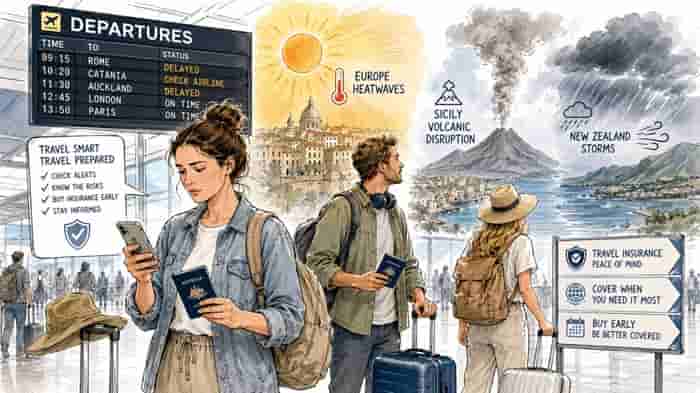
The traditional holiday checklist has always been reassuringly simple: passport, tickets, sunscreen and enough optimism to survive an airport queue. In 2026, Australians may need to add one more item to a careful reading of their travel insurance policy.
Compare the Market has warned that natural disasters are becoming a serious planning issue for overseas travellers. Europe has faced temperatures above 40°C. Volcanic activity at Mount Etna has disrupted flights in Sicily. Severe storms have also caused widespread trouble in parts of New Zealand. None of these events asked permission before upsetting thousands of travel plans.
The warning comes as Australians continue to head overseas in large numbers. The Australian Bureau of Statistics recorded 1,092,380 short-term resident returns in April 2026. That was 4.6 per cent higher than a year earlier and 19.2 per cent above April 2019. Indonesia was the leading destination, accounting for 14.8 per cent of those returns.
Compare the Market spokesperson Sarah Orr said travellers often spend months choosing flights, hotels and tours but give far less thought to sudden disruptions.
“When Australians imagine their next overseas getaway, they’re thinking about sipping cocktails on a beach or ticking landmarks off the bucket list, not scrambling to rebook flights because of a heatwave, volcano or major storm,” Ms Orr said.
“But natural disasters don’t check your travel itinerary before they strike. They can hit with very little warning and turn a dream holiday into an expensive headache. We encourage people to consider travel insurance as soon as their flights are booked.”
That advice is not simply a sales line dressed in a beach shirt. The date on which a policy is purchased can affect whether a later claim is covered.
“When a cyclone, bushfire, volcanic eruption or other disaster makes headlines, insurers usually start treating it as a ‘known event’,” Ms Orr said. “Once that happens, it could be too late to buy cover for anything connected to that disaster.
“That’s why travel insurance shouldn’t be an item you leave until the week before departure. Buying early can be just as important as choosing a policy that suits your travel needs in the first place.”
Smartraveller gives similar advice. It says that a risk already known when a policy is purchased may not be covered if it later affects the trip. It also urges Australians to read the Product Disclosure Statement, check exclusions and choose cover that suits the destination and planned activities.
A policy is only as good as its fine print
The word “comprehensive” can sound comforting. It does not mean that every policy covers every event, bill or traveller.
“Many travellers assume every policy covers every scenario, but that’s not always the case,” Ms Orr said. “Some insurers include natural disaster cover as standard, while others may have limits, exclusions or require you to pay extra for certain protections.
“The last thing you want is to find out there’s a hole in your cover when you’re stranded overseas or staring down a hefty bill for cancelled or disrupted travel plans.”
Travellers should look for cover that may include overseas medical treatment, hospital costs, 24-hour emergency assistance, trip cancellation, emergency accommodation, replacement transport, luggage and personal effects.
They should also check the excess, claim limits, waiting periods and evidence required to support a claim. Insurance policies, like airline baggage rules, tend to reveal their less-charming features in the fine print.
Exclusions deserve equal attention. Cover may be affected if a traveller visits a destination subject to “Do Not Travel” advice, ignores official instructions, takes reckless risks or books costly alternatives without first speaking to the insurer.
Smartraveller says most standard policies do not cover travel to destinations at its highest level of advice. It also notes that natural disaster cover varies between policies. Some may help with medical costs, cancellations, delays and emergency expenses. Others may not.
Call the insurer before opening the wallet
When a flight is cancelled, the natural response is to grab the first available seat and worry about the bill later. That can be an expensive piece of improvisation.
Travellers should contact their insurer’s emergency assistance service before paying for new flights, hotels or transport, wherever circumstances allow. The insurer can explain what the policy permits, which spending limits apply and what records are required.
Receipts, airline notices, medical reports, photographs and written advice from hotels or tour operators can all support a claim. It may feel tedious while the departure board flashes red, but claims departments have always had a warm regard for paperwork.
Travellers should also avoid assuming that every airline delay will automatically result in an insurance claim. Some policies impose minimum delay periods. Others restrict payments for accommodation, meals or replacement transport. Expenses directly caused by an airline or travel provider may also be treated differently from losses resulting from a natural disaster.
That raises one question in particular: who caused the disruption? The answer may determine whether the traveller should first seek a refund from the airline, hotel, cruise line or tour company rather than from the insurer.
Official advice matters
Australians should monitor Smartraveller and local emergency authorities before departure and throughout the trip. Advice levels can change quickly after a disaster, security incident or health emergency.
Travelling against official warnings may affect insurance cover. It may also limit the assistance available from the Australian Government, particularly in dangerous or inaccessible areas.
Travellers should save their insurer’s international emergency number, policy details and Smartraveller destination advice somewhere accessible without an internet connection. A printed copy may seem old-fashioned, but so does discovering that the airport Wi-Fi has vanished just when it is needed.
Travel insurance cannot stop a volcano, cool a heatwave or persuade a storm to take Sunday off. It can, however, provide practical help and financial protection when a tidy itinerary turns into a disorderly pile of delays, cancellations and unexpected bills.
The sensible order is clear: book the trip, study the policy, buy suitable cover early and keep checking official advice.
Sunscreen still belongs in the suitcase. So does preparation.
General information only: This article does not take into account individual objectives, financial circumstances or needs. Travellers should consider whether any insurance product is appropriate and read the relevant Product Disclosure Statement before purchasing it.
By: Sandra Jones – © 2026.
Read Time: 5 minutes.
Author Bio:
 Sandra has spent a working lifetime quietly rescuing journeys, one itinerary, one anxious caller, one impossible connection at a time. Years in Australia’s finest travel agencies taught her the art of calm, how to find a flight in a fog of cancellations, how to soothe a traveller when luggage wanders, how to turn nine frantic days in Europe into something resembling sense. Qualified, seasoned, endlessly patient, she learned that good travel advice is part logistics, part listening.
But the storyteller in her was always waiting for her turn. Writing offered a new map, a way to turn experience into reflection, detail into delight. At Global Travel Media, Sandra now writes the truths only insiders know: the mishaps, the laughter, the grace found between gates and goodbyes. She reminds us that travel, for all its fuss, is still one of life’s better ideas.











