

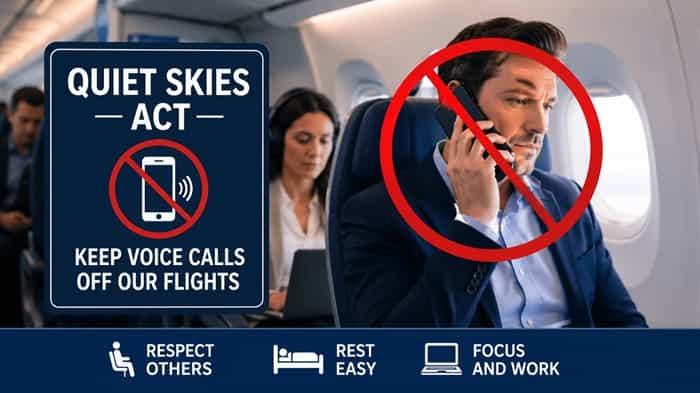
There are a few places left where a traveller can say, “Sorry, I was out of range.” For years, an aircraft cabin was one of them. Now, fast satellite Wi-Fi can put a video meeting at cruising height. US lawmakers are moving to save some peace above the clouds.
The Global Business Travel Association has backed the bipartisan Quiet Skies Act. Representatives Hillary Scholten, Rick Crawford, Greg Stanton and Rob Bresnahan introduced the bill as H.R. 9530. It would give the US Department of Transportation 180 days to issue final rules that ban certain passenger voice calls on scheduled domestic flights. The bill is now before the House Committee on Transportation and Infrastructure.
This is not a new debate. Congress dealt with the issue in the FAA Reauthorization Act of 2018. That law directed the Department of Transportation to ban in-flight voice calls made using mobile devices, except for limited exemptions. It passed the House by 398 votes to 23 and the Senate by 93 votes to six. Yet the final rule never arrived.
A Department of Transportation report in 2024 still listed the rule’s status as “undetermined”. It also said Federal Communications Commission rules do not block voice calls made over Wi-Fi. So the rulebook stayed open just as the technology caught up.
That change is now real. British Airways promotes Starlink Wi-Fi for streaming, gaming and video calls. It asks passengers to use headphones and keep their voices low. Qatar Airways also promotes its Starlink service as fast enough for a Zoom call. The science is clever. A cabin full of sales calls may be less charming, especially for the person trapped in 22B.
GBTA chief executive Suzanne Neufang said travel managers had sent a clear message.
“Our members manage travel for millions of employees, and they have been clear with us that the cabin should remain a place to work, rest and think, and not become a group phone booth for dozens of simultaneous private conversations at 35,000 feet,” Neufang said.
“We heard that feedback, brought it to Washington and are grateful to Representatives Scholten, Crawford, Stanton and Bresnahan for turning it into action. Congress directed this ban in 2018 with overwhelming bipartisan support. The Quiet Skies Act simply tells the Department of Transportation to finish the job before a quiet cabin becomes a thing of the past.”
For business travellers, this is more than good manners. A plane cabin is a shared office, dining room, cinema and, on long flights, a bedroom. Passengers can already message, email and stream. The Quiet Skies Act draws the line at turning every row into an open-plan call centre.
The bill is still in its early stages, so silence is not yet assured. Still, its support from both parties gives it a sound base. GBTA also brings a strong voice from the travel sector. Congress has been asked to finish a job left open since 2018. Travellers will hope the message comes through loud and clear without anyone taking the call.
By Octavia Koo – © 2026.
Read Time: 2 minutes.
Author Bio:
 Octavia Koo arrived in Australia in the early eighties with little fuss and a good eye. Sydney suited her. At UNSW, she studied Arts, then found her footing in graphic design before drifting, quite naturally, into the digital side of things, building websites and shaping words that made people want to stay.
Singapore followed, and with it, the fast pace of tourism platforms and ITB Asia. Long before SEO became a buzzword, Octavia understood how stories travelled online. That’s where she met Stephen, and the seed for something more was planted.
A few years later, she joined Global Travel Media.
Today, Octavia works with quiet assurance, blending art, instinct and experience to produce stories that don’t shout; they simply work and linger.











