A decade after Britain voted to leave the European Union, Brexit’s most enduring travel souvenir is not a blue passport, a border slogan or another parliamentary headache. It is a measurable loss of mobility.
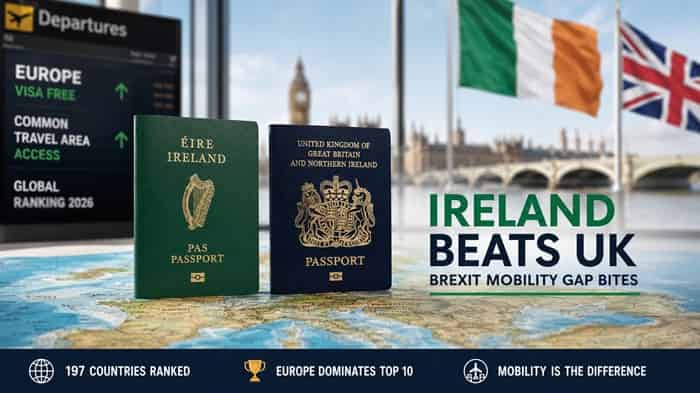
The Global Passport Index 2026 places Ireland seventh in the world for the second consecutive year, just ahead of the United Kingdom in eighth. On the surface, it is a narrow contest between two high-performing passports. Beneath the headline ranking, however, the gap is considerably more revealing.
Global Citizen Solutions’ sixth annual index assesses 197 countries and territories across 14 indicators grouped under three weighted pillars: Enhanced Mobility, Investment and Quality of Living. Enhanced Mobility accounts for half of the total score, while Investment and Quality of Living each contribute 25 per cent.
Sweden leads the 2026 composite ranking with 96.05 points, followed by Switzerland and Finland. Nine of the top 10 passports are European, with Singapore ranked 10th on 92.75 points, the only non-European gatecrasher at a party otherwise dominated by Nordic efficiency, Alpine stability and European integration.
Ireland’s overall ranking is seventh, with an Enhanced Mobility rank of ninth, an Investment rank of 21st and a Quality of Living rank of 13th. Britain remains firmly among the global elite, ranking eighth overall, supported by a 16th-place Investment ranking and a 9th-place Quality of Living ranking.
Then comes the rub.
The UK ranks 30th for Enhanced Mobility, 22 places below its composite position. That is a conspicuous mismatch for a passport sitting in the world’s top 10 and one that Global Citizen Solutions links directly to the practical consequences of Brexit.
“The United Kingdom passport held firm in the global top ten, ranked 8th overall in 2026. Yet for a passport of such standing, its mobility rank is conspicuously modest, around 30th, well adrift of the elite tier it otherwise occupies,” Global Citizen Solutions CEO Patricia Casaburi said.
“That gap is the quiet signature of Brexit. The index measures visa-free travel, where the British passport remains strong, but it cannot capture what was actually lost: the automatic right of UK citizens to live, work and permanently reside across the European Union.”
That distinction matters. British citizens may still visit the Schengen area without a visa for short stays of up to 90 days in any 180-day period. Longer stays, employment and study generally require permission. Before Brexit, the passport carried something much more valuable than a generous holiday allowance: an automatic right to settle and work across the European Union.
Ireland enjoys the best seat in this particular house. Irish citizens retain full EU freedom-of-movement rights while also benefiting from the Common Travel Area with the United Kingdom.
Under that long-standing arrangement, Irish and British citizens may live, work and study in each other’s countries. They also enjoy associated rights covering healthcare, social security, public services and voting in certain elections.
In practical terms, the Irish passport reaches into both systems. Its holders can move throughout the EU and can also settle in Britain without the visa hurdles faced by most other EU citizens.
Ireland is not part of the Schengen Area, but its EU membership and Common Travel Area rights give its citizens a rare double advantage. It is the sort of administrative neatness Brussels usually requires several committees and a colour-coded flow chart to explain.
British Passport Remains Strong But Not Complete
The result is not that Britain possesses a weak passport. Far from it.
The UK’s eighth-place finish confirms considerable strength in investment conditions, institutions, environmental performance and quality of life. Rather, the index shows how those advantages are compensating for a mobility deficit that did not exist before Britain’s departure from the EU.
Global Citizen Solutions describes Britain as a cautionary case: a passport can perform poorly in one dimension and still retain an elite overall position when its other fundamentals are strong enough to carry it.
Ireland’s improvement has also been sustained rather than sudden. According to the supplied GCS analysis, the country rose from 14th overall in 2021 to seventh by 2024 and has held that position through 2026.
Its Investment ranking now stands at 21st, while its Quality of Living performance remains inside the global top 15.
Britain’s overall position has been steadier, moving between sixth and eighth across the index’s editions. Its Investment ranking stands at 16th in 2026, and its Quality of Living ranking at ninth.
The passport, therefore, has not tumbled down the table. It has encountered a structural ceiling: excellent in the round, but unable to recover the settlement rights surrendered when the Brexit transition ended on 31 December 2020.
British nationals retain exceptional rights in Ireland through the Common Travel Area. They do not, however, possess an equivalent automatic right to live, work or study across the rest of the European Union.
Anglosphere Passports Lose Their Air of Invincibility
The broader Anglosphere picture is less comfortable.
The United States, which topped the index in 2021, ranks 12th in 2026 with a composite score of 92.37. Global Citizen Solutions describes it as the sharpest five-year decline recorded by a G7 country in the index.
The supplied analysis also records overall declines for Canada, Australia and New Zealand, while Ireland is the only one of the six Anglosphere passports examined to improve.
The underlying warning is reciprocity.
For decades, citizens of wealthy English-speaking countries enjoyed extensive visa-free access even where their governments offered less generous entry conditions in return. That imbalance is becoming harder to maintain as governments increasingly respond to restrictions with restrictions.
The United States provides the clearest example. Its Enhanced Mobility ranking fell sharply between 2021 and 2026 as bilateral visa settings changed, and Washington maintained a comparatively restrictive inbound regime.
The 2026 report notes that the United States remains one of the world’s most restrictive destinations for inbound access despite retaining an exceptionally powerful outbound passport.
“For decades, the Anglosphere passports were treated as fixed inheritance,” said Dr Laura Madrid, Lead Researcher at the Global Intelligence Unit of Global Citizen Solutions.
“Our data says it is closer to an asset that can lose value or gain it responsive to policy, to diplomacy, and to how a country chooses to treat others. Ireland’s rise and America’s fall are the same lesson read from opposite ends.”
Why Passport Rankings Matter to Travel
For the travel industry, the findings deserve more than the usual annual passport-ranking fanfare.
Mobility rules shape where people holiday, study, retire, invest and build businesses. They influence long-stay travel, expatriate markets, education flows, corporate relocation and the growing international market for residence and citizenship planning.
They also remind travellers that “visa-free” is not necessarily “friction-free”.
Electronic travel authorisations, automated border systems and tighter duration rules are adding fresh layers of administration even where formal visas are unnecessary. A passport may open the airport gate while leaving the office door, the university lecture theatre, and the residential lease firmly locked.
The Global Passport Index attempts to account for this broader value by looking beyond the number of destinations a traveller may enter. It evaluates mobility alongside investment attractiveness, governance, taxation, economic strength, sustainability, happiness, personal freedom and quality of life.
Europe’s dominance in the 2026 index, therefore, reflects more than tourism access.
Its leading passports combine broad travel rights with strong institutions, attractive investment environments and comparatively high living standards. The continent holds nine of the top 10 global positions, and 19 of the top 20 positions are drawn from Europe and the Americas.
Singapore’s 10th-place ranking proves that exceptional diplomatic reach and economic performance can break the European hold.
The city-state ranks first for both Enhanced Mobility and Investment. Its Quality of Living ranking, however, is 115th, demonstrating how a passport’s composite result may conceal very different strengths and compromises beneath the bonnet.
Brexit’s Passport Legacy Comes Into Focus
Ireland’s advantage over Britain is slim on the composite scoreboard, but the policy story beneath it is anything but marginal.
Britain remains a passport heavyweight. Ireland, however, carries the more versatile document because it combines EU rights with privileged access to the United Kingdom.
That advantage cannot be fully expressed by counting visa-free holiday destinations alone. Settlement rights, employment rights and the freedom to study abroad are considerably more valuable than the ability to breeze through immigration for a fortnight beside the Mediterranean.
Ten years after the referendum of 23 June 2016, that is Brexit’s passport legacy in plain English: Britain can still travel extremely well, but Ireland can travel, work and settle with fewer doors closed.
In global mobility, as in aviation, losing a connection may not ruin the journey, but it certainly limits the timetable.
By: Jill Walsh – © 2026.
Read Time: 6 minutes.
Author Bio:
 Jill Walsh has always kept a pen close and a suitcase closer. She started out on media releases, then learned the trade properly by escorting press trips around the world, discovering which stories travel well and which need a sharper edit.
Before long, she wasn’t just promoting destinations, she was representing them, translating civic ambition and local pride into words people actually wanted to read. These days, semi-retired and happily so, Jill has traded departure boards for deadlines, joining old friend and colleague Stephen at Global Travel Media on a casual basis.
Her patch is the business end of wanderlust: balance sheets, route maps, tender wins and the numbers that quietly decide where travellers go. She writes with dry humour, clean prose and an old-school respect for facts, a steady voice when the market starts shouting.