If actions speak louder than words, SAS has just delivered a message that could probably be heard from Copenhagen to Sydney.
The Scandinavian carrier has unveiled the biggest investment in its 80-year history, committing to a fleet expansion worth more than US$10 billion that signals one unmistakable message: SAS is betting heavily on the future of international aviation.
For an airline that has spent eight decades connecting Scandinavia with the rest of the world, this is no modest fleet refresh. It is a strategic statement about confidence, growth and the economic importance of global connectivity at a time when many airlines remain cautious about long-term expansion.
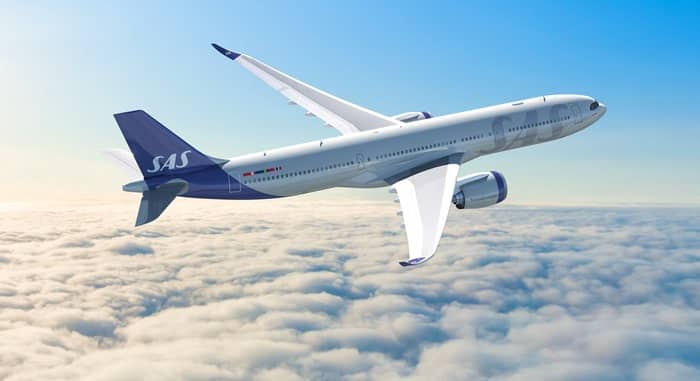
The investment includes up to 40 Airbus widebody aircraft, combining next-generation Airbus A330-900neo aircraft with additional Airbus A330-300 aircraft to bridge capacity needs as the new fleet enters service.
Together, the order represents the largest aircraft purchase ever made by SAS and forms the centrepiece of an ambitious long-term strategy designed to strengthen Copenhagen’s role as Northern Europe’s premier international gateway.
“For 80 years, SAS has connected Scandinavia with the world and the world with Scandinavia. Today, we are investing in the next chapter of our story,” said Anko van der Werff, President & CEO of SAS.
“This is the largest investment in our company’s history and a clear signal of our confidence in the future. At the same time, the analysis we are presenting today demonstrates the broader value of international access. Strong global links create opportunities for businesses, support jobs, attract investment, and strengthen competitiveness across our region.”
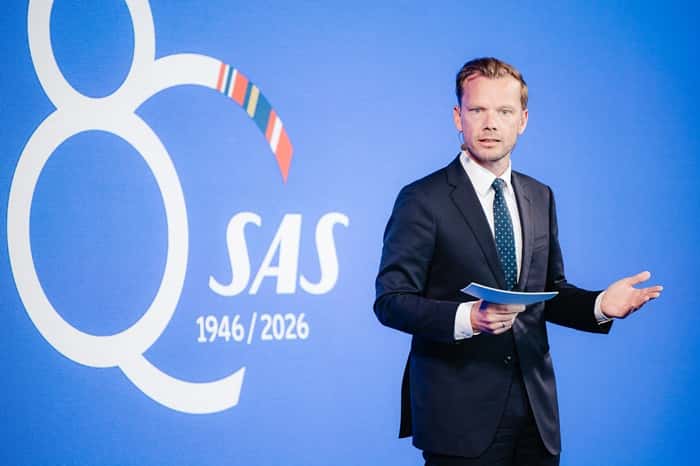
Peter Hummelgaard
That confidence extends well beyond aviation.
A catalyst for economic growth
Aircraft purchases rarely stop at airports. They ripple through economies.
To coincide with the announcement, SAS released fresh economic modelling showing how expanded international connectivity could reshape Denmark and the broader Scandinavian economy before the end of the decade.
If the airline’s expansion proceeds as planned, the analysis estimates that an additional 25,000 jobs could be created and that the airline could contribute DKK25 billion to Denmark’s GDP by 2030.
That would lift SAS’s total economic contribution to around 64,000 supported jobs and DKK66 billion in GDP across the region.
Southern Sweden is also expected to benefit, with around 4,000 additional jobs linked to the airline’s planned expansion.
For governments increasingly focused on attracting investment, international talent and high-value industries, aviation is no longer viewed simply as transport infrastructure. It is increasingly recognised as economic infrastructure.
Better air links encourage tourism, stimulate exports, improve business productivity and attract multinational investment.
In short, aircraft don’t simply carry passengers; they carry opportunity.
Copenhagen strengthens its hand
The investment also reinforces Copenhagen Airport’s position as SAS’s primary global hub.
From there, the airline connects Scandinavia with major destinations across Europe, North America and Asia while feeding passengers from regional markets throughout Denmark, Sweden and Norway.
Strengthening the hub means shorter journey times, more direct services and greater network flexibility advantages that become increasingly valuable as international travel continues its post-pandemic evolution.
For Australian travellers, improved Scandinavian connectivity also strengthens access to Northern Europe through global airline partnerships and alliance networks.
Fleet renewal continues at a pace
The latest announcement builds on an already aggressive fleet modernisation program.
Only last year, SAS confirmed a record order for 55 Embraer E195-E2 regional aircraft, while renewal of its Airbus A320neo narrowbody fleet continues across Europe.
The result is one of the most comprehensive fleet transformation programs in the airline’s modern history.
The Airbus A330-900neo brings substantial operational advantages.
Powered by Rolls-Royce Trent 7000 engines, the aircraft offers fuel consumption around 25 per cent lower per seat than previous-generation competitors while delivering significantly lower noise levels.
Passengers should also notice the difference.
The A330neo features one of the quietest cabins in its class, a longer-range capability of up to 13,600 kilometres, and an operational reliability rate approaching 99 per cent.
Just as importantly for SAS, the aircraft shares approximately 95 per cent of its airframe components with the airline’s existing A330-300 fleet, reducing maintenance complexity and lowering operating costs.
The interim A330-300 additions provide immediate capacity while ensuring growth plans are not delayed waiting for new aircraft deliveries.
It is a practical solution that allows SAS to grow today while preparing for tomorrow.
Sustainability remains on the agenda
Growth, however, is only one side of the equation.
Like every major global airline, SAS faces increasing pressure to reduce emissions while expanding international operations.
To support that objective, the carrier has signed a Memorandum of Understanding with SkyKraft to explore the future development of electric sustainable aviation fuel (e-SAF).
While large-scale commercial deployment remains some years away, the partnership reflects the industry’s broader push towards lower-emission long-haul aviation.
Combined with the fuel efficiency gains delivered by the Airbus A330neo fleet, the strategy demonstrates that operational growth and environmental improvements are no longer mutually exclusive objectives.
Eight decades and another chapter begins
Timing, as they say, is everything.
The announcement arrives as SAS celebrates its 80th anniversary, a milestone that highlights the airline’s enduring role in shaping Scandinavian connectivity since 1946.
From rebuilding post-war Europe to becoming one of the world’s most recognised international carriers, SAS has repeatedly adapted to changing markets.
This latest investment suggests it has no intention of standing still.
As international competition intensifies and global travel demand continues to evolve, SAS is positioning itself not merely to participate but to lead.
Van der Werff believes the broader economic prize extends well beyond aviation.
“Strong international access is a competitive advantage,” he said.
“In a world where investment, talent and opportunity move across borders, well-connected regions are best positioned to succeed. By investing in our future and strengthening our ability to connect Scandinavia with the world, we are helping create lasting value across Denmark, the Öresund region and Scandinavia as a whole.”
With billions committed, dozens of new aircraft on the horizon and Copenhagen firmly in its sights, SAS has effectively declared that Scandinavia intends to remain very much on the world’s aviation map.
And judging by the scale of this investment, the airline clearly believes the next 80 years are worth planning for today.
Airbus A330-900neo at a Glance
- Seating: 287–303 passengers (three-class configuration)
- Range: Up to 13,600 km (7,350 nautical miles)
- Engines: Rolls-Royce Trent 7000
- Fuel efficiency: Approximately 25% lower fuel burn per seat than previous-generation competitors
- Cabin: Quietest in its category
- Fleet commonality: 95% shared airframe parts with existing SAS A330-300 fleet
- Operational reliability: 99%
Airbus A330-300
- Seating: 250–290 passengers
- Range: Up to 11,750 km (6,350 nautical miles)
- One of the world’s most successful widebody aircraft families
- Fully compatible with existing SAS Airbus operations
By: Bridget Gomez – © 2026.
Read Time: 6 minutes.
Author Bio:
 Bridget has never been built for stillness. Of Portuguese heritage, she began as a nurse, tending veterans at the Repatriation Hospital, listening to stories as colourful as the life she was yet to live. It was worthy, steady work, but wanderlust, as always, proved louder than routine.
So, she traded starch for a backpack and disappeared for a year, chasing trains, sunsets and the occasional regrettable glass of wine. She wrote everything down: the dust, the laughter, the missteps, the magic. Those notebooks became a travel blog, then a habit, then a calling.
Eventually, she found Global Travel Media, or perhaps it found her.
Today, Bridget writes with heart, humour and a dash of mischief, still travelling, just now with words.