

For years, America’s tourism machine has resembled a giant Boeing on full thrust, noisy, powerful and almost impossible to slow down.
But the latest figures from Washington suggest someone may have eased back on the throttle.
Fresh data released by the U.S. National Travel and Tourism Office (NTTO) reveals international passenger traffic to and from the United States slipped in May 2026, while overseas visitor numbers took an even bigger hit, raising fresh questions about the pace of America’s tourism recovery.
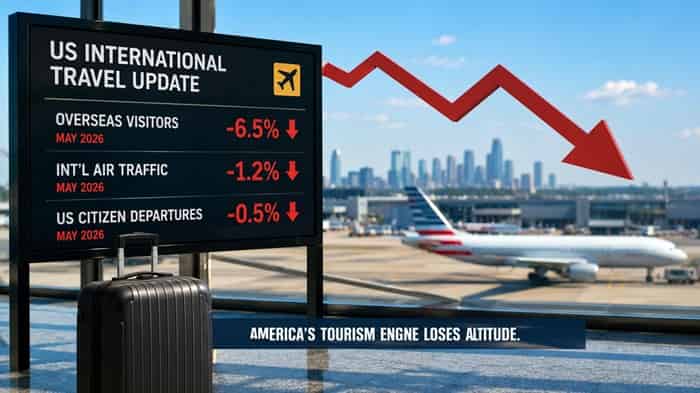
Overall international air passenger enplanements totalled 22.7 million in May, down 1.2 per cent from the same month last year.
That’s hardly panic stations for the aviation sector. In fact, total passenger volumes remain 3.3 per cent above pre-pandemic May 2019 levels.
Still, in an industry accustomed to celebrating growth with all the restraint of a cruise director armed with a microphone, any decline tends to attract attention.
And it’s inbound tourism where the warning lights are flashing brightest.
Non-U.S. citizen arrivals from overseas markets fell 4.5 per cent year-on-year to 4.5 million passengers. More worrying for tourism businesses, overseas visitor arrivals dropped 6.5 per cent to 2.8 million travellers.
Hotels, attractions, tour operators and retailers across the United States depend heavily on these visitors, who traditionally stay longer and spend more freely than domestic travellers.
While overseas arrivals have improved from April levels, they remain well short of the heights enjoyed before COVID disrupted global travel.
Current overseas visitation sits at just 78.6 per cent of May 2019 volumes.
Year-to-date figures tell a similarly sobering story, with overseas visitation through the first five months of 2026 down 4.8 per cent compared with the same period last year.
The numbers suggest America’s inbound recovery is no longer simply a case of “build it and they will come”.
Increasing global competition, shifting exchange rates, changing traveller preferences, and geopolitical uncertainty are all playing their part.
Meanwhile, Americans themselves continue proving that passports remain one of the hottest accessories of 2026.
U.S. citizens made 6.8 million international departures during May, only marginally down 0.5 per cent year-on-year.
Remarkably, outbound travel by Americans now sits 22.7 per cent above May 2019 levels.
In short, Americans are still travelling enthusiastically; they’re simply doing more of it overseas.
Regionally, Europe retained its crown as America’s largest long-haul aviation market, generating 7.5 million passengers, slightly ahead of last year’s performance and comfortably above pre-pandemic levels.
The South and Central America and Caribbean region continued its stellar run, climbing 2.2 per cent year-on-year and soaring almost 13 per cent above 2019 volumes.
Asia also delivered encouraging signs, recording growth of 3.9 per cent compared with May 2025.
Yet despite that improvement, Asian traffic remains almost 16 per cent below pre-pandemic levels, underlining just how uneven the global recovery remains.
The Middle East was the standout laggard, with passenger traffic plunging 23.1 per cent compared with last year.
Among individual country markets, Mexico remained America’s busiest international partner despite passenger numbers declining 6.7 per cent.
Canada followed closely behind, while the United Kingdom retained its position as the leading long-haul market.
Japan bucked the broader trend, posting a healthy 2.7 per cent increase in passenger volumes.
No surprises emerged among airport rankings.
New York’s John F. Kennedy International Airport once again topped the U.S. leaderboard with 2.9 million international passengers, ahead of Miami, Los Angeles, Chicago O’Hare and San Francisco.
Across the Atlantic, London Heathrow maintained its status as America’s busiest overseas gateway.
For travel suppliers, airlines and destination marketers, the message contained in the latest NTTO figures is relatively straightforward.
The recovery continues, but the easy gains may well be over.
As every seasoned travel advisor knows, headwinds are easier to manage when you know they’re coming.
The challenge now is to ensure that the world’s most visited economy remains equally attractive in an increasingly competitive global tourism marketplace.
Further data is available from the U.S. National Travel and Tourism Office.
By: Anne Keam – © 2026.
Read Time: 4 minutes.
Author Bio:
 Anne Keam’s story begins in Queensland, on a grain farm in the state’s wide western reaches, where the days were long and the lessons simple: work hard, look after your own, and don’t make a fuss. Those early years left their mark.
She later studied Arts at the University of Queensland, before doing what felt natural at the time, heading back home to the family property. But the world was calling. Anne packed a backpack and went looking, spending years on the road and finding herself most alive in South America. She wrote everything down along the way. Those notebooks, full of dust, colour, and curiosity, eventually became her blog, a quiet, personal record of seeing the world and learning from it.











