

For years, tourism conferences across the globe have resembled an annual contest in spreadsheet worship.
Who had the most arrivals? Who smashed visitor spending records? Who squeezed another precious half-day onto the average length of stay?
Bigger, faster, higher.
Rinse and repeat.
Yet in Yangon last week, something rather unusual happened.
People started talking about people.
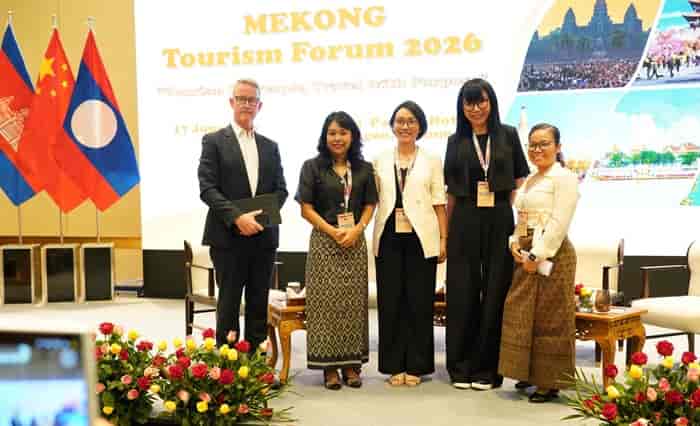
At the Mekong Tourism Forum 2026, held under the wonderfully refreshing theme “Tourism for People, Travel with Purpose”, delegates parked the PowerPoint presentations on growth curves and instead tackled a far trickier question.
What if tourism success wasn’t measured solely by cash registers ringing and hotel beds filling?
What if success were measured by stronger communities, preserved cultures, empowered women and futures created for young people?
Radical stuff, really.
Two sessions, in particular, stopped delegates in their tracks: People at the Centre of Tourism and Living Culture & Creative Expression. Different topics. Different speakers. One unmistakable message.
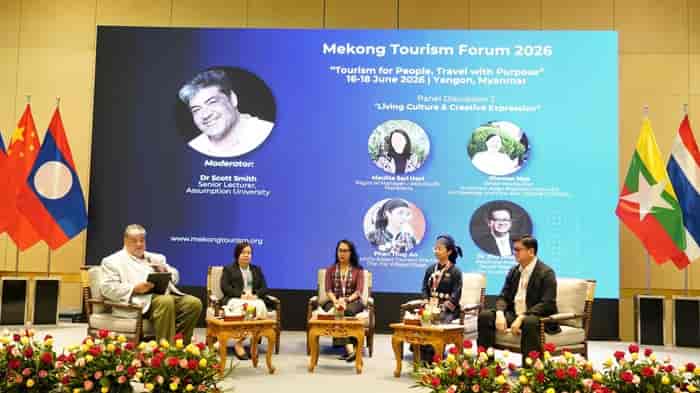
Panel Discussion “Living Culture & Creative Expression”
If local communities aren’t winning, tourism isn’t winning.
Simple.
Moderated by Clickable Impact Director Graham Harper, the people-focused panel brought together individuals who spend less time talking about change and considerably more time making it happen.
Among them was Thiri Aung, founder and CEO of Women Transforming Myanmar.
And she’s not operating on a small scale.
Her organisation supports more than 5,000 women entrepreneurs across Myanmar, helping them access training, networks, mentoring and business opportunities.
Her message was delivered without corporate jargon or consultant-speak.
“Invest in women, when women thrive, communities thrive,” she said.
It’s difficult to argue otherwise.
Across the Mekong region, women already shoulder much of the tourism. They run guesthouses, operate tour companies, manage restaurants, preserve crafts and keep local traditions alive. Yet too often, they remain absent from boardrooms and decision-making tables.
Aung believes that must change.
Not someday.
Now.
Another standout voice came from Ha Phan of the Association of Southeast Asian Social Enterprises for Training in Hospitality and Catering (ASSET-H&C).
Phan works with disadvantaged young people throughout Southeast Asia, helping them gain professional hospitality qualifications and, more importantly, genuine career opportunities.
Her distinction between jobs and careers resonated strongly.
“I often say that a job placement is an outcome, but a career pathway is an impact.”
There’s a lesson there for an industry currently obsessed with labour shortages.
Throwing bodies into vacancies may solve today’s headache. Building careers creates tomorrow’s leaders.
The conversation then shifted to accessibility, and frankly, it may have been the most powerful discussion of the entire forum.
Sokny Onn, CEO of Cambodia’s Epic Arts, challenged tourism leaders to stop viewing disability inclusion as an act of goodwill.
“Disability inclusion is a right, not a favor. It is not charity. People with disabilities are equal citizens, customers, workers, artists, entrepreneurs, and leaders.”
Bang.
No footnotes required.
Epic Arts has become internationally recognised for doing something many organisations still struggle with. It places people with disabilities in positions of leadership rather than simply designing programs for them.
As Onn reminded delegates: “When people with disabilities lead, tourism becomes more than an industry. It becomes a platform for dignity, equality, and change.”
Not a bad ambition for tourism, one might suggest.
The session’s final speaker, Koko Tang from Colourful Earth and the World Sustainable Hospitality Alliance, posed perhaps the conference’s most uncomfortable question.
Who actually gets a voice?
Because while destinations love speaking about community consultation, communities themselves are not always invited to speak.
Tang argued that measuring tourism success must extend beyond economic benefits.
“If we say tourism puts people at the centre, we need to measure not only who benefits economically, but also who has voice, whether that voice is representative, and whether it actually influences decisions.”
In short, consultation without influence is merely theatre.
The forum’s second major discussion explored culture.
Not culture packaged neatly for tourists.
Real culture.
Living culture.
The kind grandparents pass to grandchildren around kitchen tables rather than behind museum glass.
Moderated by Dr Scott Smith from Assumption University, the session featured speakers from SEAMEO SPAFA, Planeterra, Thai Hai Village in Vietnam and Guilin Tourism University.
Dr Smith captured the issue perfectly.
“Culture is not something we place behind glass. It is something people live, share, protect, adapt, and carry forward. Tourism has a responsibility to support that process, not interrupt it.”
Perhaps the session’s most touching contribution came from Thuy An Phan from Vietnam’s Thai Hai Village, recognised by UN Tourism as one of the world’s Best Tourism Villages.
While others discussed strategies and frameworks, Thuy An spoke about love.
Yes, love.
Risky territory at most tourism conferences.
Yet somehow it worked.
“With love, we can do anything. Love creates our village. Love with nature can create meaningful tourism.”
No consultant would dare write that sentence.
Which is precisely why delegates remembered it.
As attendees departed Yangon clutching business cards, coffee cups and the obligatory conference tote bags, many also left carrying something far more valuable.
Hope.
Hope that tourism can still be an industry built not merely on numbers, but on people.
Different countries.
Different communities.
Different stories.
One shared belief.
Tourism succeeds not when more people visit.
It succeeds when more people matter.
By: Supaporn Pholrach – © 2026.
Read Time: 7 minutes.
Author Bio:
 Supaporn Pholrach came up in advertising when deals were sealed with a handshake, and deadlines were written on scraps of paper, not dashboards. She learned early that people mattered more than process, and it stuck. Armed with solid training and a stubborn work ethic, she built a reputation for getting results without turning hard or hollow.
Fifteen years at Bangkok Shuho would test anyone’s stamina. Supaporn stayed the distance. These days, as Sales Manager at Global Travel Media, she helps tourism brands cut through the noise with common sense, good humour and genuine warmth.
She doesn’t chase quick wins. She earns trust, builds loyalty and keeps her word. In an industry that rarely slows down, Supaporn is someone you’re quietly glad to have on your side.











