

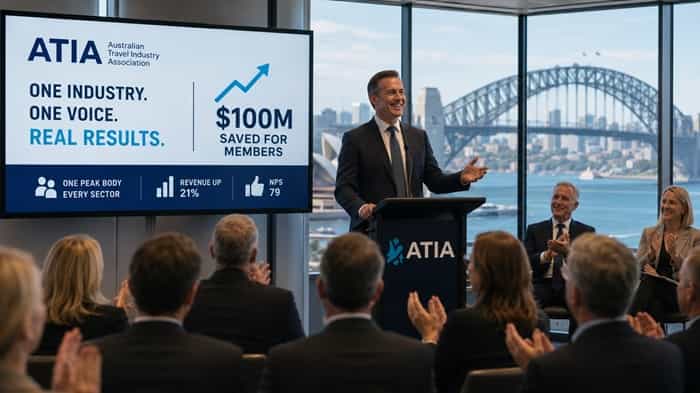
For an industry that has spent the better part of the past decade battling pandemics, regulatory headaches, airline collapses, staffing shortages and enough government reviews to sink a cruise ship, the mood at the Australian Travel Industry Association’s (ATIA) 49th Annual General Meeting in Sydney on Monday was decidedly upbeat.
In fact, if there had been any more positivity in the room, somebody may well have needed to check whether complimentary champagne was being served at breakfast.
ATIA emerged from its AGM not merely celebrating another year in business, but crowning what many within the sector see as the most transformational period in the organisation’s history.
The headline figures alone tell a compelling story.
Revenue climbed 21 per cent to $3.64 million. Member retention reached an enviable 98.5 per cent. Net Promoter Score soared to 79 against a target of 50. A surplus of $279,328 was returned directly to reserves and member benefits.
Yet, according to ATIA leadership, the real achievement extends far beyond balance sheets.
Three years after launching Project A30 at the Beyond Borders Summit, ATIA has completed the most ambitious structural expansion ever undertaken by an Australian travel peak body, creating a unified organisation representing virtually every major segment of the nation’s travel ecosystem.
Corporate travel managers joined through the merger with the Australian Travel Management Co-operative (ATMC). Independent and home-based advisors secured their own dedicated voice by establishing the Independent Travel Agents Association (ITAA). Most recently, members overwhelmingly endorsed the merger with the Council of Australian Tour Operators (CATO), bringing wholesalers and tour operators formally under the same umbrella.
For the first time in modern Australian travel history, the industry’s fragmented voices have largely been replaced by one coordinated representative body.
“Three years ago, we made a commitment at Beyond Borders that every segment of this industry would have a real seat at the table and a genuine voice in shaping outcomes,” ATIA Chair Christian Hunter told members.
“The ATMC merger, the launch of ITAA, and the CATO merger are not separate initiatives. They are the delivery of that commitment. One peak body. Every sector represented. One co-ordinated voice.”
And in Canberra, as every seasoned travel executive knows, one loud voice generally travels much further than a chorus of competing whispers.
That united approach delivered what ATIA describes as its advocacy triumph of the year.
Following extensive consultation, Senate appearances and sustained lobbying efforts, travel agents and tour operators were ultimately excluded from the proposed Aviation Ombudsman Scheme.
The outcome is estimated to save members between $40 million and $100 million in potential compliance costs.
For many smaller agencies already operating on wafer-thin margins, that decision could prove the difference between reinvesting in growth and simply keeping the lights on.
“Keeping travel agents and tour operators out of the Aviation Ombudsman Scheme was the advocacy result of the year,” Hunter said.
“It did not happen by accident. It was four consultation rounds, a Senate Inquiry, and sustained expert engagement until the outcome was secured. That is up to $100 million our members will never have to find. For small and independent businesses, that is real money.”
Real money indeed.
Anyone who has run a small travel business knows there are already enough costs landing on the desk each month without adding another regulatory invoice to the pile.
ATIA’s advocacy effort throughout 2025-26 was substantial. The association lodged ten formal submissions, participated in 128 meetings with political leaders and conducted more than 100 discussions with senior public servants.
The association has also maintained one of its most valuable assets, credibility.
Its accreditation scheme, formerly known widely across the industry through ATAS, continues to act as the profession’s benchmark.
Twenty-eight new businesses joined the accredited community during the year, while an impressive 98.5 per cent of existing members renewed.
Notably, however, ATIA demonstrated that accreditation still means something.
Around 22 per cent of businesses seeking accreditation during the year failed to meet the required standard and were refused entry.
In an era where almost anyone with a laptop, Wi-Fi connection and social media profile can call themselves a travel advisor, maintaining rigorous standards remains critical.
The 2025 ATAS Charter Review further modernised accreditation requirements to reflect contemporary business practices while ensuring oversight remains firmly industry-led.
For consumers increasingly seeking trust and assurance when booking travel, those standards matter.
ATIA also expanded member services during the year.
Enterprise Benchmarking Reports provided members with tailored business intelligence free of charge, allowing agencies and operators to compare performance against industry peers.
Meanwhile, revamped Pulse meetings have evolved into genuine forums for industry discussion, connecting everyone from solo mobile advisors through to major travel networks and tour operators.
Governance continuity was also confirmed at the AGM.
Christian Hunter was formally confirmed as Chair, while Graham Turner and Toni Ambler continue as Vice Chairs. Returning directors include David Smith of Flight Centre Travel Group, Rohan Moss of Helloworld Travel Limited, Toni Ambler of The Travel Corporation, Peter Muller of CT Partners and Brett Mitchell of Intrepid Travel.
Closing the meeting, Hunter reflected on what many attendees clearly felt.
“An NPS of 79 against a target of 50. Retention at 98.5 per cent. Revenue up 21 per cent. A surplus that goes straight back into what we offer members,” Hunter said.
“That is what a peak body in good shape looks like, and I am enormously proud of what this Board, this team, and this membership have built together.”
After years in which Australia’s travel sector often found itself fighting simply to survive, ATIA’s latest results suggest the industry is no longer merely rebuilding.
It is finding its voice and increasingly, Canberra appears to be listening.
By: Octavia Koo – © 2026.
Read Time: 6 minutes.
Author Bio:
 Octavia Koo arrived in Australia in the early eighties with little fuss and a good eye. Sydney suited her. At UNSW, she studied Arts, then found her footing in graphic design before drifting, quite naturally, into the digital side of things, building websites and shaping words that made people want to stay.
Singapore followed, and with it, the fast pace of tourism platforms and ITB Asia. Long before SEO became a buzzword, Octavia understood how stories travelled online. That’s where she met Stephen, and the seed for something more was planted.
A few years later, she joined Global Travel Media.
Today, Octavia works with quiet assurance, blending art, instinct and experience to produce stories that don’t shout; they simply work and linger.











