

There was a time when buying a holiday apartment in Thailand meant little more than securing a sunny balcony, a pool downstairs and perhaps a decent seafood restaurant within walking distance.
Those days are disappearing faster than a deckchair at sunrise in Phuket.
Today’s affluent buyers want much more. They want prestige. They want services. They want global access. Most importantly, they want a brand they recognise and trust standing behind the front door.
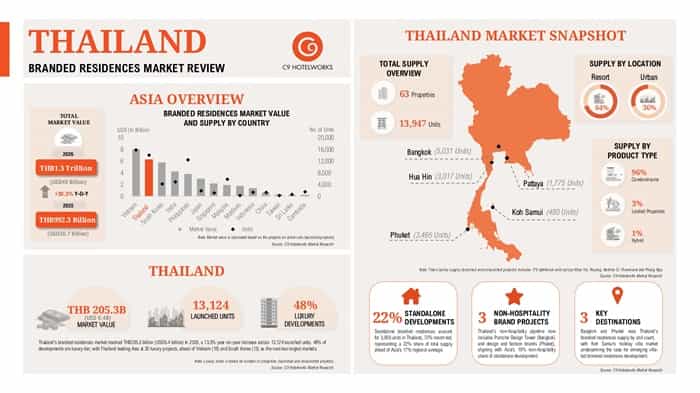
According to the latest Asia Branded Residences Market Review 2026 from C9 Hotelworks, Thailand has firmly established itself as Asia’s largest branded residences market by supply under development, cementing its position as one of the most influential luxury real estate destinations in the region.
The figures are impressive by any measure.
Thailand’s branded residences market has reached a value of THB205.3 billion (USD6.4 billion), representing annual growth of 13.3 per cent and encompassing 13,124 launched units. The country now commands 26 per cent of Asia’s total branded residential supply, the highest share of any market in the region.
In an industry where prestige increasingly drives purchasing decisions, Thailand is no longer merely participating in the game. It is setting the pace.
Across Asia, branded residences have surged to a combined market value of THB1.3 trillion spread across 50,025 launched units, reflecting remarkable year-on-year growth of more than 30 per cent.
While Vietnam currently leads the region in total market value, Thailand has become the undisputed heavyweight in the luxury category, boasting 30 luxury-tier branded residence projects compared with Vietnam’s 18 and South Korea’s 13.
That is no small achievement.
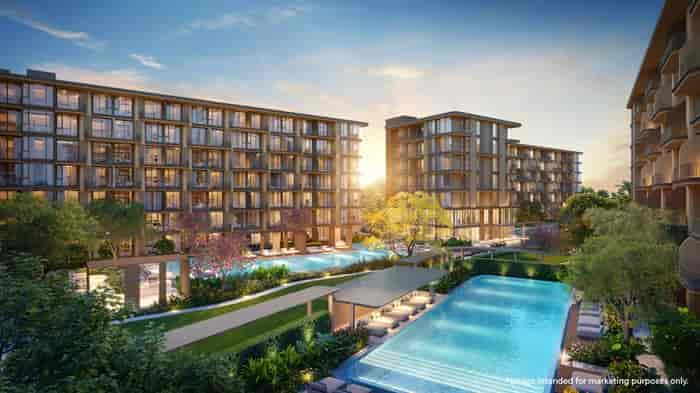
Award-winning Bangkok developer Capstone Asset recently unveiled PEYLAA Phuket, Marriott’s first Autograph Collection
Luxury property markets are notoriously competitive, particularly when developers are all chasing the same high-net-worth buyers. Yet Thailand continues to stand out because it offers something increasingly rare in global real estate diversity.
One moment, buyers can be considering a branded penthouse overlooking Bangkok’s skyline. Next, they are exploring a beachfront villa in Phuket or a secluded luxury retreat on Koh Samui.
As Bill Barnett, Managing Director of C9 Hotelworks, explained:
“Thailand has become a benchmark market for branded residences in Asia. What stands out is the depth of the luxury pipeline and the range of development formats now entering the market. Bangkok, Phuket and Thailand’s resort destinations are giving brands and developers multiple routes to growth.”
And those routes are expanding rapidly.
Bangkok remains Thailand’s largest urban branded residences market, accounting for 5,031 units. Demand continues to be driven by buyers seeking professionally managed homes backed by internationally recognised brands and hospitality operators.
Meanwhile, Phuket has emerged as Asia’s dominant resort-branded residences destination with 3,465 units, reinforcing the island’s reputation as one of the world’s most desirable luxury property locations.
Further south, Koh Samui is becoming the industry’s next rising star.
The island’s luxury villa market reached 3,055 properties during 2025, a remarkable increase of 37 per cent year-on-year. Developers are increasingly viewing Samui as fertile ground for the next generation of branded villa projects aimed at affluent international buyers.
Yet beneath the impressive numbers lies a more significant shift.
The sector is evolving.
Simply attaching a famous name to a building is no longer enough.
Today’s buyers are asking tougher questions. They want to know how properties will be managed, what services will be delivered, what membership benefits are available and how their investment will perform long after settlement.
According to Titiwat Kuvijitsuwan, Chief Executive Officer of Capstone Asset:
“The branded model is changing how developers underwrite and design residential projects. Brand standards, operating structures, service delivery and asset management now have to be built into the project from day one. Buyers are paying closer attention to what happens after handover.”
That observation highlights a major trend shaping the future of branded real estate.
Increasingly, value is being measured not only by location and architecture but by the owner’s ongoing experience.
This shift is particularly evident in the rise of standalone branded residences.
Thailand now has 3,008 standalone branded residential units, representing 22 per cent of total supply. That exceeds the Asian regional average of 17 per cent and signals growing demand for projects not directly linked to hotels yet delivering premium brand experiences.
The brands themselves are also changing.

(from left): Stephane Michel, President, Valanti Group; Titiwat Kuvijitsuwan, CEO, Capstone Asset;
Wade Shealy, CEO and Chairman, ThirdHome
Luxury hotel operators are no longer the only names entering the market.
Developments such as the Porsche Design Tower Bangkok and fashion-led projects, including Etro Residences Phuket, demonstrate how non-hospitality brands are increasingly entering the residential real estate market.
Across Asia, non-hospitality brands now account for 19 per cent of standalone branded developments.
Stephane Michel, President of Valanti Group, believes this evolution is reshaping buyer expectations.
“Lifestyle hospitality brands bring a different brief to residential development. For projects such as SLS Residences Bangkok the brand has to show up in design, programming, service culture and daily operations. That gives developers a clearer position in a crowded luxury market.”
Perhaps the most fascinating development is what happens after buyers receive their keys.
The new luxury proposition extends far beyond ownership.
Global travel privileges, exclusive memberships, property exchange opportunities and private travel networks are becoming powerful selling points.
As Wade Shealy, CEO and Chairman of ThirdHome, noted:
“The buyer benefit is becoming more global. A branded residence can now connect owners to a wider network of homes, destinations and private travel opportunities. That adds utility after purchase and gives developers another way to differentiate.”
For Thailand, the message is clear.
With Bangkok driving urban growth, Phuket dominating resort supply, and Koh Samui emerging as the next luxury hotspot, the Kingdom has secured a commanding position at the centre of Asia’s branded real estate revolution.
And in a region where luxury buyers increasingly expect five-star living long after check-in, Thailand appears perfectly positioned to keep delivering.
The full Asia Branded Residences Market Review 2026 is available via the link.
By: Supaporn Pholrach – © 2026.
Read Time: 4 minutes.
About the Author.
 Supaporn Pholrach came up in advertising when deals were sealed with a handshake and deadlines were written on scraps of paper, not dashboards. She learned early that people mattered more than process, and it stuck. Armed with solid training and a stubborn work ethic, she built a reputation for getting results without turning hard or hollow.
Fifteen years at Bangkok Shuho would test anyone’s stamina. Supaporn stayed the distance. These days, as Sales Manager at Global Travel Media, she helps tourism brands cut through the noise with common sense, good humour and genuine warmth.
She doesn’t chase quick wins. She earns trust, builds loyalty and keeps her word. In an industry that rarely slows down, Supaporn is someone you’re quietly glad to have on your side.











