

There are destinations that spend fortunes trying to persuade travellers to visit.
Then there is Italy.
A country that somehow manages to seduce generation after generation without ever appearing to try.
The latest figures from Phocuswright suggest the romance is not fading anytime soon.
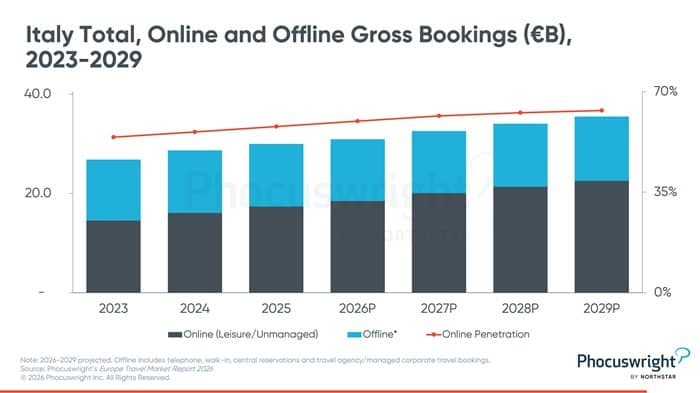
Italy’s travel market reached €30 billion in gross bookings in 2025, growing by 4.5 per cent year-on-year, while inbound tourism climbed to levels never seen before. In a world where geopolitical tensions, economic uncertainty and shifting traveller behaviour dominate industry conversations, Italy continues to do what Italy has done better than almost anyone else for decades – make people dream.
And dreams, as it turns out, are proving remarkably profitable.
The newly released Italy Travel Market Brief 2026 paints a picture of a tourism powerhouse firing on almost every cylinder. Overnight stays reached a record 476 million during 2025, an increase of 10 million nights compared with the previous year.
Yet hidden within those impressive figures is the story that should really grab the industry’s attention.
The growth isn’t coming from Italians travelling around their own backyard.
It’s coming from the rest of us.
From Australians escaping winter. Americans chasing heritage. Asians discovering Europe. Britons returning for their annual Mediterranean fix. Travellers from every corner of the globe are continuing to vote for Italy with their wallets, passports and precious annual leave.
As every travel advisor knows, destinations rise and fall in popularity. Trends come and go. Hotspots cool off.
Italy simply endures.
Perhaps it is impossible to compete against 2,000 years of history, world-class food, iconic cities, dramatic coastlines and a lifestyle that reminds stressed visitors that life isn’t always meant to be rushed.
Pete Comeau, Managing Director at Phocuswright, believes the most important statistic is not the record overnight stays but where those visitors are coming from.
“476 million overnight stays is a record, but the more telling number is where the growth is coming from,” said Comeau.
“Foreign visitors drove the increase while domestic demand stayed essentially flat. Italy is increasingly an inbound story, and with foreign visitor spending reaching €57 billion in 2025, the market’s dependence on international demand is both its greatest strength and its most significant vulnerability heading into a period of geopolitical uncertainty.”
That observation should resonate across boardrooms throughout the tourism sector.
The €57 billion spent by international visitors represents an extraordinary economic engine. Yet, it also serves as a reminder that success can sometimes create its own dependency.
For now, however, confidence remains strong.
Hotels continue to dominate Italy’s tourism economy, generating €19.1 billion in room revenue during 2025. Investors are backing that confidence with hard cash. Hotel investment exceeded €2.5 billion last year, rising 19 per cent as international funds and hospitality groups pursued opportunities ranging from luxury city properties to emerging resort destinations.
The airline sector tells a similar story.
Low-cost carriers now account for 61 per cent of summer capacity, compared with 48 per cent before the pandemic. That growth is helping spread tourism beyond the traditional gateways of Rome, Venice and Florence, opening doors for smaller destinations eager to claim their share of the tourism boom.
Even rail is enjoying a golden run.
High-speed trains have become one of the great success stories of modern European travel, and Italy’s rail network continues to attract travellers seeking convenience, sustainability and the chance to watch some of Europe’s most beautiful scenery unfold outside the carriage window.
Meanwhile, ITA Airways has quietly achieved something many observers doubted possible. Following Lufthansa’s acquisition of a 41 per cent stake, the airline delivered its first-ever profit, adding another layer of confidence to Italy’s evolving travel ecosystem.
The timing of the report is no coincidence.
Industry leaders will gather at Phocuswright Europe in Barcelona this month to debate the future of travel across the continent. Artificial intelligence, changing traveller expectations, sustainability and distribution models will all dominate discussions.
Yet, Italy’s latest performance offers a timeless lesson.
Technology changes.
Business models evolve.
Traveller habits shift.
But destinations that create genuine emotional connections with visitors rarely go out of fashion.
That may be Italy’s greatest competitive advantage of all.
Long after the latest travel trend has come and gone, travellers will still be standing in Roman piazzas, sipping coffee beside Venetian canals and watching Tuscan sunsets, wondering why they didn’t stay longer.
For Italy, that enduring appeal is proving priceless.
For the tourism industry, the value is at least €30 billion and counting.
By: Bridget Gomez – © 2026.
Read Time: 5 Minutes.
About the Author.
 Bridget has never been built for stillness. Of Portuguese heritage, she began as a nurse, tending veterans at the Repatriation Hospital, listening to stories as colourful as the life she was yet to live. It was worthy, steady work, but wanderlust, as always, proved louder than routine.
So, she traded starch for a backpack and disappeared for a year, chasing trains, sunsets and the occasional regrettable glass of wine. She wrote everything down: the dust, the laughter, the missteps, the magic. Those notebooks became a travel blog, then a habit, then a calling.
Eventually, she found Global Travel Media, or perhaps it found her.
Today, Bridget writes with heart, humour and a dash of mischief, still travelling, just now with words.











