

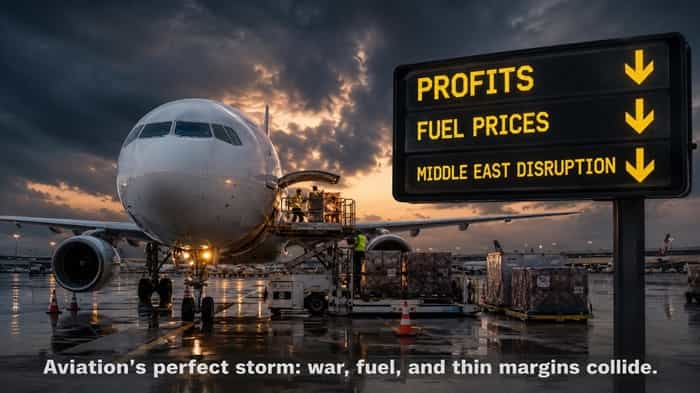
The airline industry has been reminded, rather brutally, that full aircraft do not always mean full pockets.
After several years of recovery, swagger, packed terminals and passengers once again behaving as though the world is theirs for the boarding, global aviation has hit a familiar old enemy: cost. More precisely, the cost of fuel, war, delay, disruption and the exhausting business of keeping aircraft moving when the world refuses to behave itself.
The International Air Transport Association has cut its 2026 outlook for global airline profitability almost in half, with carriers now expected to make a combined net profit of US$23 billion. That is down sharply from the earlier forecast of US$41 billion and well below the estimated US$45 billion profit achieved in 2025.
In any normal industry, US$23 billion might sound like a splendid result. In aviation, spread across billions of passengers, thousands of aircraft and a fuel bill large enough to make a treasurer reach for the sherry, it is a thin cushion indeed.
IATA expects airlines to carry 5.1 billion passengers in 2026, with load factors reaching a record 84 per cent. In plain English, aircraft are fuller than ever. The problem is that the money left over after each passenger is carried is shrinking fast.
Net profit per passenger is forecast to fall to just US$4.50. That is not a margin. It is loose change with wings.
IATA Director General Willie Walsh put it neatly, saying: “Airlines are bearing the brunt of the fuel price shock. While air fares are rising, airlines are still absorbing part of the hike in their bottom lines. Net profit per passenger is expected to fall to $4.50, half of what it was last year. Under the circumstances, that shows resilience. But it won’t even buy you a hot dog at most of the FIFA World Cup venues, and it does not leave much of buffer should other costs or taxes start rising.”
It is a classic Walsh line: sharp, factual and just uncomfortable enough to land.
Fuel becomes the villain again
The immediate culprit is jet fuel, aviation’s oldest financial headache.
IATA expects the global airline fuel bill to rise from US$252 billion in 2025 to US$350 billion in 2026. Jet fuel prices are forecast to average US$152 a barrel, up almost 70 per cent on last year.
That is the sort of increase that ruins budgets, balance sheets and the mood in boardrooms.
Fuel is now expected to account for 31.4 per cent of airline operating costs, up from 25.4 per cent in 2025. Airlines can hedge, trim capacity, adjust fares and push ancillary revenue harder, but they cannot wish aircraft into the air without fuel.
Some of the additional cost is being passed on through higher fares. Much of it is not. The difference is being swallowed by airlines, and shareholders are unlikely to applaud the taste.
Walsh said the outlook had shifted sharply against carriers.
“War-related disruptions in the Middle East and rising fuel costs have shifted the outlook for airlines to the worst,” he said. “Globally, airlines are expected to see profitability halve compared to 2025. Profits will shrink from $45 billion in 2025 to $23 billion this year. And margins will shrink from 4.2% to 2.0%.”
That 2 per cent margin is the key figure. It shows how little room airlines have when something goes wrong. In aviation, something always goes wrong.
Middle East carriers take the hardest hit
The Middle East sits at the centre of the storm.
IATA expects airlines in the region to see profits fall from US$7.2 billion in 2025 to a US$4.3 billion loss in 2026. Demand is forecast to fall 11.4 per cent, while capacity is expected to decline 4.4 per cent.
For a region built on the great global hub model, the disruption is severe. Gulf carriers have spent decades turning geography into gold, linking Europe, Asia, Africa and the Americas through vast connecting hubs. When airspace closes, routes lengthen, or passengers lose confidence, that model starts to creak.
Yet, the region is not without strength. Its airports, fleets and long-haul networks remain among the most powerful in aviation. Its carriers also have comparatively strong structural advantages, including favourable tax settings and secure fuel access.
The issue is not whether the Gulf model survives. It will. The question is what margins look like when the smoke clears.
Asia Pacific still grows, but pays more
Asia Pacific remains a growth story, though a more expensive one.
IATA expects the region to post a US$6.6 billion profit in 2026, down from US$9.8 billion in 2025. Demand is still rising, supported by a recovery in international travel and strong domestic markets. But carriers across the region are exposed to higher fuel costs, longer routings and currency pressure.
The region’s reliance on Gulf crude imports makes it especially sensitive to disruption in Middle Eastern energy flows. A weaker local currency against the US dollar also makes fuel, aircraft leases and debt more expensive for many airlines.
There are some offsets. Some Asia-Pacific carriers are gaining traffic on Europe–Asia routes as passengers and freight shift away from disrupted Middle Eastern connections. Cargo may also find pockets of strength, particularly where capacity becomes tight.
Still, the message is clear: demand is not the problem. Cost is.
Europe gets another unwanted lesson
European airlines are expected to remain profitable, with IATA forecasting a net profit of US$9.6 billion in 2026. That is down from US$13 billion in 2025.
Europe has some protection through fuel hedging, but hedges expire. When they do, higher fuel costs begin to bite.
The continent also faces its usual collection of aviation irritants: airspace restrictions, labour disputes, airport charges, environmental regulations and passengers who want cheap fares, punctual flights and champagne service for the price of cordial.
European airlines may benefit from some direct traffic between Europe and Asia, replacing connections through Gulf hubs. But this is not enough to offset weaker household spending, higher energy costs and regulatory pressure.
In Europe, aviation rarely gets a clean runway.
North America holds firm, but not easily
North America is forecast to deliver US$9.4 billion in profit, down from US$12.4 billion in 2025.
The region is less exposed to operational disruptions in the Middle East, but more exposed to immediate fuel price movements because many carriers have moved away from hedging. When fuel rises, the cost hits quickly.
Network carriers are better placed than low-cost airlines. They have premium cabins, loyalty programmes and more ways to segment fares. Low-cost carriers have fewer levers to pull when domestic demand softens, and cost-conscious passengers start counting every dollar.
The result may be a wider divide between large network airlines and smaller, more exposed operators.
Aircraft shortages add another burden
The industry is also being squeezed by aircraft supply problems.
The global aircraft backlog has reached 18,100, more than half the active fleet. Airlines want newer, more efficient aircraft, but manufacturers are still struggling to deliver at the pace required.
That leaves carriers flying older aircraft for longer. Older aircraft need more maintenance, use more fuel, and make it harder to meet emissions targets.
Lease rates have also climbed to record levels, reflecting scarce supply and strong demand.
This is one of aviation’s quieter crises. It does not generate the drama of war or fuel spikes, but it steadily eats into efficiency, growth and profitability.
Travellers are still keen to fly
The good news for airlines is that passengers have not lost their appetite for travel.
IATA polling shows 97 per cent of travellers were satisfied with their last trip, while 41 per cent expect to travel more in the next 12 months. Another 52 per cent expect to travel about the same amount.
That is remarkable given rising fares, geopolitical conflict and broader economic pressure.
Passengers are more cautious, however. Many are checking government travel advisories, researching more before booking and purchasing closer to departure to avoid nasty surprises.
Yet aviation still holds its place in public life. Travellers continue to see flying as safe, useful and good value. They may curse baggage fees and queue like saints at security, but they still want to go.
The old truth returns
The 2026 outlook is not a collapse. It is a warning.
Airlines are carrying more people, earning more revenue and filling more seats. But the industry’s old weakness remains: when costs surge, profits vanish with alarming speed.
Aviation is essential, admired and endlessly scrutinised. It connects economies, families, businesses and holidays. It also operates on margins so thin they would make a sandwich blush.
The year ahead will test airline discipline. Fares will rise. Capacity will be trimmed in places. Ancillary revenue will become even more important. Fleet planning will be stretched. Passengers will keep flying, but they may pay more and receive less flexibility.
For now, the industry remains airborne. But 2026 has made one thing plain: aviation’s recovery is real, but it is not bulletproof.
And when jet fuel turns nasty, even the fullest aircraft can feel strangely light in the wallet.
By: Jill Walsh – © 2026.
Read Time: 6 minutes.
About the Author.
 Jill Walsh has always kept a pen close and a suitcase closer. She started out on media releases, then learned the trade properly by escorting press trips around the world, discovering which stories travel well and which need a sharper edit.
Before long, she wasn’t just promoting destinations, she was representing them, translating civic ambition and local pride into words people actually wanted to read. These days, semi-retired and happily so, Jill has traded departure boards for deadlines, joining old friend and colleague Stephen at Global Travel Media on a casual basis.
Her patch is the business end of wanderlust: balance sheets, route maps, tender wins and the numbers that quietly decide where travellers go. She writes with dry humour, clean prose and an old-school respect for facts, a steady voice when the market starts shouting.











