

There is an old saying in business that if everyone is running in the same direction, somebody is probably heading for trouble.
According to fresh research released this week, the travel industry may have been doing exactly that for years.
Every January, marketing teams sharpen budgets, agencies prepare campaign schedules, and operators dive headfirst into what has become one of travel’s great annual rituals: chasing peak booking season.
The assumption has always been simple. More travellers searching means more travellers buying.
But what if that assumption is wrong?
What if the industry’s most expensive advertising period is actually delivering some of its weakest returns?
That uncomfortable question sits at the centre of a major new study from travel marketing agency Propellic, which has analysed more than US$250 million in advertising spend across more than 120 travel brands worldwide.
Its findings are likely to make many travel marketers wince.

John Matson, Chief Revenue Officer at Propellic
The report suggests that operators routinely pay premium prices during peak booking periods to acquire customers who would have booked anyway.
For an industry where margins can already be thinner than an airline blanket in economy class, that’s not a small problem.
It’s an expensive one.
Paying More for the Same Traveller
The headline number jumps off the page.
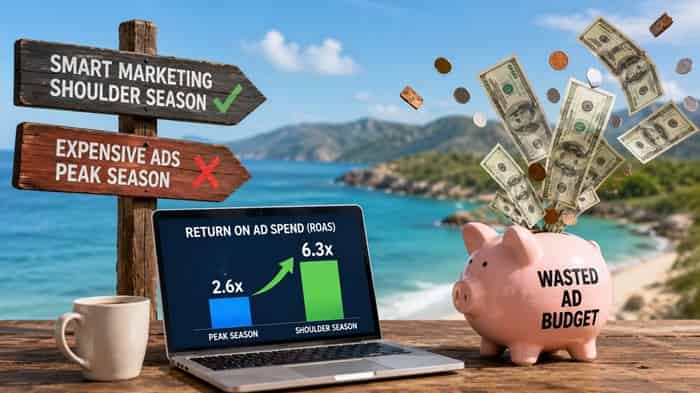
Propellic found that campaigns run during peak booking season generated an average Return on Ad Spend (ROAS) of 2.6x.
Campaigns operating during the shoulder season achieved an average ROAS of 6.3x.
That is more than double the return.
The surprise is that travellers booking during quieter periods spend almost as much as those booking during the industry’s busiest months.
The difference sits within a narrow five per cent range.
In other words, operators are often selling the same holidays to the same type of customer while paying dramatically less to acquire them.
If that sounds counterintuitive, that’s because it is.
Travel marketing has traditionally followed demand.
Propellic’s research suggests smart operators may need to start thinking about following efficiency instead.
The Safari Keyword That Explains Everything
John Matson, Chief Revenue Officer at Propellic, believes the problem comes down to competition.
And plenty of it.
“Imagine July, when 50 tour operators are bidding on the same keyword such as ‘safari tours Kenya.’ A click that cost $3 in February may cost $11 during peak booking season, yet the traveller is no more likely to convert immediately,” Matson said.
“The longer the consideration window, the more peak-season auction premiums decouple from actual booking outcomes.”
For multi-day tour operators, that observation is particularly important.
Unlike someone booking a hotel room for next weekend, travellers considering an African safari, a European river cruise or a guided tour through South America rarely book on impulse.
They research.
They compare.
Not only that, but they ask questions.
Then they compare again.
Sometimes they compare for months.
The booking may eventually happen, but the customer journey is usually longer than a Qantas boarding announcement.
That means operators often pay inflated advertising costs without accelerating bookings.
The Industry’s Hidden Measurement Problem
The report also highlights another issue quietly frustrating marketers across the sector.
Attribution.
It may not be the most exciting word in travel, but it could be one of the most important.
Across travel categories, between 83 and 90 per cent of paid media spending is directed towards non-brand search terms.
Yet those campaigns frequently receive far less conversion credit than branded searches.
In the multi-day travel sector, non-brand campaigns account for around 90 per cent of advertising spend but only 74 per cent of attributed conversions.
The numbers appear to suggest branded campaigns are the stars.
The reality is far messier.
A traveller may first discover a tour company through a generic search, spend weeks researching, then finally return through a branded search before booking.
Traditional reporting systems often credit the final click while ignoring the journey that made the booking possible.
It’s a bit like awarding the winning goal while pretending the rest of the match never happened.
According to Propellic, the industry’s best-performing brands have already recognised this problem.
They’re investing less in guesswork and more in understanding how customers actually move from inspiration to purchase.
Winners Aren’t Always Spending More
One of the report’s strongest findings is that top-performing travel brands are not necessarily the biggest spenders.
They’re simply measuring better.
“The brands outperforming competitors are not necessarily spending more aggressively, but rather implementing more sophisticated attribution infrastructure capable of measuring the full customer journey across discovery, consideration, and conversion,” Matson said.
That distinction could become even more important in 2026.
A Tougher Road Ahead
Travel marketers are entering a year shaped by forces largely outside their control.
Geopolitical tensions continue shifting demand patterns.
Inflation remains stubborn.
Fuel prices are pushing travel costs higher.
Consumers are taking longer to commit to major purchases.
At the same time, artificial intelligence is beginning to reshape how travellers search for information.
The rise of AI-powered search and zero-click experiences means fewer traditional discovery opportunities for travel brands.
Less available inventory inevitably means more competition.
More competition means higher costs.
And higher costs make every marketing dollar matter.
The Real Lesson
The biggest takeaway from Propellic’s report isn’t that travel companies should stop advertising during peak periods.
It’s that many operators have become conditioned to chase demand without questioning whether it delivers value.
The industry’s smartest marketers are beginning to ask a different question.
Not when travellers are searching.
But when advertising works hardest.
Because in travel, as in life, following the crowd is easy.
Finding value where nobody else is looking is where the real journey begins.
Read the full research report at: Propellic Research Centre.
By Bridget Gomez – © 2026.
Read Time: 5 Minutes.
About the Author.
 Bridget has never been built for stillness. Of Portuguese heritage, she began as a nurse, tending veterans at the Repatriation Hospital, listening to stories as colourful as the life she was yet to live. It was worthy, steady work, but wanderlust, as always, proved louder than routine.
So, she traded starch for a backpack and disappeared for a year, chasing trains, sunsets and the occasional regrettable glass of wine. She wrote everything down: the dust, the laughter, the missteps, the magic. Those notebooks became a travel blog, then a habit, then a calling.
Eventually, she found Global Travel Media, or perhaps it found her.
Today, Bridget writes with heart, humour and a dash of mischief, still travelling, just now with words.











