

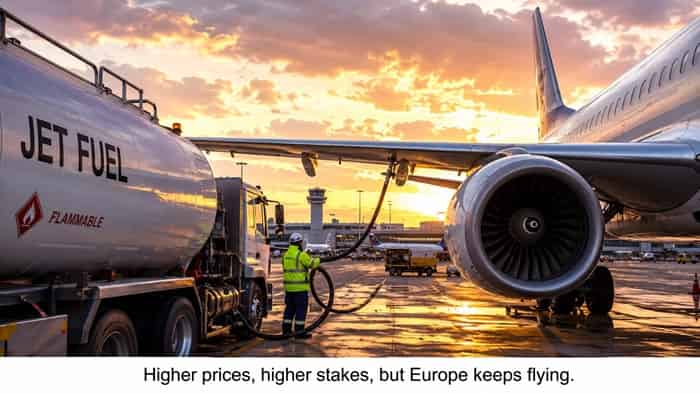
If there is one thing the aviation industry has learned over the past quarter-century, it is that trouble rarely sends a calendar invitation.
One moment airline executives were preparing for another bumper European summer. The next, they were watching fuel prices rocket skyward as conflict in the Middle East threatened one of the world’s most important energy corridors.
For a few uncomfortable weeks, Europe’s airline chiefs found themselves confronting a scenario nobody wanted to contemplate.
What happens when the fuel keeps getting dearer, inventories keep shrinking and millions of travellers still expect to be sitting on a beach somewhere in Spain by July?
The answer, surprisingly, has been remarkably simple.
Keep flying.
Despite one of the most significant disruptions to global jet fuel supplies in recent memory, Europe’s aviation sector has largely refused to hit the panic button. Aircraft are still departing. Holidaymakers are still booking. Airlines are still expanding.
And perhaps most remarkably of all, some carriers now believe the crisis could leave them stronger than before.
The trouble began when escalating tensions in the Middle East sent shockwaves through global energy markets. The closure of the Strait of Hormuz at the end of February removed a substantial volume of jet fuel from international supply chains almost overnight.
Suddenly, a market that had been comfortably supplied found itself scrambling for alternatives.
Jet fuel prices responded with the enthusiasm of a startled kangaroo.
European cargo values surged from below US$800 per tonne in late February to almost US$1,750 per tonne by the end of March. Traders rushed to secure supply. Inventories tumbled. Airlines began making urgent calls to suppliers.
For an industry where fuel represents one of the largest operating expenses, the situation was enough to trigger uncomfortable flashbacks.
Not to COVID.
Quite the opposite.
During the pandemic, aircraft sat idle while fuel tanks overflowed.
This time, passengers wanted to travel and airlines needed every litre they could get their hands on.
Europe proved particularly exposed.
The continent imports around 550,000 barrels of jet fuel every day and traditionally sources around 60 per cent of that volume from the Middle East.
When those flows dried up, inventories across the Amsterdam-Rotterdam-Antwerp fuel hub began falling sharply.
By late May, stockpiles had slipped below levels normally considered comfortable, creating a market where every available cargo suddenly mattered.
The fear wasn’t merely about higher prices.
The fear was whether there would be enough fuel at all.
Yet just as panic threatened to take hold, the global market began doing what markets often do when money is on the table.
It adapted.
American exports surged.
West African refiners increased production.
Nigeria’s Dangote refinery emerged as an unexpected hero of the story, sending additional fuel volumes into international markets precisely when Europe needed them most.
The replacement supplies did not fully replace the lost Middle Eastern barrels.
But they replaced enough.
And, as it turns out, enough was all the industry required.
By May, prices had eased considerably from their March highs. The worst fears of widespread shortages began fading.
The mood in airline boardrooms changed almost overnight.
Back in March, Lufthansa Group chief executive Carsten Spohr delivered a statement that now looks increasingly prophetic.
“There will be many other parts of the global economy who will be short of fuel [before the aviation industry].”
At the time, it sounded optimistic.
Today, it sounds remarkably accurate.
The reason is simple economics.
Jet fuel remains one of the most valuable products a refinery can produce. When prices rise sharply, refiners respond accordingly.
As EasyJet chief executive Kenton Jarvis observed recently, additional supplies have flowed into Europe from Norway, the United States and West Africa while refinery production has increased globally.
The influx, he noted with characteristic understatement, was “probably not surprising given how expensive it is”.
In other words, where there is profit, supply eventually follows.
That growing confidence is reflected in airline schedules.
EasyJet has trimmed just 0.3 per cent of planned summer capacity.
Jet2 has reassured customers that holiday plans remain firmly on track.
Lufthansa has delivered similar messages.
Even Ryanair, never known for excessive optimism unless it sees an opportunity, remains bullish.
Chief executive Michael O’Leary says passengers continue to book, albeit closer to departure dates than usual.
Travellers may be cautious.
They may be reading headlines.
They may be waiting longer before pulling out the credit card.
But they are still travelling.
“Close in bookings were stronger and stronger,” O’Leary said after April trading exceeded expectations.
That resilience tells us something important.
Travellers might delay decisions.
They might compare prices.
They might spend a little less once they arrive.
But after several years of disruption, they are no longer willing to postpone holidays indefinitely.
The industry’s challenge now is not whether people will travel.
It is where they will travel.
Some long-haul destinations remain vulnerable to geopolitical uncertainty. European destinations, meanwhile, continue benefiting from travellers seeking perceived stability closer to home.
For Ryanair, EasyJet and other short-haul specialists, that may prove an unexpected gift.
And therein lies the bigger story.
The fuel crisis may ultimately be remembered not for grounding aircraft but for accelerating the reshaping of Europe’s airline industry.
Every major aviation shock creates winners and losers.
The pandemic eliminated weaker carriers and strengthened larger groups.
This fuel shock could produce a similar outcome.
Large airline groups possess fuel hedges, stronger balance sheets and greater buying power. Smaller competitors often do not.
If elevated costs persist, consolidation may accelerate.
The giants will keep growing.
The minnows may find survival increasingly difficult.
That prospect is already visible across Europe.
Lufthansa has absorbed ITA Airways.
Air France-KLM has secured SAS.
The battle for TAP Air Portugal continues.
Ryanair continues expanding aggressively wherever opportunities emerge.
The result is a market increasingly dominated by a handful of powerful airline groups.
Ironically, the very crisis that once threatened Europe’s aviation recovery may ultimately strengthen the industry’s biggest players.
For travellers, that story is still being written.
For airline executives, however, one conclusion is already becoming clear.
The Gulf fuel shock rattled the industry.
It frightened investors.
It squeezed supply chains.
Not only that, but it drove prices to uncomfortable heights.
But it failed to stop Europeans from doing what they love most when summer arrives.
Packing a suitcase, heading to the airport and chasing a bit of sunshine somewhere beyond the horizon.
And in aviation, that remains the most powerful fuel of all.
By: Octavia Koo – © 2026.
Read Time: 7 Minutes.
About the Author.
 Octavia Koo arrived in Australia in the early eighties with little fuss and a good eye. Sydney suited her. At UNSW, she studied Arts, then found her footing in graphic design before drifting, quite naturally, into the digital side of things, building websites and shaping words that made people want to stay.
Singapore followed, and with it, the fast pace of tourism platforms and ITB Asia. Long before SEO became a buzzword, Octavia understood how stories travelled online. That’s where she met Stephen, and the seed for something more was planted.
A few years later, she joined Global Travel Media.
Today, Octavia works with quiet assurance, blending art, instinct and experience to produce stories that don’t shout; they simply work and linger.











