

Just when airlines thought they had enough turbulence to deal with.
Aircraft shortages. Rising costs. Labour headaches. Geopolitical uncertainty. The industry’s worry list was already longer than an airport security queue on a Monday morning.
Now comes another blow.
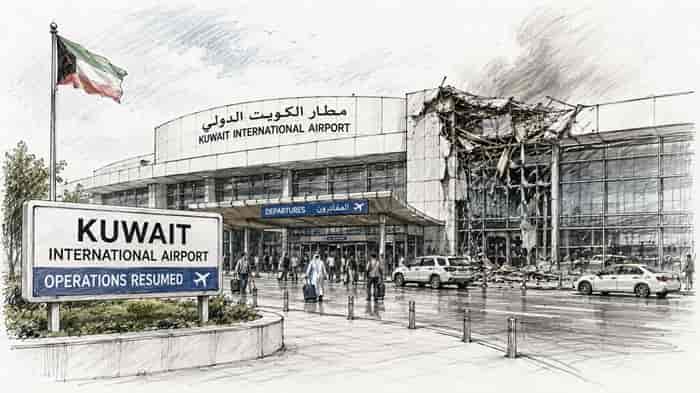
Kuwait International Airport has reopened after what Kuwaiti authorities described as an Iranian drone and missile attack that killed one person and injured 63 others, while Iran denied responsibility and blamed a US interceptor.
For travellers passing through Kuwait, the airport’s reopening is welcome news.
For the travel industry, it is a reminder of a harsh reality that many hoped belonged to history books rather than modern departure boards.
When drones and missiles are reported around passenger terminals, aviation executives stop talking about growth forecasts and start talking about contingency plans.
The strike temporarily disrupted one of the Gulf’s important aviation gateways, forcing authorities to suspend operations while emergency teams assessed the damage and secured the site. Flights have since resumed, but the broader implications are only beginning to emerge.
The timing could hardly be worse.
The Gulf has spent the better part of two decades reinventing itself as one of the world’s great aviation crossroads.
Millions of travellers connect through the region every year. Australians heading to Europe know the routine well. A stop in the Gulf is often as familiar as ordering coffee before boarding.
That familiarity suddenly feels a little less certain.
What happened in Kuwait is not simply an airport story.
It is a confidence story.
Tourism, perhaps more than any other industry, runs on confidence. Travellers need confidence to book. Airlines need confidence to invest. Tourism boards need confidence to market destinations years into the future.
Remove confidence, and even the most sophisticated tourism machine begins to splutter.
That is why events unfolding across the Gulf are being watched so closely by travel executives worldwide.
The attack came amid escalating military action involving Iran and the United States, with tensions spilling across some of the world’s most strategically significant transport corridors.
For aviation leaders, the concern extends beyond airport operations.
Airspace restrictions can change quickly.
Insurance costs can rise overnight.
Fuel prices can react within hours.
Passenger sentiment can shift even faster.
One senior airline executive once described geopolitical instability as aviation’s version of an approaching thunderstorm.
You may not know exactly where it will hit.
But you know it will affect somebody’s flight plan.
The travel industry has seen this movie before.
The Gulf Wars.
September 11.
The Arab Spring.
COVID.
Each crisis arrived with predictions of long-term damage.
Each time, travel eventually found a way back.
That resilience remains one of aviation’s defining characteristics.
Yet resilience should never be mistaken for immunity.
Every disruption extracts a cost.
Airlines reroute aircraft.
Travel advisors spend hours reassuring nervous clients.
Tour operators field cancellations.
Destinations fight to protect hard-earned reputations.
The bill always arrives somewhere.
For now, Kuwait’s reopening sends an important signal.
Authorities are determined to keep people moving.
Aircraft are once again departing.
Passengers are once again checking in.
The airport is once again doing what airports are designed to do: connect people rather than divide them.
There is something quietly reassuring about that.
Aviation has always been at its best when the world is at its most uncertain.
It keeps families connected.
It keeps trade flowing.
Not only that, but it keeps tourism alive.
And sometimes, as events in Kuwait have demonstrated this week, simply keeping aircraft moving can become an act of resilience in itself.
The coming weeks will reveal whether this incident remains an isolated shock or becomes part of a broader regional challenge.
The travel industry will be hoping for the former.
Because while airports are excellent at recovering from disruption, nobody wants to see global tourism testing its crisis-management skills yet again.
The industry has had quite enough practice already.
By Jason Smith – © 2026.
Read Time: 6 Minutes.
About the Author.
 Jason Smith didn’t learn travel from textbooks. He learned it in airports, taxis and hotel lobbies, watching the business unfold long before he played his own part. Half American, half Asian, he grew up around the quiet workings of tourism, where people come and go, and stories rarely stand still.
Bangkok came first, then formal study, then a career that carried him through Singapore, Malaysia and Vietnam. Each place left something behind. In the end, Thailand felt like home, and I took on a senior role in hotel sales.
Then everything stopped. Borders shut, planes grounded, and Jason found himself back in America with time to reflect.
Now at Global Travel Media, he writes travel as it really is, not polished, not perfect, but human, and all the better for it.











