

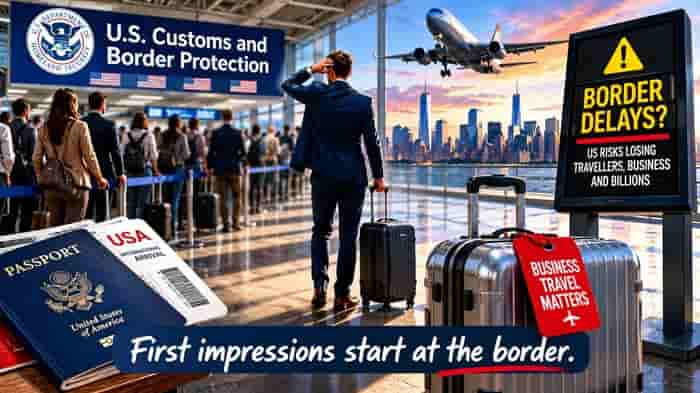
If there’s one thing international travellers dislike more than flight delays, it’s standing in a queue, wondering why nobody seems to be moving.
And according to the Global Business Travel Association (GBTA), America may be about to test the patience of both tourists and business travellers alike.
The association has sounded the alarm over potential changes being considered by the US Administration that could affect Customs and Border Protection (CBP) operations at major airport gateways.
While the proposal remains under consideration, the mere prospect of reducing CBP resources at some of America’s busiest international arrival points has already raised eyebrows throughout the travel industry.
Because here’s the reality.
When nations compete for visitors, conferences, investment and global events, the first impression often isn’t a hotel lobby or a convention centre.
It’s the immigration queue.
Nobody books a long-haul trip dreaming of fluorescent lighting, retractable barriers and a two-hour wait to have their passport examined.
Yet that’s precisely what industry leaders fear could become more common if border processing capacity is reduced.
The timing is particularly sensitive.
Around the world, destinations are aggressively pursuing international visitors as global travel continues to recover and business events return to full strength.
From Singapore to Dubai, from London to Sydney, governments are investing billions in making arrivals faster, smoother and more welcoming.
The message is simple: come here, spend money, do business.
America risks sending a different message.
Suzanne Neufang, CEO of GBTA, did not mince words.
“In light of the U.S. Administration’s consideration of changes to Customs and Border Protection (CBP) operations at certain airport ports of entry, including the withdrawal of CBP officers from major gateway airports, the Global Business Travel Association (GBTA) is expressing serious concerns about the potential implications for international travel into the U.S. and the resulting impact for the U.S. economy overall.”
Behind that carefully measured language sits a significant economic concern.
According to GBTA, international inbound business travel contributes US$50.7 billion annually to the American economy.
That’s not pocket change found beneath an airline seat cushion.
That spending supports hotels, airlines, convention centres, restaurants, attractions, ground transport operators and countless small businesses spread across the country.
Every delayed arrival, every missed connection and every frustrating border experience creates potential ripple effects far beyond the airport terminal.
Business travellers, perhaps more than any other segment, place a premium on certainty.
A corporate executive travelling to negotiate a deal, attend a conference or inspect a new investment opportunity doesn’t want border delays becoming part of the itinerary.
In today’s hyper-connected economy, destinations are no longer competing solely on attractions or infrastructure.
They are competing on ease.
Ease of entry.
Ease of movement.
Ease of doing business.
That is where GBTA believes the United States must tread carefully.
The organisation argues that maintaining adequate CBP staffing levels, expanding trusted traveller programs and investing in smarter screening technology represent a far more effective path forward.
Security, after all, remains non-negotiable.
But the travel sector has long argued that security and efficiency are not opposing forces.
The world’s best border systems increasingly deliver both.
GBTA has previously raised concerns about proposals affecting ESTA requirements and other entry-related policies, warning that seemingly minor administrative changes can have disproportionate consequences for international mobility.
The broader concern is competitiveness.
Every traveller who decides to attend a conference in Singapore rather than Chicago.
Every investor who chooses London instead of Los Angeles.
Every event organiser who looks elsewhere because arrivals have become too complicated.
Those decisions add up.
The United States remains one of the world’s most important travel and business destinations.
But as every travel advisor knows, loyalty only goes so far when a smoother option exists elsewhere.
For now, GBTA is urging policymakers to look beyond operational spreadsheets and staffing models and consider the bigger picture.
In a fiercely competitive global travel market, making it harder to enter the country is unlikely to make it easier to grow the economy.
And that’s a queue nobody wants to join.
By Jill Walsh – © 2026.
Read Time: 4 Minutes.
About the Author.
 Jill Walsh has always kept a pen close and a suitcase closer. She started out on media releases, then learned the trade properly by escorting press trips around the world, discovering which stories travel well and which need a sharper edit.
Before long, she wasn’t just promoting destinations, she was representing them, translating civic ambition and local pride into words people actually wanted to read. These days, semi-retired and happily so, Jill has traded departure boards for deadlines, joining old friend and colleague Stephen at Global Travel Media on a casual basis.
Her patch is the business end of wanderlust: balance sheets, route maps, tender wins and the numbers that quietly decide where travellers go. She writes with dry humour, clean prose and an old-school respect for facts, a steady voice when the market starts shouting.











