

Canada has stumbled upon something rather extraordinary.
Not oil. Not lithium. Not another moose wandering onto a runway outside Calgary.
Tourism.
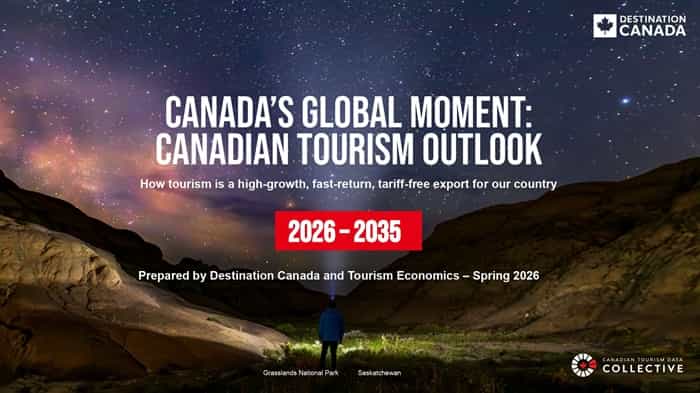
And according to a powerful new report from Destination Canada and Tourism Economics, the country is standing on the brink of what could be the most lucrative tourism expansion in its modern history.
The numbers are enough to make even battle-hardened Treasury officials loosen their ties.
By 2035, Canada’s tourism sector is forecast to surge to an eye-watering $216.3 billion in annual revenue, a whopping 67 per cent increase over 2024 levels.
That is not a recovery story anymore.
That is a full-scale economic breakout.
And unlike many industries currently sweating through tariffs, trade wars and geopolitical tantrums, tourism arrives beautifully gift-wrapped as a tariff-free export.
No containers. No customs stand-offs. No shipping bottlenecks.
Just travellers, suitcases, and credit cards working overtime.
Canada Suddenly Looks Like the Smart Kid in Class
Timing, as every seasoned traveller knows, is everything.
Right now, much of the world feels exhausted. Economically jittery. Politically noisy. Overcrowded. Overfiltered. Overcooked.
Canada, meanwhile, has quietly wandered into the global spotlight looking calm, scenic, polite and refreshingly sane.
That reputation is proving commercially priceless.
The report reveals Canada now ranks number one globally for international reputation in the RepCore Nations study, tied with Switzerland. It also sits third in the 2025 Anholt Nation Brand Index and remains one of the world’s safest travel destinations.
Frankly, in today’s climate, simply appearing stable is becoming a luxury tourism product.
Destination Canada’s “Canada, naturally” campaign cleverly leans into exactly that. No fake gloss. No overproduced nonsense. No synthetic “Instagram versus reality” bait-and-switch.
The campaign promises authenticity.
And travellers, increasingly weary of manufactured experiences, are buying it.
Big time.
As the report bluntly notes, visitors are searching for places that feel “real, open and genuinely welcoming.”
A radical concept in 2026, apparently.
Tourism Is Quietly Becoming an Economic Beast
Here is the part politicians may soon start quoting with suspicious enthusiasm.
Tourism is now forecast to grow at 5.3 per cent annually through to 2030, comfortably ahead of the broader Canadian economy, which is projected to expand at 3.7 per cent over the same period.
Even better, tourism already ranks among Canada’s top three exports, accounting for 13.1 per cent of all national services exports in 2025.
Combined, travel and tourism now represent almost one-third of Canada’s total services exports.
Not bad for an industry once unfairly dismissed as “people taking selfies near mountains”.
And those economic benefits are not confined to shiny downtown towers in Toronto or Vancouver.
Tourism currently supports one in every 10 Canadian jobs and injects more than $364 million every single day into communities across the country.
Daily.
That is serious economic circulation.
From remote northern regions to coastal fishing villages and prairie towns that many international travellers could not previously locate on a map, tourism is spreading wealth remarkably broadly.
Which, politically speaking, tends to make governments very happy indeed.
Canadians Are Holidaying at Home Again
One of the more fascinating shifts emerging from the report is the rise of “reshored” domestic travel.
In plain English, Canadians are rediscovering their own backyard rather than immediately racing off on overseas holidays.
And it is worth billions.
Domestic reshoring contributed $1.5 billion to the Canadian economy during 2025 alone, while total reshored spending between 2025 and 2027 is expected to reach $4.4 billion.
Turns out Canada is rather beautiful once people stop taking it for granted.
Inter-provincial travel is also booming as Canadians explore regions they previously ignored in favour of somewhere involving palm trees and regrettable souvenir shirts.
The upside for regional tourism operators is enormous.
Smaller communities are benefiting from increased visitation, longer stays and stronger year-round demand, precisely the kind of sustainable growth destinations dream about while writing strategic plans nobody usually reads.
America Still Dominates, But Asia Is the Real Rocket
The United States remains Canada’s biggest tourism market by sheer scale. That will not change anytime soon.
But the report makes one thing crystal clear: the real acceleration is happening beyond North America.
Overseas tourism markets are forecast to grow at a blistering 9.8 per cent annually through 2035, nearly double the projected growth rate from the US market.
Asia, particularly Japan, South Korea and China, is emerging as the heavyweight growth engine.
And importantly, these visitors spend well.
Very well.
The report highlights that many Asian travellers generate significantly higher spend-per-night returns, making them especially valuable for destinations focused on yield rather than sheer volume.
Meanwhile, higher-income American air travellers are also becoming increasingly important.
Spending from US air arrivals is forecast to grow at 6.7 per cent annually through 2030, significantly outperforming land and drive markets.
The logic is beautifully simple.
Fly-in visitors stay longer, spend more, and tend not to panic every time petrol prices rise by eight cents.
Business Events Are Back, and They Mean Business
The convention and business events sector is also roaring back to life.
And not before time.
Business events, according to the report, are among Canada’s highest-yield tourism exports, generating trade relationships, investment opportunities, talent attraction and long-term economic legacy.
Canada’s International Convention Attraction Program (ICAP), launched through the 2023 Federal Budget, has already delivered more than $800 million in economic impact with an astonishing reported return on investment of 20-to-1.
Those are numbers capable of making even the driest economist briefly develop a personality.
Association conferences are forecast to exceed pre-pandemic levels by 2028, bringing with them a fresh wave of international delegates, investment opportunities and business connections.
In tourism terms, these are golden visitors.
They spend heavily, travel year-round, and rarely ask where the nearest budget backpacker hostel is located.
The Challenge Now? Not Stuffing It Up
Of course, no tourism boom arrives without complications.
Canada still faces workforce shortages, infrastructure pressures, capacity constraints, and growing global competition.
The report repeatedly warns that future growth depends on improving productivity, expanding air access, strengthening workforce capacity and embracing AI discoverability.
That final point matters more than many operators realise.
Increasingly, travellers are discovering destinations through AI-powered search tools, recommendation engines and generative platforms. Businesses that are invisible to AI systems may soon become entirely invisible to travellers.
The tourism operators who thrive over the next decade will not simply market better.
They will structure content smarter, improve digital visibility, and remove friction from booking pathways.
Or, put another way, they will make it absurdly easy for travellers to hand over money.
The good news for Canada?
Global tourism demand is still climbing sharply, and the country’s reputation has arguably never been stronger.
That creates a rare opportunity.
One that may not come around again anytime soon.
Because while other nations squabble over tariffs, political division and economic uncertainty, Canada has quietly positioned itself as something travellers increasingly crave:
Safe.
Authentic.
Welcoming.
And spectacularly good-looking.
Not a bad tourism strategy, really.
Source Report: Destination Canada Tourism Outlook
by Jill Walsh – (c) 2026.
Read Time: 8 Minutes.
About the Author.
 Jill Walsh has always kept a pen close and a suitcase closer. She started out on media releases, then learned the trade properly by escorting press trips around the world, discovering which stories travel well and which need a sharper edit.
Before long, she wasn’t just promoting destinations, she was representing them, translating civic ambition and local pride into words people actually wanted to read. These days, semi-retired and happily so, Jill has traded departure boards for deadlines, joining old friend and colleague Stephen at Global Travel Media on a casual basis.
Her patch is the business end of wanderlust: balance sheets, route maps, tender wins and the numbers that quietly decide where travellers go. She writes with dry humour, clean prose and an old-school respect for facts, a steady voice when the market starts shouting.











