

There are disruptions, and then there are disruptions that remind you, rather starkly, why aviation remains as much about people as it is about precision engineering.
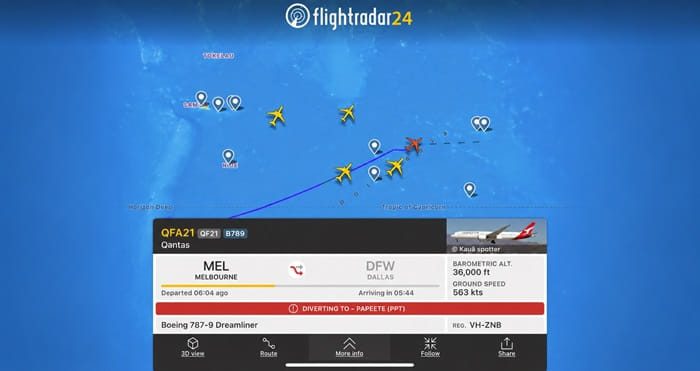
On what should have been a routine long-haul crossing from Melbourne to Dallas, Qantas found itself dealing with the sort of mid-air drama that no amount of scheduling or fuel planning can quite anticipate. Flight QF21, a flagship service linking Australia with the United States, was forced into an unscheduled diversion to Papeete in Tahiti after a passenger allegedly bit a flight attendant, yes, bit, prompting swift intervention from crew and fellow travellers.
It’s the kind of incident that reads like an overcooked anecdote from the golden age of travel writing. Only this one happened at 35,000 feet, with consequences measured not in column inches but in safety protocols and operational cost.
According to the airline, the situation escalated mid-flight over the weekend, with the passenger becoming disruptive before allegedly assaulting a crew member. The aircraft made a precautionary landing in Papeete, capital of French Polynesia, where local authorities were waiting. The individual was removed without further incident and has since been handed a lifetime ban from flying with the airline.
A Qantas spokesperson was unequivocal, and rightly so. “The safety of our customers and our crew is our number one priority and we have zero tolerance for disruptive or threatening behaviour on our flights,” they said. It’s a line the industry has repeated more often in recent years and with good reason.
What followed was a familiar, if frustrating, sequence for those onboard. The aircraft refuelled, passengers stretched their legs in an unexpected Pacific interlude, and the service eventually resumed its journey to Dallas several hours behind schedule. By the time wheels touched down in Texas on Saturday morning (AEST), the delay had rippled through onward connections, leaving many travellers scrambling.
One passenger, comedian Mike Goldstein, offered a more colourful account via social media, describing the disruption with a mixture of disbelief and gallows humour. In a video posted online, he quipped about a “drunk guy on my long haul flight… trying to step out for a cig,” adding that it was “best to drop him off at a jail in Tahiti.”
Behind the humour, however, lies a more sobering reality. Goldstein later claimed the situation had escalated significantly before the diversion, alleging physical altercations between passengers and behaviour that tipped from nuisance to genuine threat. While such accounts remain unverified, they underscore a broader issue facing airlines globally: the steady rise of disruptive passenger incidents.
For carriers like Qantas, the calculus is clear. Safety trumps schedule, every time. A diversion of this nature is neither cheap nor convenient; it can cost tens of thousands of dollars, disrupt network flow, and strain crew duty limits. Yet the alternative is unthinkable.
It’s also a timely reminder that the romance of long-haul travel, those sweeping arcs across oceans and continents, rests on a fragile social contract. Hundreds of strangers, confined in a pressurised tube, relying on mutual respect and a shared understanding of acceptable behaviour. Break that contract, and the system responds decisively.
The passenger at the centre of the incident is understood not to be Australian, though nationality is largely beside the point. Airlines worldwide have been tightening their stance on unruly conduct, with bans, fines and, in some jurisdictions, criminal prosecution becoming more common.
For the rest of the passengers on QF21, the journey will be remembered less for its destination and more for its detour, a brief, unexpected stop in Tahiti that no one had pencilled into their itinerary.
And for the industry? Another case study, another reminder, and perhaps another quiet recalibration of how airlines manage the unpredictable variable that is human behaviour at altitude.












