

In travel, the loudest deals are rarely the most important.
While the industry fusses over fleet orders and flashy hotel openings, HBX Group has been doing something far more telling, tightening its grip on the part of the journey that travellers increasingly care about: what happens after they arrive.
Its acquisition of Bridgify won’t dominate dinner conversations, but it should. Because this is less about buying a company and more about buying relevance in a market that has shifted under everyone’s feet.
Once upon a time, selling travel was straightforward: get the seat filled, the room booked, job done. Today, that’s merely the entry ticket. The real game lies in experiences: tours, attractions, moments worth remembering, and, more importantly, worth recommending.
A Million Experiences… and a Way to Make Sense of Them
Bridgify arrives with scale more than one million curated experiences sourced globally but scale alone is not the story. The travel sector has never lacked inventory; it has lacked clarity.
Too many choices, poorly stitched together, delivered through systems that often feel like they belong to another era.
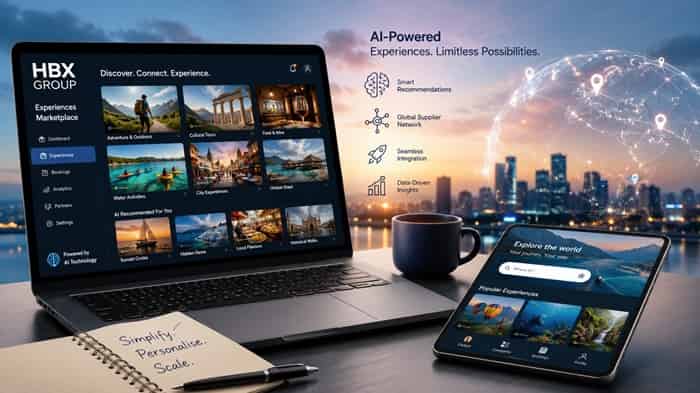
Bridgify’s pitch is disarmingly simple: take that sprawl and make it usable. Its AI-driven platform matches travellers with experiences in a way that feels less like a catalogue and more like a conversation. Less scrolling, more doing.
For HBX, that’s the attraction.
As CEO, Nicolas Huss noted, the deal is about “combining technology and data to simplify the travel industry.” Corporate speak, yes, but in this case, not entirely hollow.
Because simplicity, in travel distribution, has been in short supply for years.
The Real Prize: Frictionless Selling
Behind the scenes, this is about plumbing, and better plumbing rarely makes headlines. But it should.
Bridgify’s API-led architecture allows partners to slot experiences into their offerings without having to rebuild the house. Airlines, OTAs, and wholesalers can plug in, brand it as their own, and get on with selling.
That’s gold in a sector where integration headaches have long outnumbered solutions.
And it speaks to a broader shift: travel companies no longer want more products; they want products that behave cleanly, are integrated, are easily scaled, and can generate revenue without causing chaos.
Personalisation Without the Pretence
There’s a great deal of talk in travel about personalisation, much of it, frankly, wishful thinking. A first name in an email does not constitute insight.
Bridgify, to its credit, goes a step further. Its recommendation engine is built to match travellers with experiences that actually fit based on behaviour, preferences, and timing. Done well, that moves the needle from suggestion to relevance.
Done poorly, it becomes noise.
HBX is betting it can land on the right side of that equation.
Bridgify CEO Amit Shamni called the deal “an important milestone,” adding that the combined business can deliver “more flexible and innovative solutions for partners.” The phrasing is familiar, but the logic holds.
Scale the network, sharpen the intelligence, and suddenly the offering looks a great deal more compelling.
A Deal Built for the Long Game
The financials tell their own story. A modest €3 million upfront, with the bulk tied to future performance.
No grand gestures. No reckless chequebook.
Instead, a structure that rewards delivery and keeps everyone honest. In an era where AI acquisitions can drift into fantasy pricing, that restraint feels almost old-fashioned and rather sensible.
Just as important, Bridgify’s founders are staying on. Continuity matters. Technology can be bought; understanding how to make it work is another matter entirely.
Where This Leaves the Market
Strip it back, and this is a play on where value is heading.
Experiences are no longer an add-on; they are fast becoming the differentiator. The companies that can surface the right experience at the right moment without making the customer work for it will take the spoils.
HBX is positioning itself accordingly.
Not with noise, but with infrastructure. Not with promises, but with capability.
It’s a quiet strategy, but a deliberate one. And in a business that has spent years chasing volume, the pivot towards intelligence may prove to be the smarter bet.
Because in the end, travellers don’t remember the booking.
They remember what they did.
by Soo James – (c) 2026.
Read Time: 4 minutes.
About the Author.
 There’s nothing rehearsed about Soo James, and that’s precisely the point. Malaysian by heritage, Sydney by schooling, she arrived at UNSW to study Arts, then took a left turn into IT, not out of ambition, but curiosity. Somewhere among systems and schedules, she worked out what really held her attention: people, language, and the quiet spaces between them.
Writing followed naturally. Travel and lifestyle gave her room to observe, to listen, to notice the details others rush past. Soo writes the way good travellers move, watching the room before admiring the view, catching the gesture before chasing the headline.
At Global Travel Media, her stories don’t shout or sell. They linger. They slow you down, open a door, and gently suggest there’s more to see if you’re willing to look.











