There are profitable airlines. Then there is Emirates.
While much of the global aviation industry spent the past year nervously watching geopolitical flashpoints, fuel volatility and increasingly fragile travel corridors, the Dubai-based aviation giant quietly did what it does best: make money. Mountains of it.
The latest Emirates Group Annual Report confirms the carrier has once again cemented its position as the world’s most profitable airline, posting record profits, record revenues and record cash reserves, a performance that would make even the hardiest Wall Street banker loosen his tie and smile.
And it did so while navigating one of the most turbulent periods global aviation has seen in years.
For the financial year ending 31 March 2026, the Emirates Group delivered a staggering pre-tax profit of AED24.4 billion (US$6.6 billion), up seven per cent on the previous year. Revenue climbed to an unprecedented AED150.5 billion (US$41 billion), while cash assets swelled to AED59.6 billion (US$16.2 billion).
In aviation circles, those are not merely healthy numbers. They are altitude records.
The airline itself contributed the lion’s share, generating AED22.8 billion (US$6.2 billion) in profit before tax, reaffirming its crown as aviation’s undisputed heavyweight champion. Meanwhile, sister company dnata quietly produced another powerhouse performance, with revenue surging 12 per cent to AED23.6 billion.
In simpler terms: while others were tightening seatbelts, Emirates was rewriting the route map.
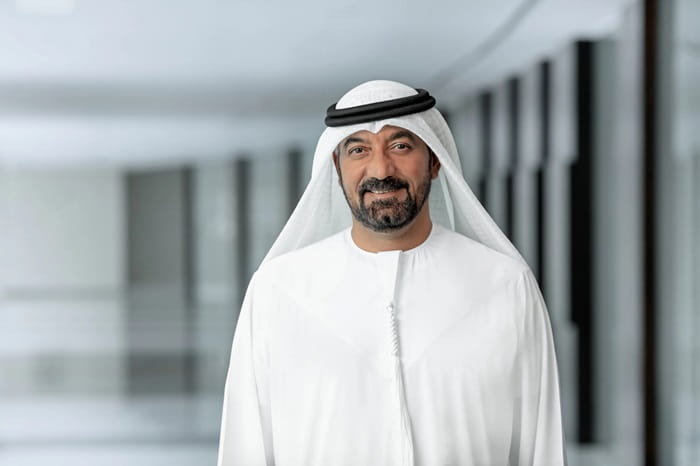
His Highness Sheikh Ahmed bin Saeed Al Maktoum, Chairman and Chief Executive of Emirates airline and Group, struck a confident tone throughout the report, describing the results as proof of the organisation’s “strength and resilience”.
“These outstanding results, despite significant challenges in the last month of our financial year, reaffirm the strength and resilience of the Emirates Group’s business model, which is rooted in safety, excellence, innovation, people and partnerships,” Sheikh Ahmed said.
That final month, however, was no routine bump in the skies.
On 28 February, military activity involving the Gulf region caused major disruption to commercial air traffic, affecting operations throughout the UAE and beyond. For many airlines, such events would trigger operational paralysis and investor panic. Emirates, however, responded with the calm efficiency of a veteran captain guiding passengers through turbulence.
Operations were stabilised, cargo activity accelerated, and commercial continuity maintained.
That resilience, aviation insiders say, stems from a uniquely integrated ecosystem built over decades in Dubai, one where government strategy, infrastructure and aviation growth move in near-perfect formation.
Indeed, Sheikh Ahmed openly credited Dubai’s leadership for helping secure commercial flight corridors during the crisis, reinforcing how deeply aviation remains woven into the emirate’s economic DNA.
The result is an airline that continues to behave less like a traditional carrier and more like a sovereign economic engine with wings.
And while many competitors remain trapped in post-pandemic rebuilding mode, Emirates continues to expand aggressively.
During the year, the airline launched services to four new destinations: Da Nang, Hangzhou, Siem Reap and Shenzhen, further broadening its network, which now spans 152 cities across 80 countries. Partnerships also expanded, with Emirates now linked to 32 codeshare and 117 interline partners, giving travellers access to more than 1,700 destinations worldwide.
That global reach continues to underpin the airline’s extraordinary commercial performance.
Passenger demand remained remarkably strong despite broader economic uncertainty, with Emirates carrying 53.2 million passengers during the year. Passenger yields rose four per cent, demonstrating the airline’s ability to command premium pricing in a highly competitive market.
That pricing power is no accident.
Emirates has spent years cultivating a reputation for in-flight luxury, operational consistency and polished customer service. While other airlines increasingly resemble airborne bus services with optional sandwiches, Emirates still understands the enduring appeal of glamour at 40,000 feet.
The carrier continued pouring billions into customer experience enhancements throughout 2025-26.
Its massive US$5 billion retrofit program rolled on at full throttle, with 91 aircraft already refreshed with upgraded interiors and the increasingly popular Premium Economy product.
The airline also accelerated installation of Starlink high-speed onboard Wi-Fi, fitting 21 aircraft by year-end.
For passengers accustomed to airline internet speeds resembling a pensioner wrestling with dial-up in 1998, this is no small development.
On the ground, Emirates unveiled a new dedicated First Class check-in lounge at Dubai International Airport, expanded chauffeur-drive offerings in Japan, and introduced new accessibility initiatives designed to support travellers with autism and varying sensory needs.
In an industry often obsessed with cost-cutting, Emirates continues to wager heavily on experience.
So far, the bet is paying handsome dividends.
Meanwhile, fleet expansion remains relentless.
Emirates added 15 Airbus A350 aircraft during the year and now operates 19 A350s to 21 destinations. At the 2025 Dubai Airshow, the airline further doubled down, announcing fleet commitments totalling US$41.4 billion, including additional Boeing 777-9s and A350 aircraft.
Its order book now stands at an eye-watering 367 aircraft extending through to 2038.
That pipeline effectively tells the market one thing: Emirates has no intention of shrinking quietly into middle age.
And it is not just passengers driving growth.
Emirates SkyCargo delivered another standout performance, carrying 2.4 million tonnes of freight worldwide and generating AED16.2 billion in revenue.
Cargo may lack the glamour of champagne in First Class suites, but seasoned airline executives know it is often freight that keeps the balance sheet smiling during uncertain times.
SkyCargo expanded its freighter network to 44 destinations and launched Emirates Courier Express, a door-to-door cross-border logistics solution targeting the rapidly evolving e-commerce market.
That diversification reflects a broader reality in aviation today: airlines can no longer survive solely on passenger traffic. The winners increasingly operate integrated logistics ecosystems.
And Emirates understands that better than most.
The Group also continued investing heavily in infrastructure, technology and people.
Total investment across aircraft, facilities and advanced technologies reached AED17.9 billion during the financial year, while workforce numbers climbed eight per cent to more than 130,000 employees globally.
Importantly for the UAE, the Group’s national workforce now exceeds 4,000 employees, reinforcing the government’s ongoing localisation ambitions.
Sheikh Ahmed made special mention of staff performance during the year’s disruptions.
“Our people are a big part of our success, enabling us to respond with agility in a dynamic operating environment,” he said.
That operational culture continues to distinguish Emirates from many legacy carriers still battling staffing shortages, labour disputes and inconsistent service standards.
The dnata side of the business also delivered a quietly formidable year.
Often overshadowed by Emirates’ global brand power, dnata has steadily evolved into one of aviation’s most influential support service providers.
Revenue climbed 12 per cent to AED23.6 billion, driven by strong activity across airport operations, catering, travel services and cargo handling.
The company handled nearly 889,000 aircraft turns globally and processed 3.2 million tonnes of cargo.
Not bad for the business, many passengers barely realise it exists beneath the airport surface.
dnata also continued to expand internationally, investing in facilities in Amsterdam, Italy, Australia, and Azerbaijan, while increasing its exposure to modern travel distribution platforms and cargo logistics networks.
Its acquisition of Australia and New Zealand-based Wymap Group further strengthened dnata’s cargo trucking capabilities across the region.
Closer to home for Australian travellers, dnata’s investment in new catering facilities in Perth and Western Sydney signals continued confidence in the Australian aviation market.
That matters.
Australia remains one of Emirates’ most strategically important international markets, particularly as long-haul demand between Australia, Europe and the Middle East continues to recover strongly.
And while geopolitical tensions continue to cast shadows across parts of the world, Emirates appears determined to maintain long-term confidence.
The Group’s financial reserves now provide extraordinary operational flexibility. Unlike many rivals forced into painful restructuring during periods of uncertainty, Emirates can continue investing without resorting to panic-driven cost reductions.
Sheikh Ahmed made that point abundantly clear.
“The Emirates Group enters 2026-27 with very strong cash reserves, which enable us to progress with our plans to strengthen our business without knee-jerk cost control measures,” he said.
That statement alone will likely send a few nervous competitors reaching for aspirin.
The Group also continued to expand its sustainability initiatives during the year, although Emirates remains realistic about aviation’s complex environmental challenges.
The airline signed agreements to explore Sustainable Aviation Fuel supply at Dubai airports, joined the Aviation Circularity Consortium, and invested further in fuel-efficiency initiatives.
There were also notable investments in environmental programs beyond aviation itself, including an additional AU$50 million commitment to the luxury Emirates Wolgan Valley resort in Australia’s Greater Blue Mountains region.
Community engagement remained another strong focus.
The Emirates Airline Foundation supported disadvantaged children globally, while employee-led charity initiatives delivered food donations, medical mission support and humanitarian programs across multiple countries.
In an age when corporate social responsibility statements often feel mass-produced by committee, Emirates continues to back its initiatives with substantial financial commitment.
And perhaps that is ultimately the real story here.
Beyond the enormous profits and aircraft orders lies an airline group that continues operating with extraordinary strategic clarity.
It knows precisely what it wants to be.
Premium. Global. Scalable. Ambitious.
While many airlines spend years trying to rediscover their identity after each crisis, Emirates simply keeps building.
Of course, challenges remain.
Fuel prices remain unpredictable. Geopolitical tensions across the Middle East could re-escalate at any moment. Supply chain delays continue affecting aircraft manufacturers globally. Competition across premium long-haul travel is intensifying.
But Emirates enters the next financial year from a position of unusual strength.
Its balance sheet is robust. Demand remains healthy. Fleet growth is secured. Dubai continues expanding as one of the world’s most important aviation crossroads.
And perhaps most importantly, the airline still possesses something increasingly rare in global aviation: confidence.
Not the loud, chest-beating confidence of marketing campaigns and investor slogans.
Real confidence.
The sort built through decades of disciplined growth, strategic investment and operational consistency.
In an industry famous for turbulence, Emirates continues to fly remarkably smoothly.
And for rivals watching from the departure lounge, that view is becoming increasingly uncomfortable.
Source: Emirates Group 2025-26 Annual Report, Emirates Group Annual Report.