

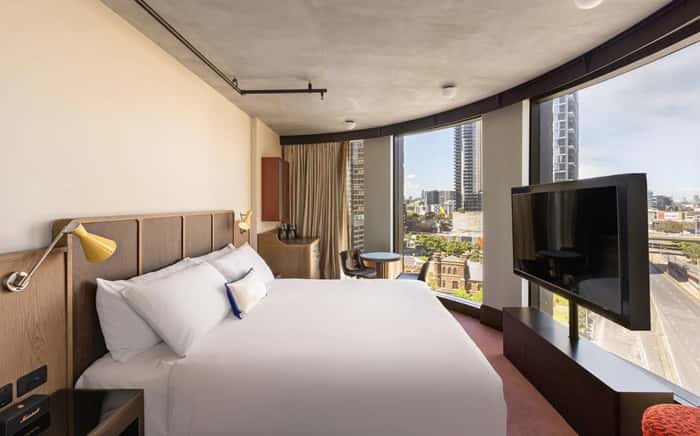
Melbourne has never struggled for culture. Hotels, perhaps, are another matter.
For decades, visitors have arrived in Australia’s cultural capital to discover extraordinary food, design, music and art scenes, only to retreat at night into accommodation that could just as easily exist anywhere else. Hannah Street, a new independent hotel development near Southbank, wants to change that.
Its creators describe the property not as “a hotel in Melbourne” but “a hotel of Melbourne”, and while that might sound like familiar lifestyle-hotel rhetoric, the project’s thinking appears unusually rigorous.
Rather than leaning into predictable Melbourne tropes of exposed brick, laneway graffiti and coffee culture, the design team instead chased something harder to define: the city’s quiet confidence, intellectual edge and layered personality. The result is a hotel that deliberately avoids spectacle, even while sitting in the shadow of one of Australia’s largest entertainment precincts.
The architecture, led by Fraser & Partners, favours permanence over fashion. Stone portals, framed windows and tactile materials create a building that feels strangely familiar on approach, as though it has always occupied the site. Yet closer inspection reveals deeply contemporary detailing, including 3D-printed formwork and carefully calibrated spatial transitions.
Interiors by Flack Studio lean heavily into residential sensibilities rather than conventional hotel design language. Spaces are intimate, layered and personal rather than overtly theatrical. The project consistently references “craft” over design, and that distinction becomes increasingly clear throughout the property.
Art is central to the experience, though never treated as decoration. Commissioned works by artists including Justine Williams and Joe Duck are woven into guestrooms and public areas in ways that encourage discovery rather than demand attention. The collection mirrors Melbourne itself: accessible on the surface but increasingly rewarding the longer you engage with it.
Guestrooms have been developed using a highly analytical “kit of parts” methodology based on how travellers actually behave in rooms. Instead of rigid room typologies, the approach allows spaces to flex while maintaining a consistent design philosophy throughout the hotel.
Wellness facilities also avoid current hospitality clichés. The gym is intentionally serious, the 20-metre lap pool designed around sensory focus rather than Instagram appeal, while sauna and steam spaces are positioned as everyday rituals rather than luxury extras.
Perhaps most importantly, the hotel’s food and beverage strategy feels genuinely embedded within Melbourne’s hospitality ecosystem. Mulberry Group will oversee five distinct venues designed to function as Melbourne destinations first and hotel outlets second, ensuring locals and guests naturally share the same spaces.
In an era where many lifestyle hotels chase trends with exhausting urgency, Hannah Street’s greatest strength may be restraint. Its ambition is not novelty but longevity. The project argues that timelessness is not an aesthetic preference but a commercial strategy.
Whether Hannah Street ultimately succeeds will depend on execution once the doors open. But its central proposition feels compelling: a hotel that does not ask guests to escape Melbourne, but instead invites them to sink deeper into it.
Source material derived from a presentation delivered by Edward Pearse of Time & Place at the Design Inn Symposium 2026.
by Roderick Eime – (c) 2026.
Read Time: 3 minutes.
About the Author.
 Widely published, multiple award-winning specialty travel and tourism journalist and photographer with a broad general knowledge.
Rod’s experience in professional media spans four decades, giving him a firm grounding in traditional media as well as an insight into the evolution of digital and online communications.
A natural storyteller, Rod seeks to entertain, inspire and engage readers as well as inform and educate. Whether it is an adventure travel story amongst reindeer herders in Siberia or a potentially stodgy end-user account for an industrial lubricant manufacturer, Rod believes a reader should be enriched and motivated.
His photography has won several awards, including a rare double ‘Travel Photographer of the Year’ gong from the Australian Society of Travel Writers in 2011 and 2013.
An early adopter of digital and online publishing, he first published web pages in 1994.
Learn more at www.traveloscopy.com or contact him at [email protected].











