

There’s an old saying in travel: the journey matters just as much as the destination. Yet for millions of travellers, that journey begins in a cramped aluminium tube at 35,000 feet and ends with stiff necks, bleary eyes, and a first day abroad written off entirely.
Now, a seasoned industry insider has delivered a rather blunt truth: poor sleep on planes isn’t bad luck, it’s bad seat selection.
After 27 years in the aisle and skies spanning 65 countries, veteran flight attendant Sherry Peters has seen it all. Speaking in collaboration with mattress specialists Sleepy’s, Peters has lifted the curtain on what she calls one of the most common and avoidable mistakes travellers make.
And yes, it’s exactly where you’re sitting.
The Seat That Sabotages Your Sleep
Let’s not dress it up; some seats were never designed for rest.
“Seats near the galley or toilets are the absolute worst if you’re trying to sleep,” Peters says.
“There’s constant foot traffic, people queuing, lavatory doors slamming, and constant crew activity; it’s almost impossible to get uninterrupted rest.”
It’s a familiar scene: trolleys rattling, passengers hovering awkwardly, overhead lights flicking on at all hours. For those chasing even a modest nap, these zones are less a sanctuary and more a circus.
Yet many travellers unknowingly book these seats for convenience, proximity to amenities, quicker service, without realising the trade-off is a night (or day) of fractured rest.
The Case for the Window Seat
In contrast, Peters is unequivocal about the alternative: the humble window seat.
“Being next to the window gives you much more control over your environment, which is key to falling asleep,” she explains.
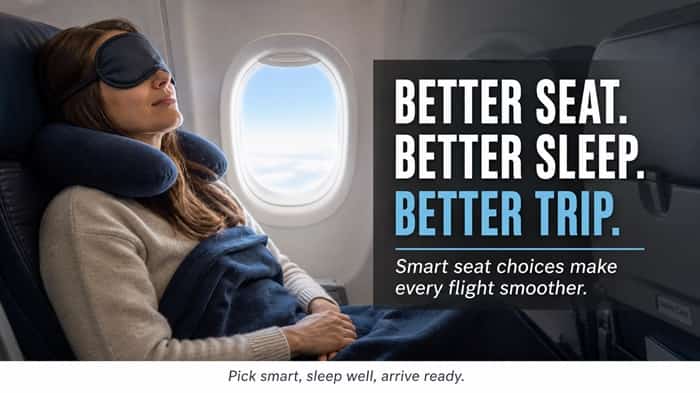
“You can close the shade, lean against the wall for support, and avoid being elbowed by people passing in the aisle. It’s one of the closest things to a controlled sleep environment on a plane.”
Control, it seems, is the real currency at cruising altitude.
While passengers often blame jet lag or flight duration, Peters insists the decisive factor is far simpler: your ability to manage light, noise, and movement.
Why Control Beats Comfort
“Most people blame jet lag or the flight itself, but often it comes down to how to control your environment and if you are staying hydrated,” she says.
“I may not be able to control the time of day, but I can control noise and light by closing the window shades and using noise-cancelling headsets.”
It’s a pragmatic philosophy, less about luxury, more about strategy.
“I may not be able to control that I’m surrounded by 300 people who are wide awake, but I can control how much I get jostled. That’s how I trick my body into thinking it’s time to sleep, even mid-flight.”
In an era where airlines are refining premium cabins and selling sleep as a product, Peters’ advice is refreshingly grounded: start with what you can control, and build from there.
Five Practical Hacks from the Aisle
For those willing to go beyond seat selection, Peters offers a toolkit of small, deliberate adjustments, the kind seasoned crew swear by.
1. Support beats slumping
Leaning against the window alone won’t cut it. Peters recommends stabilising your head with an adjustable eye mask or similar support to prevent the dreaded mid-flight neck twist.
2. Close the shade early
“Closing the shade as soon as I sit down signals my brain that it’s time to sleep,” she says — a simple cue that pays dividends later.
3. Build a sleep ‘bubble’
A jacket, a blanket, even a hood — anything that reduces visual and auditory distractions can help mimic a quieter, darker space.
4. Mind your posture
“I lean slightly toward the window and support my arm so my shoulders and neck can actually relax.” Subtle shifts, significant gains.
5. Recline with purpose
Even a modest recline can ease pressure on the lower back. Add a lumbar pillow, and the difference becomes noticeable.
The Mistakes That Keep Travellers Awake
Despite the abundance of advice, Peters notes the same errors cropping up time and again:
- Sitting near high-traffic zones
- Choosing aisle seats for convenience
- Ignoring posture and seat support
- Assuming sleep will happen naturally
“Your seat choice alone can make or break your sleep on a plane,” she says.
It’s a statement that carries weight, particularly for business travellers, where arrival fatigue can translate directly into lost productivity.
A Smarter Way to Fly
For an industry increasingly focused on passenger wellbeing, Peters’ insights offer a timely reminder: the fundamentals still matter.
You don’t need a lie-flat bed or a first-class ticket to improve your in-flight rest. Often, it comes down to a thoughtful seat selection and a handful of practical habits.
And in the grand scheme of travel, where time, comfort, and experience are all fiercely contested, that’s a return on investment worth considering.
After all, the best trips don’t begin when you land. They begin with how well you arrive.
by May Marclay – (c) 2026.
Read Time: 4 minutes.
About the Author.
 May Marclay’s career hasn’t followed a straight line, and she’s better for it. She began in real estate, then moved into hospitality, finding her rhythm with Centara in the Maldives. There, she worked the Asian markets the old-fashioned way: building trust, closing deals, and turning conversations into lasting business.
The UAE sharpened its focus. At IHG, supporting an Area General Manager, she saw the machinery of a major travel hub from the inside, no gloss, just how things actually get done.
Now, with her sights set on healthcare, May brings a broader lens than most. She speaks three languages, reads widely, travels with intent, and writes with the calm assurance of someone who understands both the detail and the bigger picture without needing to say so too loudly.











