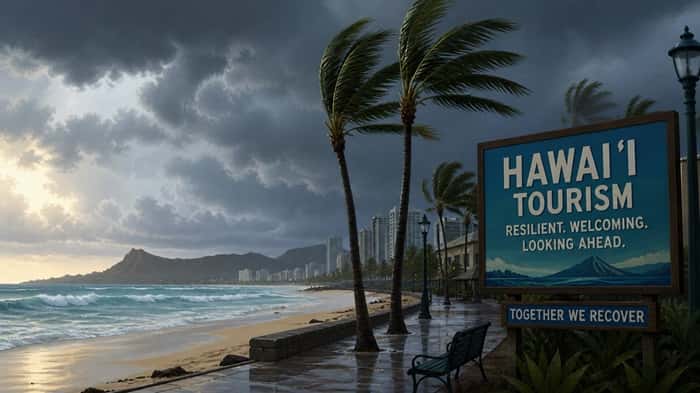
There’s nothing quite like a tropical idyll to remind the world why travel still matters, but even paradise, it seems, isn’t immune to a well-timed storm.
Fresh figures released by the Department of Business, Economic Development and Tourism (DBEDT) paint a sobering picture for March 2026, as Hawai‘i’s visitor economy felt the full force of Kona Low storms that swept across the islands at precisely the wrong moment, during spring break.
The data, now publicly available via the Hawaii Tourism Authority (HTA), reveals a modest yet meaningful downturn. Visitor arrivals slipped 1.7% compared to March last year, while total spending edged down 1.6% to US$1.96 billion. On paper, those numbers might appear manageable. In practice, they ripple through an economy where tourism remains the single largest private-sector driver.
And ripple they did.
The storms, as many operators will attest, were more than a passing inconvenience. Flights were delayed or cancelled, itineraries reshuffled, and a string of attractions and businesses temporarily shuttered. The average daily visitor count dropped 5.1% year-on-year, which translates directly into fewer diners in restaurants, emptier tour buses, and quieter retail floors.
In a destination as finely tuned to visitor flow as Hawai‘i, even marginal declines can feel disproportionately sharp.
There’s another layer to the story, and it’s one the aviation sector will be watching closely. Airlines, in a show of confidence earlier this year, increased scheduled seat capacity into Hawai‘i compared to March 2025. Yet despite the added lift, arrivals fell short.
It’s a delicate equation. Airlines are nothing if not pragmatic; routes live and die by demand curves. If forward bookings fail to keep pace, capacity will inevitably shift elsewhere towards destinations showing stronger yield and load factors. In plain terms: if travellers don’t come, planes won’t either.
That reality places renewed urgency on rebuilding traveller confidence ahead of the critical northern summer period.
HTA, working in concert with state leadership and global marketing partners, is already moving to steady the ship. Efforts are underway to stimulate demand, reassure travellers, and support the network of small businesses and communities that rely so heavily on visitor spend.
There’s also a broader message being quietly reinforced: Hawai‘i remains open, welcoming, and very much ready for business.
Further initiatives aimed at boosting demand and reinforcing confidence are expected to be announced in the coming days, timed, no doubt, to capture early summer booking windows. For an industry that thrives on forward momentum, timing will be everything.
For now, the March figures serve as both a cautionary tale and a call to action. Weather may be beyond control, but perception and demand are very much within reach.
For those seeking a deeper dive into the data, the full report can be accessed here:
https://www.hawaiitourismauthority.org/research/monthly-visitor-statistics/.
And as any seasoned operator will tell you, tourism has always been a resilient beast. It bends, occasionally stumbles, but more often than not, it finds its footing again.