

There’s a particular kind of silence that follows a wildfire. Not peace, never that, but a pause. The sort of quiet where even seasoned travellers, the seen-it-all brigade, tend to shuffle their feet and mutter something about “devastation”.
At Grootbos Private Nature Reserve, they’d gently suggest you hold that thought.
Because what looks like ruin along the hills of Walker Bay is, in fact, the opening act.
Between November 2025 and January 2026, fire moved through this corner of the Cape Floristic Region with the sort of enthusiasm not seen in over twenty years. It took its share of about half the reserve and kept going across the Overberg.
And yet, here’s the part that tends to unsettle first-time observers: this was never the disaster it appeared to be.
Fire, But Not As You Know It
Fynbos doesn’t fear fire. It plans for it.
Sean Privett, who has spent more than three decades reading this landscape like an old ledger, puts it without fuss:
“After the fires, when the landscape cools, the seeds stored underground for decades are released. New species, or those that flower specifically after fire, return. The ashes and burnt plant material add much-needed nitrogen to the generally nutrient-poor soil, creating a perfect recipe for new growth. Fire, in this context, isn’t destruction. It’s renewal on a grand, ancient scale.”
It’s the sort of line that sounds poetic until you realise it’s simply accurate.
Privett continues, cutting neatly through the drama:
“Fire is an essential part of fynbos ecology. Without it, the ecological clock stalls, species falter, and diversity fades. What appears to be devastation is, in truth, the fynbos ‘reset’ button.”
There it is. Not a catastrophe. Maintenance.
The Comeback and It’s Not Subtle
Now comes the part that separates this place from your standard nature recovery story.
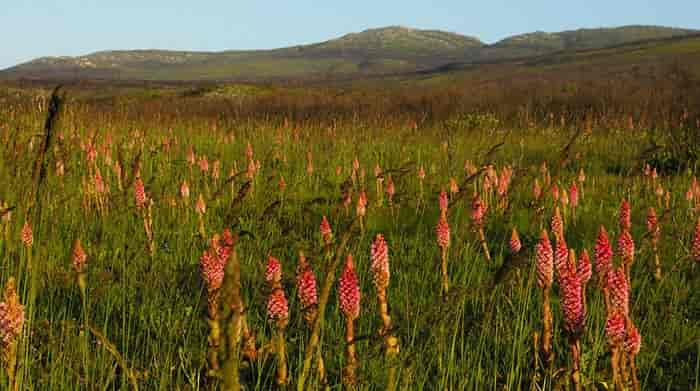
Give it a season, perhaps two, and Grootbos begins to behave like a stage after a curtain call, suddenly busy again, only brighter. Much brighter.
Dormant seeds, some lying low for decades, take their cue. Fire lilies arrive first, unapologetically vivid. Orchids follow delicate, almost improbable. Iris sweeps in with colour, while proteas and ericas rebuild the landscape’s structure with steady determination.
It’s not a gentle return. It’s a full-blown superbloom.
And crucially, it doesn’t happen often. This kind of floral resurgence turns up roughly once every twenty years, which in travel terms places it firmly in the “don’t leave it too late” category.
Within this relatively small patch, barely 0.3% of the continent, you’re looking at close to a fifth of Africa’s plant biodiversity. More than 1,030 species have been recorded here. Some, discovered only recently, reveal themselves exclusively after fire has done its work.
In other words, if you weren’t here before, you missed them. And if you don’t arrive soon, you may miss them again.
Luxury, With Dirt Under Its Fingernails
Grootbos has long walked a careful line between polish and authenticity, and to its credit, it hasn’t slipped.
Yes, the lodges are refined. Yes, the views stretch lazily across Walker Bay. But the experience doesn’t hide the land, it leans into it.
Guides here don’t recite; they interpret. A 4×4 botanical drive might detour mid-track because something unexpected has pushed through the soil overnight. Forest walks slow to a near halt when a new species is spotted. Coastal rides remind you, quietly, that this isn’t just a floral story, it’s a marine one too.
Even the softer edges of herbal teas, honey tastings, the kitchen’s reliance on indigenous ingredients feel less like curated theatre and more like common sense. This is a place that understands its surroundings and, importantly, doesn’t overstate them.
Art That Actually Means Something
There’s also a refreshing lack of gimmickry in conservation messaging.
The Grootbos Florilegium, Africa’s first botanical art gallery of its kind, could have easily slipped into decorative indulgence. Instead, it serves a purpose.
Its 250 botanical works aren’t simply pretty. They document species, some rare, some endangered, all significant. More importantly, proceeds go straight back into conservation and education via the Grootbos Foundation.
It’s the sort of loop the industry talks about endlessly and rarely executes this cleanly.
Timing Is Everything, Always Has Been
Travel, at its best, rewards those who pay attention to timing. Not trends. Not hashtags. Timing.
And right now, Grootbos is entering a window that doesn’t stay open for long.
Over the next couple of years, this landscape will continue to evolve layer by layer, bloom by bloom, before settling back into its quieter rhythm. The spectacle will soften. The rarities will retreat. The cycle will reset again, as it always has.
So yes, you can visit anytime. But you won’t see this anytime.
For those inclined to witness nature doing what it has always done without apology and without compromise, this is the moment.
Reservations: [email protected]
Phone: +27 (0)28 384 8053
Website: https://www.grootbos.com.
by Octavia Koo – (c) 2026.
Read Time: 5 minutes.
About the Author.
 Octavia Koo arrived in Australia in the early eighties with little fuss and a good eye. Sydney suited her. At UNSW, she studied Arts, then found her footing in graphic design before drifting, quite naturally, into the digital side of things, building websites and shaping words that made people want to stay.
Singapore followed, and with it, the fast pace of tourism platforms and ITB Asia. Long before SEO became a buzzword, Octavia understood how stories travelled online. That’s where she met Stephen, and the seed for something more was planted.
A few years later, she joined Global Travel Media.
Today, Octavia works with quiet assurance, blending art, instinct and experience to produce stories that don’t shout; they simply work and linger.











