

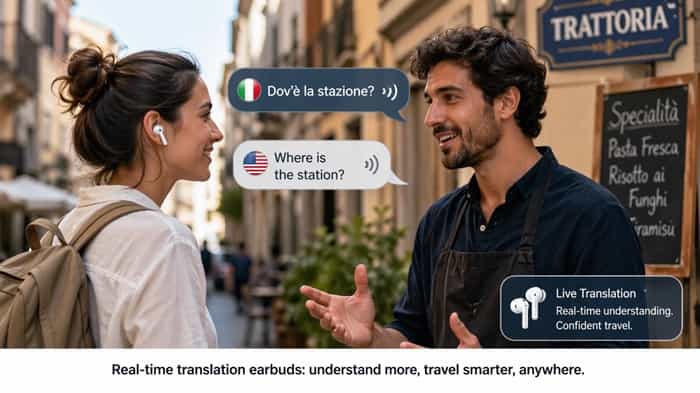
If ever there were a moment when technology felt less like a gimmick and more like a seasoned travel companion, this is it.
The humble language barrier, once responsible for countless awkward exchanges, missed trains, and wildly misordered meals, is quietly being dismantled by live translation earbuds. Not in theory, not in some far-off future, but right now, in the ears of travellers who’d rather understand than guess.
According to the latest Winter 2026 Traveller Sentiment and Safety Survey from Global Rescue, travellers are not just aware of the technology, they’re warming to it with the sort of enthusiasm usually reserved for upgrades and aisle seats.
A convincing 86% of respondents say they’re familiar with live translation earbuds, powered by the likes of Google and Apple. That’s not curiosity, it’s mainstream recognition. Only 14% remain unfamiliar, which, in travel-tech terms, is practically a rounding error.
But here’s where it gets interesting. The appetite isn’t evenly spread.
Men appear slightly more ready to embrace the technology, while women, ever the more discerning travellers, show a broader spread between enthusiasm and hesitation. It’s not resistance; it’s selectivity. Meanwhile, travellers outside the United States are edging ahead in both awareness and intent, suggesting the global market is already leaning in.
And frankly, it makes sense.
Anyone who has stood in a foreign city trying to decipher a rapid-fire set of directions knows the stakes. This isn’t about ordering coffee in perfect Italian; it’s about understanding warnings, instructions, and the small but crucial nuances that keep a journey running smoothly.
That’s precisely the point made by Dan Richards, CEO of Global Rescue, who cuts through the noise with a clarity the industry sometimes lacks.
“When travellers understand the tools available to them, they travel with more confidence and independence,” he said. “Live translation technology removes a major barrier for international travellers and has the potential to significantly enhance both safety and experience abroad.”
It’s not hyperbole, it’s practical reality.
The survey shows 67% of travellers already view the earbuds as valuable, with nearly a third rating them as very valuable. Only 7% dismiss them outright, which, given the natural scepticism that greets any new gadget, is remarkably low.
There’s also a quiet shift in how travellers are thinking. This isn’t just about convenience anymore; it’s about control.
Being able to understand a train announcement, a hotel explanation, or a local warning in real time removes the uncertainty that has long defined international travel for many. It replaces guesswork with confidence, and confidence, in this business, is everything.
Adoption intent tells a similar story. A solid 78% of travellers say they would use live translation earbuds if the technology were readily available on their smartphones. Nearly four in ten are not just open to the idea, they’re eager.
Men lead slightly, with 80% indicating they’re likely to use the technology, while 70% of women say the same. Again, it’s not reluctance from female travellers so much as a more measured approach, hardly a surprise in an industry where experience tends to sharpen judgement.
Non-US travellers, however, are the clear frontrunners, with 83% signalling intent to adopt. In a global travel economy, that’s the sort of number that tends to get manufacturers and service providers paying very close attention.
Richards adds another layer, and it’s one the industry would do well to remember:
“Technology that improves communication can also reduce risk. Being able to understand directions, warnings or instructions in real time can help travellers avoid misunderstandings that escalate into safety issues.”
There it is again, safety.
It’s easy to be dazzled by the novelty of real-time translation, but the real value lies in what it prevents. Miscommunication has always been one of travel’s quiet hazards. Remove it, and the entire journey becomes smoother, safer, and far more enjoyable.
From an industry standpoint, the implications are substantial. Airlines, hotels and tour operators have spent decades trying to bridge language gaps with multilingual staff and translated materials. Now, the traveller arrives equipped, independent, informed, and far less reliant.
It doesn’t replace human interaction, far from it. If anything, it enhances it. Conversations become easier, connections more genuine, and the experience richer.
And for those who still prefer to lean on a phrasebook and a hopeful smile? Well, there’s no rule against tradition. But it’s becoming increasingly clear that the modern traveller is packing something else alongside their passport.
Something small. Something clever. And, finally, something that listens as well as it speaks.
For more information, visit Global Rescue.












