

Airlines are using the Iran conflict as cover to hike award ticket fees—and customers are letting them get away with it. Here’s what should be happening instead.
Airlines sure have a funny way of saying thank you.
After you spend years obsessively funnelling every purchase through their co-branded credit cards and sitting in its cramped economy class seats, you finally go to redeem your “free” flight—only to find a $1,400 bill waiting for you at checkout.
Since the recent conflict in the Middle East began, it’s only gotten worse. Airlines are using the chaos as a smokescreen to hike their amorphous carrier-imposed fees.
British Airways just raised surcharges on economy tickets from the U.S. to London by 50 percent. A business class award now carries a one-way surcharge of up to $800—a 36 percent jump in a single week.
Not to be outdone, the Lufthansa Group has pushed its business class surcharges to North America as high as $1,400 round-trip. Air France-KLM also joined the frenzy, raising its award fees by up to 40 percent without a word of warning to its members.
You’re welcome.
How did this happen?
The airline industry loves to complain about oil. Whenever prices spike, it’s a convenient excuse to jack up fees. Now the geniuses running these airlines think you’ll happily pay twice for a ticket: once with your loyalty, and again with cash.
But here’s the secret: Many of these airlines aren’t even paying the market price for fuel.
Major international carriers engage in hedging, a practice that uses complex financial tools to lock in fuel prices months or years in advance. The Lufthansa Group is reportedly 77 percent hedged for all of 2026. British Airways’ parent company, IAG, has similarly locked in its costs.
U.S. carriers hedge their fuel purchases, too. For example, Delta Air Lines is expecting a $300 million benefit in the latest quarter from a wholly owned subsidiary, Monroe Energy, which operates a refinery in Pennsylvania to hedge against volatile jet fuel costs.
When fuel prices jump on the evening news, these airlines aren’t necessarily paying more for their jet fuel. Yet they still ask you to pay a fuel surcharge based on a price hike they aren’t passing on.
And when fuel prices drop? The fuel surcharges remain and get rebranded as “carrier-imposed fees.”
| Airline | Former Fee (Round-trip) | New Fee (Round-trip) | Percent Change |
| British Airways | $584 | $800 | +36% |
| Lufthansa Group | $500 | $700 | +40% |
| Air France-KLM | $500 | $700 | +40% |
| JetBlue (Partner awards) | $0 | $265 | New Fee |
The great loyalty default
It’s time to stop calling these programs rewards. They are really just an unsecured, high-interest loan you’ve given the airline.
Think about it. You offer your business and your data up front. In exchange, the airline gives you a promissory note in the form of miles.
Now that you’re trying to collect, the airline is effectively defaulting on that loan. By collecting a surcharge, it is telling you that its own currency is worthless and that you have to pay for your ticket again.
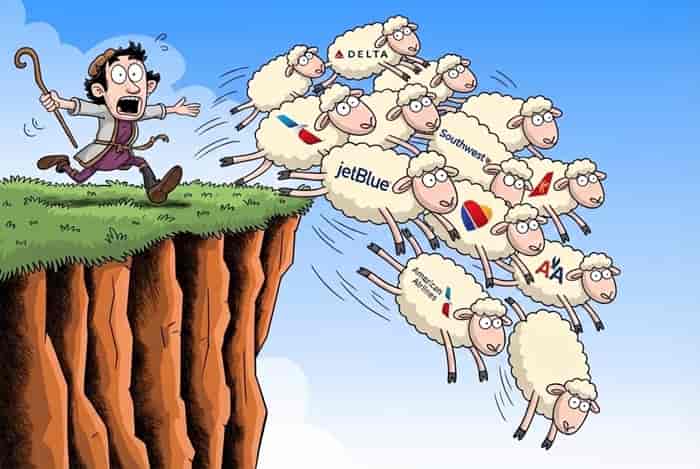
And the worst part is that we’re letting it happen. Like lemmings in a nature documentary, travellers are being pushed into a frenzy of mile-collecting by relentless ads, in-flight come-ons, and sweet nothings whispered by loyalty-program fan blogs. People are so afraid of losing their status that they mindlessly follow the herd of other point collectors. They’ve become addicts who pay for the privilege of being ignored—and overcharged.
How to fight back
We need a government policy that requires honesty in advertising. If an airline offers you an award ticket, it shouldn’t be allowed to tack on hundreds of dollars in arbitrary fees.
But until the Department of Transportation steps in, you have to vote with your wallet.
My radical proposal: Stop being the bank. Shred the co-branded credit cards and stop chasing status that costs more than it saves. Treat every flight as a commodity, not a relationship. If you use a credit card, get one that gives you straight cash back—a currency the airline can’t devalue with the stroke of a pen.
The airline industry is betting that you’re too addicted to your gold status to notice you’re being fleeced. Prove it wrong. In a world where a “free” ticket costs $1,400, maybe the best way to win the loyalty game is not to play at all.
Research citations
-
Air Traveller Club. (2026, April 10). Jet Fuel Prices Double: Airlines Implement $800 Surcharges on Award Tickets. Retrieved from https://www.airtraveler.club/news/jet-fuel-prices-double-800-surcharge-tickets/
-
National Today. (2026, April 12). JetBlue Adds Surcharges for United Award Travel under “Blue Sky” Partnership. Retrieved from https://nationaltoday.com/us/nj/newark/news/2026/04/12/jetblue-adds-surcharges-for-united-award-travel/
-
Thrifty Traveller. (2026, March 28). Flying Blue Raises Fees on Award Tickets Without Warning. Retrieved from https://thriftytraveler.com/news/points/flying-blue-raises-fees-on-award-tickets/
-
Travel-Dealz. (2026, April 05). Lufthansa Group Fuel Surcharges Reach Record Highs for 2026. Retrieved from https://travel-dealz.com/news/lufthansa-group-fuel-surcharges/
By Christopher Elliott – (c) 2026.
Read Time: 7 minutes.
About the Author.
 Christopher Elliott is an author, consumer advocate, and journalist. He founded Elliott Advocacy, a nonprofit organization that helps solve consumer problems.
He publishes Elliott Confidential, a travel newsletter, and the Elliott Report, a news site about customer service.
If you need help with a consumer problem, you can reach him here or email him at [email protected].











