There was a time not so long ago when the defining sound of Macau was the shuffle of cards and the polite clatter of chips. These days, it’s more likely to be the quiet hum of servers and the occasional whirr of a service robot delivering a drink with unnerving precision.
That shift will be on full display when G2E Asia and the Asian IR Expo return to The Venetian Macao from May 12–14, 2026. The twin events, long regarded as the region’s principal marketplace for gaming and integrated resort operators, are expected to draw more than 8,000 delegates from over 90 countries.
The headline this year is not scale. Its direction.
From Tables to Technology
After 17 years, G2E Asia has seen its fair share of industry cycles, booms, corrections, and regulatory resets. What it hasn’t seen before, at least not at this pace, is a wholesale pivot towards digital infrastructure.
This year’s themes, AI, robotics, and entertainment technology, are less about novelty and more about necessity.
As Yip Je Choong, Senior Vice President at RX (Reed Exhibitions), noted:
“This year’s joint events spotlight the innovative strategies and technologies driving this evolution.”
That word evolution does a fair bit of heavy lifting. What operators are really grappling with is transformation at speed: how to modernise legacy systems, meet shifting customer expectations, and still turn a profit.
An Industry Rewiring Itself
Walk the floor this year, and the change is hard to miss. The exhibition, spanning more than 30,000 square metres, brings together around 150 brands, many of them less concerned with roulette wheels than with data pipelines.
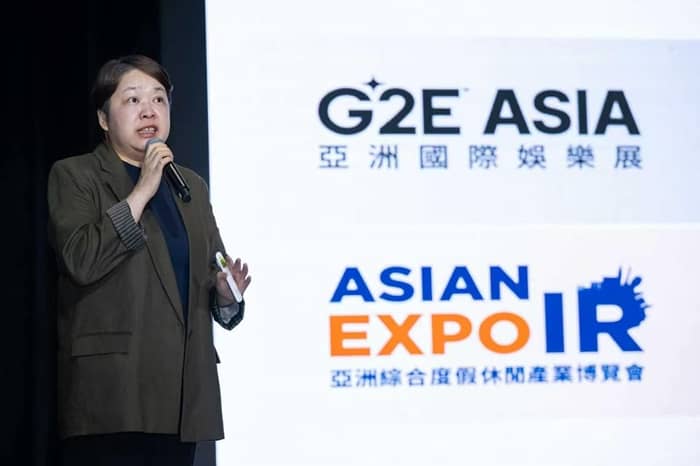
Vera Ng
New features tell the story:
- A Display for Gaming Zone, focused on digital interfaces and analytics
- A Gaming Entertainment Zone, blending content, engagement and technology
- An expanded Technology Zone, complete with back-to-back “Tech Talk” sessions
Then there’s the more theatrical end of things: robots serving coffee, automated cocktail stations, and AI-driven networking tools pairing delegates with algorithmic efficiency.
It’s clever, certainly. Whether it’s essential is another question, but one the market appears to have already answered.
Macau as Test Case
The choice of Macau as host is more than logistical convenience. It is, in many respects, the industry’s most visible case study.
For years, the city has been working to reposition itself as less dependent on pure gaming revenue and more focused on diversified entertainment and tourism. Technology has become the bridge between those ambitions and reality.
Operators here are under pressure to deliver more with less: richer experiences, tighter compliance, better data visibility. That makes Macau an ideal proving ground for the sort of solutions on display this May.
It also explains why heavyweights from Morgan Stanley and Amazon Web Services will be contributing to the conversation. This isn’t theoretical, it’s operational.
The Conference: Where the Real Work Happens
If the exhibition floor is about demonstration, the conference programme is about dissection.
Across three days, sessions will tackle the issues that matter often in refreshingly practical terms.
Expect discussions around:
- AI in gaming operations, particularly around personalisation and forecasting
- Casino floor optimisation is still the bread-and-butter of revenue strategy
- Blockchain integration, moving from pilot to production
- Financial crime prevention, where technology and regulation intersect
One thread runs consistently through the agenda: the need to balance innovation with responsibility.
A Shift Towards Responsible Technology
The inclusion of the Global Gaming AI Governance and Sustainable Development Summit is telling. A few years ago, such a session might have been tucked away as an afterthought. Now it sits front and centre.
The industry is confronting a simple reality: more powerful tools bring more complex risks.
Discussions will range from global AI governance frameworks to the practicalities of responsible gaming. Notably, there’s a case study examining how AI is being used in China’s lottery systems to identify and mitigate risky behaviour before it escalates.
It marks a subtle but important shift from reactive compliance to proactive management.
Hospitality Joins the Digital Push
Over at the Asian IR Summit, the focus widens beyond gaming floors to the broader integrated resort ecosystem.
Here, AI is not just about efficiency; it’s about experience.
Sessions will explore:
- How AI is reshaping guest personalisation
- Ways to enhance the customer journey using data-driven insights
- The rise of immersive entertainment, where digital and physical overlap
There is also a notable emphasis on sport and entertainment as drivers of growth. Panels examining partnerships, tourism conversion, and data-led destination planning suggest operators are thinking well beyond the casino.
In other words, the resort of the future looks less like a gaming hall and more like a multi-purpose entertainment precinct.
The People Behind the Strategy
No shortage of senior voices will take the stage.
Executives from major resort operators, analysts from Citi Research, and technology leaders from across the region will offer perspectives grounded in day-to-day realities.
These are not abstract discussions. They are shaped by balance sheets, regulatory frameworks, and, increasingly, data models.
Which makes them worth listening to.
Networking, Minus the Guesswork
Even the social side of the event has been re-engineered.
AI-powered matchmaking tools promise to take some of the randomness out of networking, connecting delegates based on shared interests and commercial alignment.
It’s efficient, no doubt. Whether it replaces the value of a well-timed conversation over a drink remains to be seen.
Still, in an industry that prizes relationships, anything that sharpens the odds tends to get attention.
Timing Is Everything
The return of G2E Asia comes at a moment of recalibration.
The sector is still adjusting to post-pandemic realities, evolving regulations, and a customer base that expects faster, smoother, and increasingly personalised.
At the same time, the technology available to meet those expectations has matured rapidly.
That creates a familiar tension: invest now, or risk falling behind.
Events like this do not resolve that tension, but they do make it visible.
The Commercial Bottom Line
For all the discussion of innovation, the fundamentals remain unchanged.
Operators are focused on:
- Increasing yield per visitor
- Improving retention
- Managing cost structures
Technology offers tools to address all three. The challenge lies in implementation, choosing the right systems, integrating them effectively, and ensuring they deliver measurable returns.
It’s less about chasing trends and more about making disciplined decisions.
Registration and Access
Industry professionals can still register, with early bird conference passes available until April 15, 2026. Exhibition-only access remains free until May 11.
Further details can be found via:
-
G2E Asia – www.G2EAsia.com
-
Asian IR Expo – www.AsianIRExpo.com
The Takeaway
If there’s a single thread running through this year’s event, it is this: the industry is no longer experimenting with digital transformation; it is committing to it.
Macau, once defined by its tables, is now positioning itself as a laboratory for what comes next.
And while the chips are still very much in play, the real game is increasingly being decided elsewhere quietly, efficiently, and in lines of code.