

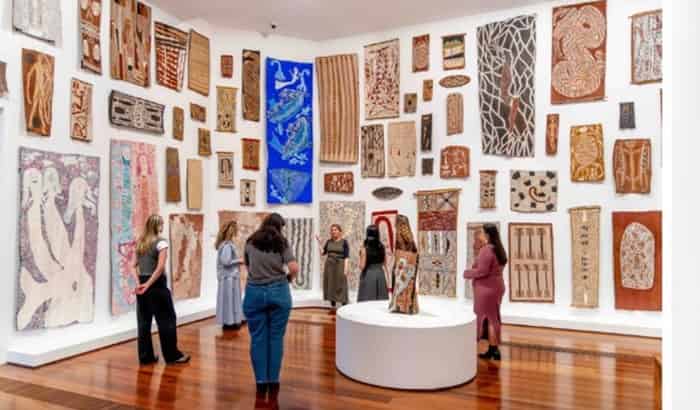
There’s a particular kind of silence in galleries. Not the reverent hush you expect, but the slightly uncertain pause of people wondering what they’re meant to be looking at and why.
Melbourne’s National Gallery of Victoria has decided to do something rather sensible about that.
In partnership with Cultural Attractions of Australia, the NGV has introduced two private tours that replace guesswork with storytelling and, in doing so, quietly restore the point of the whole exercise.
Because art, for all its polish and pedigree, was never meant to be confusing.
Where the story starts long before the frame
The Best of NGV Australia tour doesn’t begin with paintings. It begins with people.
Led by one of the gallery’s storyteller-guides, a title that feels refreshingly honest, the experience moves through the Ian Potter Centre with the sort of clarity that makes you wonder why all galleries don’t operate this way.
Here, First Nations works are not treated as artefacts to be admired at arm’s length. They are explained, unpacked, and crucially connected back to the country that produced them.
Bark paintings, for instance, are no longer just intricate surfaces. They become technical achievements, cultural records and, occasionally, acts of quiet defiance. You don’t just look at them, you begin to understand why they exist.
And then there are the surprises.
A hidden work by Ralph Balson, discovered behind a portrait by his contemporary George Crowley, is the sort of detail that reminds you that galleries are not static places. They evolve. They reveal. Sometimes, they even keep secrets.
It’s the difference between seeing a collection and being let in on it.
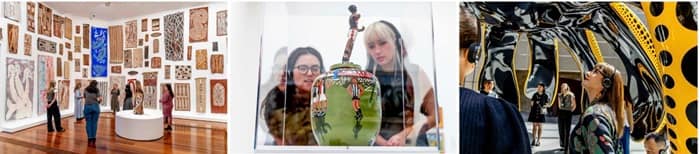
Cultural Attractions of Australia’s Best of NGV Australia (1 & 2) and Best of NGV International (3)
A brisk, brilliant trip around the world
If the Australian tour grounds you, Best of NGV International sends you travelling.
Not in the hurried, checklist fashion that tends to plague large institutions, but with purpose. One hour. A handful of works. Enough context to make each one land properly.
There’s Giambattista Tiepolo’s The Banquet of Cleopatra, which is as grand as its title suggests and just as theatrical. It’s the sort of painting that rewards a second look, particularly when someone is there to explain how and why it was constructed.
A Delft vase, at first glance decorative, becomes something more interesting: evidence of centuries-old trade routes and cultural exchange between East and West.
And then, just as you settle into historical reflection, along comes Yayoi Kusama’s Dancing Pumpkin, bold, immersive, and cheerfully indifferent to convention. You don’t so much view it as step into it.
Which, in a way, is the point.
No expertise required, just curiosity
What’s refreshing here is the absence of pretension.
These tours are not pitched at academics or insiders. They are designed for anyone willing to ask the most useful question in a gallery: “What am I actually looking at?”
Groups are capped between 10 and 20, small enough to hear, large enough to feel like an occasion. At $40 per person, it’s also priced sensibly, which in the current climate is almost a novelty in itself.
Weekday availability between 10 am and 5 pm makes it an easy fit for corporate groups, visiting clients or anyone keen to swap a standard meeting for something with a bit more substance.
Bookings, sensibly, require two weeks’ notice. Good things, as ever, are rarely last-minute.
Part of a bigger cultural play
This isn’t happening in isolation.
Cultural Attractions of Australia, part of Tourism Australia’s Signature Experiences programme, has been steadily stitching together the country’s most compelling institutions into something resembling a national narrative.
From the Sydney Opera House to the Australian War Memorial, the idea is simple: present Australia not just as a place to visit, but as a place to understand.
The NGV’s new tours fit neatly into that ambition. They don’t shout for attention. They earn it.
Booking information
For those inclined to approach art with a little more context and considerably less confusion, bookings are available via:
- Best of NGV Australia: https://culturalattractionsofaustralia.com/experiences/best-of-ngv-australia/
- Best of NGV International: https://culturalattractionsofaustralia.com/experiences/best-of-ngv-international/
The takeaway
There’s an old newsroom rule: if you can’t explain something simply, you probably don’t understand it well enough.
These tours take that principle and apply it to art.
No fuss. No jargon. Just good stories, well told.
And, in the end, that’s what people remember.
by Alison Jenkins – (c) 2026.
Read Time: 3 minutes.
About the Author.
 Alison Jenkins has lived most of her working life in the slipstream of aviation, where timetables matter, and people matter more. In airline sales, she built a reputation the old-fashioned way: by knowing her clients, her routes, and never missing the human detail.
Quick with a smile, quicker with a solution, she made deals with warmth and kept her edge intact.
Trade shows, FAMILS, airport lounges and hotel lobbies became her second address. And somewhere along the way, notebook in hand, she began writing the journeys rather than selling them. Her reports grew lively, observant, full of the small truths only travellers notice.
That was the moment it dawned on her: she wasn’t simply travelling. She belonged in its stories.











