

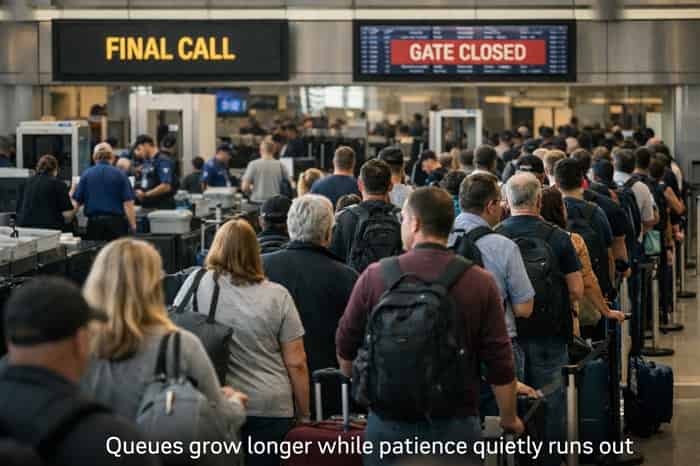
Airports, at their best, are a triumph of choreography. Bags glide, people shuffle, planes depart with reassuring regularity. At their worst, they resemble a waiting room where time has quietly given up.
Right now, across the United States, it’s very much the latter.
The queues are the giveaway. Not the usual peak-hour inconvenience, but long, stubborn lines that barely seem to move, fed by a security system that has lost both pace and patience. For many travellers, the outcome is painfully simple: they arrive on time, do everything asked of them… and still miss the flight.
No drama. Just a gate closing somewhere in the middle distance.
The Trouble With Thin Ranks
At the centre of the slowdown is the Transportation Security Administration, where staffing has slipped to levels that would make even a seasoned operations manager wince.
More than 480 officers have departed during the current disruption, while roughly 50,000 remain on the job without pay. Unsurprisingly, attendance has taken a hit. National absenteeism has climbed beyond 10%, and at major hubs it has reportedly reached 30-50%.
Put plainly: when half your roster doesn’t turn up, the line doesn’t move.
And when the line doesn’t move, neither do the passengers.
When a Missed Flight Becomes a Financial One
This is where things become rather more interesting and considerably more expensive.
According to Chargebacks911, the industry is already seeing early signs of a familiar pattern: disruption first, followed by disputes shortly after.
“Every major travel disruption event has been followed by a spike in payment disputes,” said Monica Eaton.
“We’ve seen this pattern before… When passengers miss flights through no fault of their own and there is no clear path to resolution, they look for the quickest and easiest route to recover their money.”
And here’s the part worth noting: that route is rarely the airline’s.
It’s the bank.
The Awkward Question of Responsibility
There’s a quiet stalemate sitting underneath all this.
Airlines will tell you correctly that security screening isn’t their responsibility. Passengers will also tell you correctly that they paid for a service they didn’t receive. Travel insurers, depending on the fine print, may or may not step in.
Which leaves a rather uncomfortable gap.
And gaps, in this business, tend to be filled quickly.
“Liability ambiguity is one of the biggest drivers of illegitimate chargebacks,” Eaton noted. “When consumers do not know who is responsible, they often bypass formal claims processes.”
Translation: they go straight to their bank and let someone else argue about it.
Volume Changes Everything
Timing, as ever, is doing nobody any favours.
Airlines for America expects around 171 million passengers to travel between March and April, about 2.8 million people a day.
At that scale, even a small percentage of missed flights becomes significant. Not catastrophic, perhaps, but certainly enough to keep finance departments awake at night.
Because chargebacks don’t arrive one at a time. They arrive in clusters.
Not an Isolated Problem
If this were neatly contained within the United States, the industry might manage it with a shrug and a spreadsheet.
But disruption, like bad weather, has a habit of travelling.
Europe continues to wrestle with air traffic control strikes. Parts of the Middle East remain operationally complicated. Networks everywhere are still settling into something resembling normal.
Even the UK Foreign Office has felt obliged to caution travellers about delays at US airports, which is usually a polite way of saying, “pack your patience.”
For global travel businesses, these issues don’t line up neatly. They overlap, amplify, and occasionally collide.
A Window That Closes Quickly
The advice from Chargebacks911 is not complicated, but it is urgent.
Act early.
Review refund policies. Be clear, painfully clear if necessary. Speak to customers before they feel the need to escalate. And keep records, because in a dispute, memory is rarely enough.
“The window to get ahead of this is short,” Eaton said. “Dispute volumes don’t spike immediately… they build over days and weeks.”
It’s a slow burn, not a sudden explosion. Which makes it easier to miss and harder to contain.
The Quiet After the Queue
For now, the story is still being told in queues: long, restless, and unmistakably human.
But the real impact will be felt later, in systems and statements, as transactions are challenged and revenue quietly slips away.
Air travel has weathered bigger crises. It always does.
But this one has a certain irony to it.
No storm. No headline-grabbing catastrophe.
Just not enough people to keep things moving.
And in aviation, that’s often all it takes.
by Sandra Jones – (c) 2026.
Read Time: 4 minutes.
About the Author.
 Sandra has spent a working lifetime quietly rescuing journeys, one itinerary, one anxious caller, one impossible connection at a time. Years in Australia’s finest travel agencies taught her the art of calm, how to find a flight in a fog of cancellations, how to soothe a traveller when luggage wanders, how to turn nine frantic days in Europe into something resembling sense. Qualified, seasoned, endlessly patient, she learned that good travel advice is part logistics, part listening.
But the storyteller in her was always waiting its turn. Writing offered a new map, a way to turn experience into reflection, detail into delight. At Global Travel Media, Sandra now writes the truths only insiders know: the mishaps, the laughter, the grace found between gates and goodbyes. She reminds us that travel, for all its fuss, is still one of life’s better ideas.











