

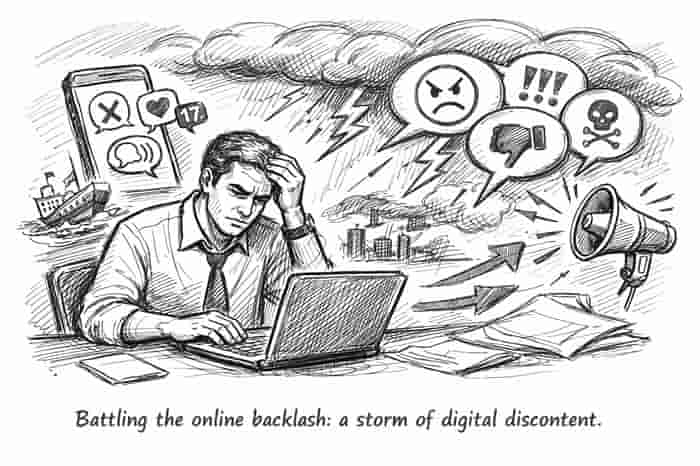
Comments on social media count and can accumulate.
The democratisation of online communication is typically disempowering for businesses, particularly for those that don’t closely monitor their texts. Power to consumers and communicators.
Corporate leaders can and do rapidly lose control. Online narratives are difficult to influence or dominate and are time- and resource-intensive to do so.
When unattended and unanswered, these missives have profound, immediate, widespread, and ongoing consequences.
Businesses cannot afford to be passive or disengaged in response to online comments about the company, the brand, the products, services, applications, people, prices, value, and service.
Monitoring and effecting real-time responses need to be measured, objective, authoritative, usually decisive and as a “rule of thumb”, the communications should be taken offline and be personal, confidential, private and respectful.
Privacy and confidentiality are valued attributes in all relationships.
The absence of, and deficiencies in, documented communication strategies are usually very apparent. The lack of a dedicated company communications executive (specialist) and repeated use of collective nouns like “the customer service team”, “management”, “the company” and “the committee” result in jarring, impersonal, process-focused interactions that are devoid of personal undertakings. Declared accountability is lost. So too are expectations of resolutions.
STRATEGIES, TACTICS AND PROCESSES
Well-considered and documented communication strategies instil a strong measure of discipline in engagements and exchanges.
Salutations need to be personal and personable. Therefore, in most instances, “Hi”, “Your” and “G’day” are inappropriate. Indeed, they can be confronting, affronting and offensive – compounding what is likely to be a vexed circumstance.
Immediate and unqualified expressions of sorrow, guilt, fault, and admission are often ill-advised and inappropriate, and may carry negative connotations and implications.
It is well to remember that in matters of customer service, delivery, and performance, the seeming issue at hand is often not the real issue.
Causes of consumer expressions of disappointment, anger and frustration can be, and often are, the straw that broke the camel’s back, in a series of misadventures on a bad day for the customer, client or complainant. Attention needs to be limited to the real, valid factors.
Ask questions in the first instance. The answers will enable causes to be identified, analysed, addressed and ultimately resolved. In short, initially presume, concede or admit to nothing. Establish the facts. It is fair, reasonable, equitable and important to do so.
In actual or potential conflict resolutions, it is fundamental to ensure outcomes are mutually satisfying and fulfilling.
Complaints, grievances and public comments, together with responses, must be authentic, credible, justifiable and substantiated.
CAREFUL LANGUAGE
In addressing accusations – often unsubstantiated or unjustified – care must be taken to avoid immediately assuming a defensive stance.
Some allegations are simply “come-ons”, in which the accusers are trying to gain financial or material advantage. Such claims are baseless; others can be morally and legally unconscionable. However, each must be accorded due respect, care and attention.
Adhering to doing what is right is non-negotiable. Stay focused, be objective, considered and balanced.
OUTLINE THE DETAILS
Many complainants expect immediate and full resolution or restitution. That is a function of the prevailing NOW culture, in which instant gratification is expected, demanded, and utilised as a baseline.
Explanations on and about the many and varied aspects that need to be addressed by the company develop awareness and appreciation of just how much is involved in addressing and redressing points of dispute, despair and dissatisfaction.
Better understanding and tolerance are developed regarding how much time and resources are required to achieve the desired and positive outcomes.
Most importantly, there is a need to manage expectations, with due consideration to time phases and conclusion dates. Care must be taken to avoid the use of meaningless and obtuse terms like “as soon as possible”. Remember, what gets measured gets done and is valued.
REVERT TO LAW
Persistent, insistent, and unreasonable communications from some complainants may necessitate engaging legal practitioners to protect the image, reputation, and standing of the company, its people, products, and services.
This will often be a last resort and should be effected expeditiously, with grace and exhibiting evidence of one’s wish to resolve outstanding issues, within the law, business conventions and standards, and with reasonable understanding.
In such cases, negotiated settlements should be concluded (initially) between the complainant and the nominated legal practitioner.
ACTION POINTS
- Nominate or recruit an experienced, qualified, trained and authorised social media executive.
- Formulate, document and implement a structured, disciplined communication strategy – specific to social media.
- Effect a comprehensive, intensive monitoring process of all relevant social media communications pertinent to the company.
- Install a response procedure that generates online, real-time responses to encourage, invite, and direct personal contact with the social media executive.
- Ensure the qualification, elaboration, and justification of all complaints, comments, and issues.
- Encourage positive, personal, two-way communication to reach consensus on matters to be addressed, actions to be taken, and outcomes to be achieved.
- Identify contributing team members for actions to be taken.
- Nominate projected timing benchmarks.
- Provide progress reports on resolution activities.
- Deliver the promise.
- Encourage follow-up, endorsing online communications.
- Within 72 hours, communicate gratitude, express thank you and celebrate success.
Barry Urquhart
Business Strategist
Marketing Focus
M: 041 983 5555
E: [email protected]
W: www.marketingfocus.net.au
COMMENTARY: CLARITY – IS THAT CLEAR?
Laser focus is important. So too clarity. A sharp focus on outcomes benefits all. Before, during and after the endeavour.
CRYSTALLISE. CONSOLIDATE. COORDINATE. CLARIFY. LIKE. SHARE
by Barry Urquhart – (c) 2026.
Read Time: 4 minutes.
About the Author.
 Barry Urquhart is a highly regarded market research and strategic planning consultant, recognised throughout Australasia for his insight, clarity, and thought leadership. A seasoned keynote speaker at premier conferences, Barry is also the acclaimed author of Serves You Right! And Service Please!, two of the region’s top-selling titles on customer service excellence.
Respected as a trusted voice in business strategy, Barry continues to lead influential workshops and development programs that help organisations drive sustainable growth, elevate service culture, and achieve competitive distinction.
For Media Enquiries or Speaking Engagements:
Email: [email protected]
Mobile: +61 041 983 5555











