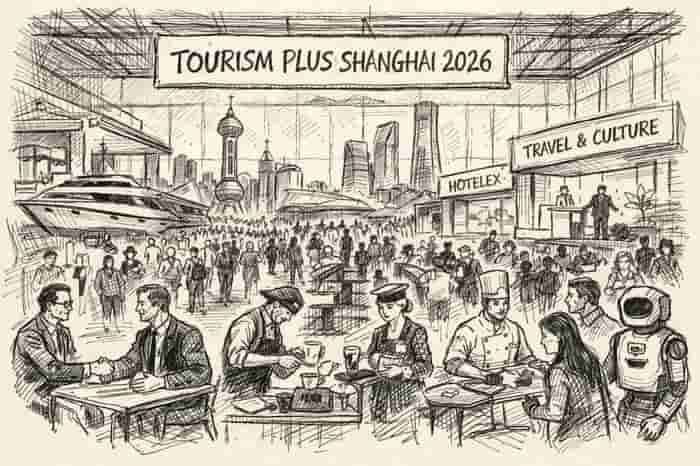
There are trade shows, and then there are statements of intent.
Tourism Plus Shanghai 2026 fell squarely into the latter category, a sprawling, unapologetically ambitious gathering that didn’t just reopen the doors to global tourism dialogue; it practically threw them off their hinges.
By the time the final visitors drifted out on April 3, the numbers told their own story: nearly 450,000 attendees from 189 countries and regions, a floor space that would test even the most seasoned exhibition veteran’s stamina, and, perhaps most telling of all, a sharp rise in international participation. Overseas attendance jumped by close to 50 per cent. That’s not a rebound. That’s a surge.
Spread across the Shanghai World Expo Exhibition & Convention Centre, the National Exhibition and Convention Centre, and the Shanghai New International Expo Centre, the event clocked in at a formidable 700,000 square metres. It wasn’t so much an exhibition as a small, functioning ecosystem complete with its own rhythms, language, and, at times, mild chaos.
And that, in fairness, is exactly what the modern tourism industry looks like.
The World Shows Up Properly
What mattered here wasn’t just foot traffic. It was who was walking through the doors.
Buyers, investors, operators, and technologists, over 800 of them, engaged in formal matchmaking sessions, each one a reminder that behind the glossy displays sits a very real commercial engine. Deals were discussed, partnerships nudged along, and more than a few ambitious ideas likely found their first serious audience.
Shanghai, long comfortable with its role as China’s commercial showpiece, is now making a credible play to become Asia’s tourism investment nerve centre. And judging by the queue at those meeting rooms, the market is listening.
Not Just Travel Everything Around It
If you arrived expecting a neat parade of destinations and hotel brands, you would have been quickly disabused of the notion.
Tourism Plus Shanghai has evolved into something broader and arguably more interesting. It is no longer about where people go, it is about how they live when they get there.
Coffee culture rubbed shoulders with high-end kitchen tech. Boutique hotel design shared space with pet-friendly travel concepts. There were exhibitions devoted to tea, chocolate, architecture, wellness, and even the quietly booming world of self-drive travel.
It may sound like a jumble. It isn’t. It’s a reflection of a truth the industry has finally accepted: travellers don’t compartmentalise their lives, so why should tourism?
A Stage for Skill and a Touch of Theatre
Then there were the competitions.
Twenty-two of them, ranging from barista showdowns to culinary craftsmanship, from housekeeping precision to bartending flair. There was even lure fishing, which, depending on your temperament, is either a sport or a test of patience best left to saints.
Yet these contests served a purpose beyond spectacle. They highlighted the human side of an industry often distracted by technology. Skills matter. Craft matters. And, as it turns out, a perfectly brewed coffee can still draw a crowd in a hall full of robots.
Technology, Without the Hype
Speaking of robots, they were there too quietly going about their business.
Artificial intelligence, large language models, and smart control systems were not presented as distant possibilities but as tools already being folded into daily operations. Hotels are getting smarter, kitchens more automated, and service delivery increasingly seamless.
What was refreshing, however, was the lack of breathless evangelism. The technology was on show, certainly, but it was grounded. Practical. Useful. A means to an end, rather than the end itself.
Conversations Worth Having
Across more than 190 forums, the industry did what it does best: talk.
Over 1,000 speakers tackled everything from tourism investment and hotel design to sustainability, urban planning and the curious intersection of wellness and architecture. There was even discussion of the “metaverse,” though whether travellers will ever swap a real beach for a virtual one remains, mercifully, up for debate.
Still, beneath the jargon and the occasional overreach, there was substance. The conversations reflected an industry taking stock of itself, what it has learned, what it has lost, and where it might sensibly head next.
Shanghai Plays the Long Game
What makes this event particularly effective is its integration with the city itself.
Tourism Plus Shanghai didn’t sit in isolation. It bled into surrounding precincts, linking with food festivals, retail experiences and urban activations. Hotels filled, restaurants buzzed, and the city, for a week at least, felt like a living extension of the exhibition floor.
It is a clever model, and one other cities would do well to study.
The Bigger Picture
Strip away the numbers, the exhibitions and the inevitable industry jargon, and a simpler narrative emerges.
Tourism is rebuilding, but not as it was.
It is broader, more interconnected, and, in many ways, more grounded in everyday life. The lines between travel, lifestyle and commerce have blurred, perhaps permanently. And events like this are where those new boundaries are tested.
See You Next Year
Tourism Plus Shanghai will return from March 28 to April 2, 2027. It will likely be bigger. Almost certainly louder. And, if current momentum holds, even more international.
For now, though, the takeaway is clear.
When nearly half a million people gather to talk travel and do a fair bit of business along the way, you are not looking at recovery.
You are looking at confidence.
And confidence, in this industry, has always been the most valuable currency of all.