

There’s a familiar chill sweeping through Australia’s tourism sector, and it’s not coming from the weather.
Fuel costs are climbing, aircraft are quietly being parked, and the once-reliable caravan of grey nomads has slowed to a crawl. Families, squeezed by rising living costs, are shelving holiday plans altogether. For many small tourism operators, the ledger has been telling a sobering story for months now: fewer bookings, thinner margins, and an uneasy sense that something deeper has shifted.
And it has.
Not just in how people travel, but how they choose.
The Invisible Marketplace Has Arrived
While operators have been watching visitor numbers dip, a quieter revolution has been gathering pace behind the scenes. Today’s traveller, particularly those still willing to spend, is no longer trawling through pages of search results.
They’re asking AI.
Instead of typing keywords into a search engine, they’re opening tools like ChatGPT or Perplexity and posing direct, conversational questions:
“What’s worth doing near Noosa this weekend for two adults, no kids, under $300?”
The answer comes back instantly. A curated list. A handful of recommendations. Sometimes just one or two businesses.
And that’s the entire game.
There’s no page two. No second scroll. No lucky discovery.
You’re either in, or you’re invisible.
The Numbers Tell a Stark Story
The shift isn’t speculative; it’s measurable.
- 42% of travellers used AI tools to plan trips in 2025
- ChatGPT now reaches 900 million weekly users
- Since Google AI Overviews launched in Australia in late 2024, organic click-through rates have dropped by 61% where AI summaries appear
In plain English: the old rules of digital visibility are being rewritten at speed.
And the travellers leading this change, the couples, professionals, and empty nesters with disposable income, are precisely what the market operators need right now.
A Familiar Lesson, Relearned the Hard Way
There’s a certain déjà vu here. During the COVID lockdowns, domestic tourism became the lifeline. Locals rediscovered their own backyard, and operators who adapted quickly survived.
The same opportunity is sitting there again, just wearing a different coat.
Liz Ward, CEO of Tourism Tribe, puts it plainly:
“When travel budgets shrink, operators can’t afford to wait for the family holiday market to come back. The local market is right there, just like during COVID lockdowns. The couples, the weekenders, the people spending on experiences instead of flights. But if AI can’t find you, neither can they”
It’s a sharp reminder that visibility today isn’t about glossy brochures or even search rankings; it’s about being readable, credible, and relevant to machines making decisions on behalf of humans.
Enter the AI Playbook
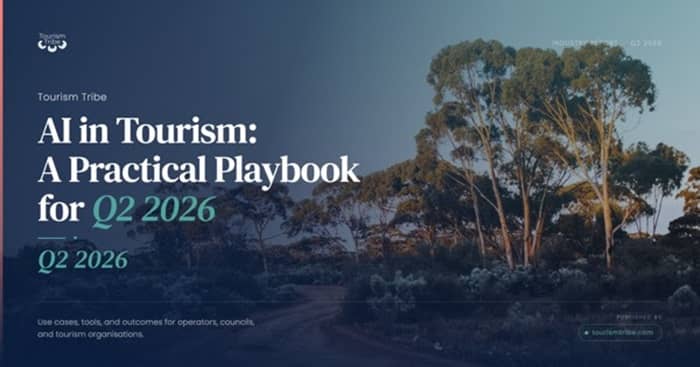
Recognising the urgency, Tourism Tribe has stepped in with a practical solution: the AI in Tourism Playbook.
Free, accessible, and refreshingly grounded, the playbook is designed to help operators reposition themselves in what is rapidly becoming an AI-first marketplace.
Available at tourismtribe.com/ai-playbook, it’s structured across four key audiences:
- Tourism operators
- Regional councils
- Travel sector businesses
- Destination Marketing Organisations (DMOs)
Each section offers tailored strategies, use cases, and immediate actions for Q2 2026, no jargon, no fluff, just practical steps.
And it arrives at a critical moment.
According to Tourism Tribe’s own State of Artificial Intelligence in Tourism 2025 report, 71% of Australian operators have begun experimenting with AI tools, but only 19% feel confident using them.
The appetite is there. The capability, less so.
Local Knowledge Becomes the Trump Card
Here’s where things take an interesting turn.
For years, online travel agencies (OTAs) have dominated digital discovery. Big budgets, slick platforms, and algorithm-driven visibility gave them the upper hand.
But AI is shifting that balance.
AI agents don’t just favour scale, they favour authentic, verifiable, local knowledge.
The best sunset picnic spot is at 4 pm. The walking trail that’s actually open this week. The café locals swear by not the one paying for prominence.
That’s not something a global booking platform can easily replicate.
For the first time in a long while, the advantage tilts back toward the people who know the place best.
Pocket Rocket: A Tool Built for Speed
Complementing the playbook is Pocket Rocket, a free AI-readiness tool available at my.tourismtribe.com.
It’s as straightforward as it sounds.
In under 60 seconds, the tool scans a website across eight key categories, delivers a benchmarked score, and identifies three priority actions. No downloads. No technical gymnastics. Just open it, add it to your home screen, and you’re away.
It’s a neat answer to a question operators have been asking for nearly two decades: “Can I keep you in my pocket?”
Now, quite literally, they can.
Fabienne Wintle, CIO of Tourism Tribe, captures the shift succinctly:
“Your website is no longer a brochure. It is a data source for someone else’s AI assistant. Operators used to compete for attention across 20 browser tabs. Now they compete inside a single AI conversation they never see. The operators who will do well through this aren’t the biggest. They’re the ones who show up where AI is looking. That’s what this playbook is for.”
Built Fast, Built for Now
Notably, both the playbook and Pocket Rocket were developed, funded, designed, and launched entirely in-house, without waiting for external support.
It’s a move that reflects the pace of change itself.
As Ward explains:
“There was no time to wait for government grants or innovation funds, we have had to move very quickly just like the pace of AI technology. Our mission is to support the industry through smart tech and strategy and that involves rapid and agile AI transformation of our own business and tools. We knew that these tools were needed now by the industry and we’re excited to make them freely available.”
There’s something reassuringly old-school about that approach: roll up the sleeves, get on with it, and deliver something useful when it’s needed most.
The Bottom Line
Tourism has always been a resilient industry. It bends, it adapts, and eventually it rebounds.
But this moment feels different.
The downturn is real, yes. But the bigger shift is structural. The way travellers discover, compare, and decide has changed, and it’s not going back.
For operators willing to adapt, there’s an opportunity here. Perhaps even an advantage.
For those who don’t, the risk is simple: not being found at all.
by Prae Lee – (c) 2026.
Read Time: 5 minutes.
About the Author.
 You can tell a great deal about a person by how they meet a Bangkok morning. Prae Lee doesn’t charge into it; she glides, unhurried, as if time itself has agreed to behave. There is a calm assurance about her, the sort earned by knowing both your roots and your destination.
A graduate of Chulalongkorn University, she earned her business degree with quiet pride, then further polished it in Singapore and Australia. Travel didn’t change her. It refined what was already there: curiosity, discipline, grace.
Back in Bangkok, she slipped modern life into the family business, mastering social media with an instinct for listening and selling with Thai gentleness.
Prae never seeks attention, yet everything she touches grows brighter.
Now with Global Travel Media, she writes with authenticity, drawing on culture, travel and a rare, steady confidence.











