

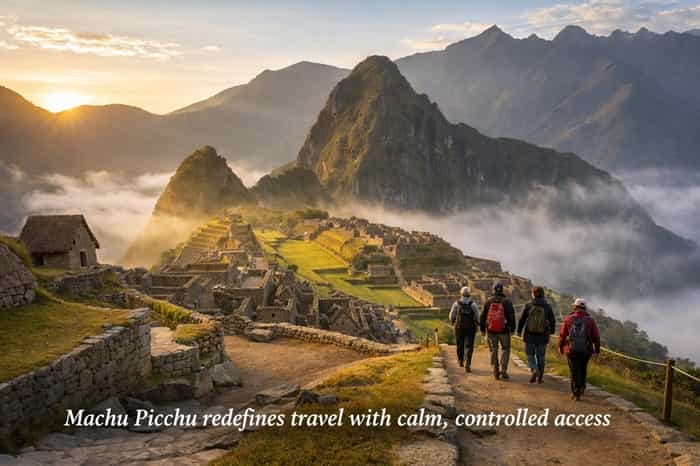
There are moments in travel when a destination pauses, takes a breath, and decides it would rather endure than simply expand. Peru has just had one of those moments.
With the approval of the Machu Picchu Master Plan to 2031, the Peruvian government has effectively drawn a line in the Andean sand, one that signals a deliberate pivot away from the unchecked swell of mass tourism towards something altogether more refined, and frankly, long overdue.
For a site that has spent decades balancing global fascination with fragile reality, this is less a regulatory tweak and more a philosophical reset.
At its core, the plan introduces tighter visitor controls, structured circuits, sharper conservation priorities, and, importantly, a more meaningful role for local communities. It arrives at a time when “overtourism” has shifted from industry jargon to lived experience across the globe. Machu Picchu, it seems, has no intention of becoming another cautionary tale.
Hedder Quispe Puente de la Vega, Founder of Cusco-based operator Machu Travel Peru, puts it plainly:
“This is not a restrictive measure, it is a necessary evolution. The approval of the Master Plan confirms that Machu Picchu is moving towards a more responsible and sustainable model of tourism, where preservation and visitor experience go hand in hand.”
It’s a sentiment that resonates well beyond Peru. The industry has been inching towards this reckoning for years, nudged along by environmental pressures, shifting traveller expectations, and the undeniable reality that iconic destinations cannot simply scale indefinitely.
What makes the timing particularly astute is the looming arrival of the Chinchero International Airport. Increased accessibility is, in most cases, a double-edged sword. More visitors, yes, but also more pressure. The Master Plan appears designed to ensure that improved connectivity doesn’t translate into uncontrolled volume.
As Hedder notes:
“The timing is key. With improved connectivity on the horizon, establishing clear capacity limits and management strategies ensures that growth does not come at the expense of heritage. Infrastructure is not the threat, mismanagement is.”
There’s a certain old-world wisdom in that line one that would have served a number of over-loved destinations rather well.
Crucially, the plan doesn’t place all its eggs in the Machu Picchu basket. Instead, it actively encourages travellers to explore beyond the headline act into the broader Sacred Valley and surrounding regions. This is not just smart tourism management; it’s good economics. Distributing visitor flows means spreading opportunity, easing congestion, and offering a richer, more layered Peruvian experience.
For operators already working within these parameters, the announcement feels less like disruption and more like validation.
Machu Travel Peru, for instance, has long championed small-group journeys, six to eight travellers at a time, focusing on low-impact travel and close collaboration with local communities. It’s a model that once sat on the fringes of mainstream tourism but now appears firmly in the centre.
“We are entering a new phase where Machu Picchu will be experienced in a more organised, less crowded, and more meaningful way,” Hedder explains. “For travellers, this enhances the visit. For Peru, it protects a cultural and natural legacy that belongs to the world.”
And therein lies the real story.
This is not about limiting access, it’s about elevating it. Fewer crowds, clearer pathways, deeper engagement. The sort of travel that harks back to a time when journeys were considered rather than consumed.
For the industry, the message is equally clear: the era of volume-first tourism is fading. In its place comes something more measured, more respectful, and if managed properly, more profitable in the long run.
“The future of Machu Picchu depends on shared responsibility,” Hedder concludes.
“With the right management, this can become the most sustainably managed period in the site’s history.”
It’s a bold claim. But for once, it doesn’t feel like marketing copy. It feels like intent.
by Jason Smith – (c) 2026.
Read Time: 3 minutes.
About the Author.
 Jason Smith didn’t learn travel from textbooks. He learned it in airports, taxis and hotel lobbies, watching the business unfold long before he played his own part. Half American, half Asian, he grew up around the quiet workings of tourism, where people come and go, and stories rarely stand still.
Bangkok came first, then formal study, then a career that carried him through Singapore, Malaysia and Vietnam. Each place left something behind. In the end, Thailand felt like home, and I landed a senior role in hotel sales.
Then everything stopped. Borders shut, planes grounded, and Jason found himself back in America with time to reflect.
Now at Global Travel Media, he writes travel as it really is, not polished, not perfect, but human, and all the better for it.











