


There’s a particular kind of confidence in a city that decides to redesign its front door.
Auckland, long admired for its harbour but occasionally guilty of turning its back on it, has taken a decisive step forward with the unveiling of Te Waharoa, a new international cruise terminal set to open in early 2027. And unlike many infrastructure announcements that arrive with a fanfare and quietly fade, this one feels different, grounded, purposeful, and, crucially, overdue.
The project, led by the Port of Auckland, forms the centrepiece of a $200 million investment into the city’s cruise precinct. It will sit prominently along Quay Street, not hidden, not apologetic, but front and centre where a gateway belongs.
A Gateway Worth the Name
“Gateway” is one of those words that gets thrown around rather casually in tourism circles. Te Waharoa, however, seems intent on earning it.
Port of Auckland CEO Roger Gray put it plainly:
“We’re investing in infrastructure that supports Auckland’s long-term prosperity. Te Waharoa international cruise terminal is a major step in building a thriving, globally connected city.”
It’s a tidy quote, but behind it sits a more pressing reality. Auckland already welcomes more than 300,000 cruise passengers annually, and the current facilities, while serviceable, are hardly the sort of arrival experience you’d write home about.
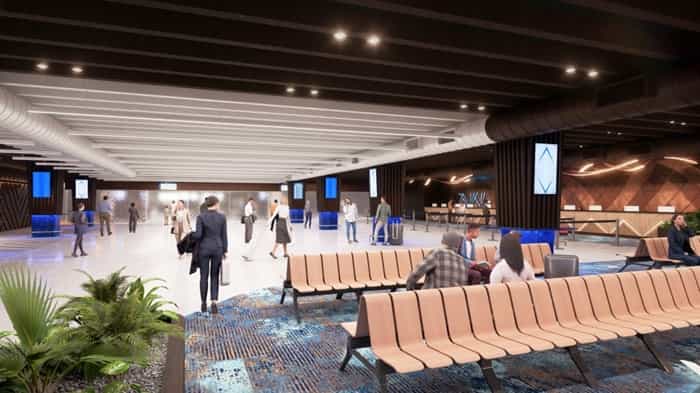
Te Waharoa aims to change that, handling up to 1,500 passengers an hour with a degree of efficiency that should please both cruise lines and slightly jet-lagged travellers wondering where the coffee is.
From Wharf to Welcome
Perhaps the most sensible and refreshing aspect of the development is its connection to the city itself.
Passengers won’t be shepherded through a maze of buses or anonymous transit zones. Instead, they’ll step off the ship and stroll straight into Britomart, with ferries, restaurants, hotels and the CBD all within easy reach.
It’s the sort of urban planning that sounds obvious until you realise how often it isn’t.
There’s also a practical layer. Dedicated pick-up and drop-off zones for buses and taxis will streamline movement, while improved logistics will allow cruise ships to re-supply efficiently, no small detail when you consider the appetite of modern vessels.
Bigger Ships, Better Business
The accompanying upgrade to Bledisloe North Wharf is equally significant. Designed to accommodate ships up to 350 metres in length, it positions Auckland squarely in the path of the industry’s largest and most lucrative vessels.
And make no mistake, this is about business.
Cruise tourism contributes more than $600 million annually to Auckland’s economy, a figure that tends to sharpen focus rather quickly. Across New Zealand, tourism remains the country’s second-largest export sector, accounting for around 7.7% of GDP.
In that context, Te Waharoa isn’t a vanity project; it’s economic infrastructure with a very clear return on investment.
A Cultural Handshake
However, the project finds its deeper meaning in its partnership with Ngāti Whātua Ōrākei.
Deputy Chair Ngarimu Blair offered a perspective that lifts the conversation beyond steel and concrete:
“Te Waharoa sits in the heart of our rohe… Welcoming manuhiri to our shores is not new to Ngāti Whātua Ōrākei, it’s a responsibility we’ve carried for generations.”
It’s a reminder that arrivals are not merely logistical; they’re cultural. And in a city like Auckland, that distinction matters.
A Waterfront Reclaimed
Mayor Wayne Brown, never one to shy away from a blunt assessment, sees the project as part of a broader shift.
“I welcome this investment… By opening up our wharves, we are transforming industrial zones into vibrant, accessible public spaces.”
For a city blessed with 3,200 kilometres of coastline, it’s a philosophy that feels both obvious and, historically, a little neglected.
Te Waharoa signals a turning point: less about the port as a boundary and more about the waterfront as a shared asset.
The Quiet Confidence of Good Infrastructure
There’s no grandstanding in this announcement. No overblown promises or architectural theatrics.
Instead, Te Waharoa carries the hallmarks of a project that understands its role: move people efficiently, present the city well, and leave a lasting impression without trying too hard.
It’s the sort of development that, if done properly, will simply work and, in doing so, elevate everything around it.
Auckland has always had the harbour. Now, at last, it’s building an arrival worthy of it.
by Michelle Warner – (c) 2026.
Read Time: 5 minutes.
About the Author.
 Michelle Warner has always carried stories the way others carry passports lightly, faithfully, and with purpose. She learned her craft in newsrooms, shaping sentences with care, before swapping deadlines for departures as a flight attendant with some of the world’s great airlines. Years aloft sharpened her eye for character and deepened her fondness for the small, dignified rituals of travel, the quiet kindness of strangers, the poetry of arrival, the patience learned between time zones.
Now grounded by choice, Michelle has come home to writing with the same calm authority she once brought to turbulent cabins. Her prose blends an editor’s discipline with a traveller’s wonder, tinged with humour and reverence for the golden age of travel. Each piece feels like a handwritten boarding pass, gracious, observant, and unmistakably alive.











