

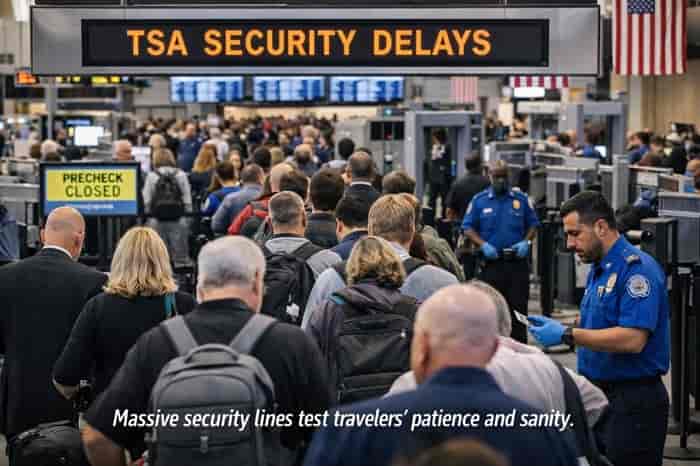
There are delays, and then there are delays that make you question your life choices somewhere between removing your shoes and surrendering your dignity to a plastic tray. Right now, across the United States, it is firmly the latter.
The Global Business Travel Association (GBTA) has delivered a blunt message to lawmakers: fix the government shutdown, or watch the aviation system buckle under the weight of its own inefficiency. And not gracefully, either.
From Washington, D.C., where policy paralysis seems to have taken up permanent residence, the ripple effects are now being felt in terminals nationwide. The immediate casualty? The Transportation Security Administration workforce is stretched thin and operating under mounting strain.
GBTA CEO Suzanne Neufang did not mince words:
“Business travel depends on predictability and efficiency, and right now, both are breaking down at America’s airports. GBTA is once more urging Congress to resolve the shutdown before departing for a two-week Congressional spring recess. The traveling public, the TSA workforce and the U.S. business community need leadership and action now. It is time to get travel and travelers moving again.”
Quite.
When Efficiency Becomes a Memory
Programs such as TSA PreCheck, once the golden ticket for the time-poor executive, are now showing visible cracks. Designed to keep vetted travellers moving and queues civilised, they are instead becoming yet another bottleneck in an already overburdened system.
The numbers tell a story that no spin doctor could soften. A typical 48-hour business trip is now at risk of losing up to 12 hours in airport security queues alone. That’s not a delay; that’s an operational failure.
And in business travel, time is not merely money; it is momentum. Lose it, and meetings are missed, deals are deferred, and confidence quietly erodes.
Economic Stakes Too Large to Ignore
This is not a niche inconvenience for frequent flyers in tailored suits. The United States remains the world’s largest business travel market, with GBTA forecasting a formidable US$395.4 billion in spending this year. Add to that US$484.4 billion in direct economic contribution, support for six million jobs, and roughly 2% of national GDP, and the stakes become unmistakably clear.
When airports stall, economies follow.
Companies are already reconsidering travel plans, delaying meetings, and perhaps most concerning, rethinking whether the United States remains a reliable gateway for global business. That is not the sort of reputational dent that buffs out easily.
A System Under Pressure
Behind the scenes, TSA personnel are doing what professionals tend to do in these moments, carrying on, often at personal cost. Long hours, limited resources, and mounting traveller frustration have created a pressure cooker environment that no workforce can sustain indefinitely.
Meanwhile, GBTA has not been idle. The association has met with members of Congress, coordinated with industry groups, and mobilised hundreds of its members to push for action. Yet, as each day passes without resolution, the queues grow longer, and patience grows shorter.
The Clock Is Ticking
There is a certain irony in a system designed to keep people moving now being the very thing holding them still. But irony does not catch flights, close deals, or support economic growth.
The message from GBTA is as clear as an empty departure board: act now, or risk long-term damage to one of the world’s most critical travel ecosystems.
Because in aviation, as in business, momentum lost is rarely regained without cost.












