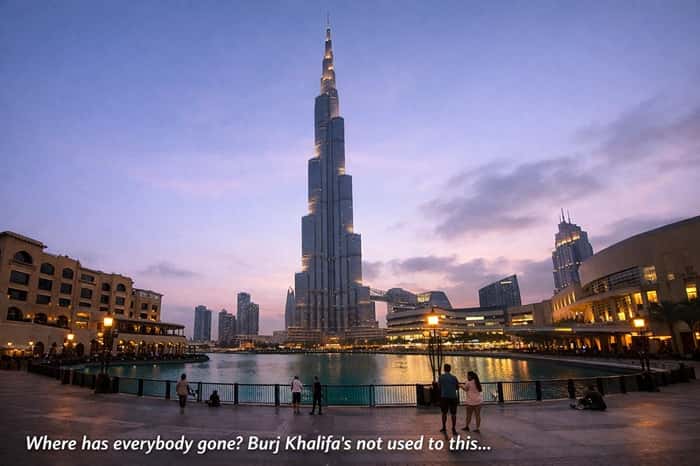
There’s a peculiar sound you don’t expect to hear in Dubai.
Nothing.
Not the usual hum of rolling suitcases. Not the chatter of tour groups clustering under flags. Not even that familiar symphony of camera shutters firing off in rapid succession as yet another traveller tries to capture the world’s tallest building from just the right angle.
Around the Burj Khalifa, normally a theatre of global tourism in full voice, the silence has crept in. Not dramatically, not catastrophically, but noticeably enough to make seasoned observers pause.
And when Dubai pauses, the industry pays attention.
A City That Doesn’t Do Quiet
Dubai was never designed to whisper. It’s a city built on momentum, confidence, and a rather unapologetic belief that if you build it bigger, brighter and shinier than anyone else, the world will come.
And for the most part, it has.
Amid financial shocks, pandemics, and occasional bouts of global uncertainty, Dubai has proven itself remarkably adept at bouncing back often faster than its competitors would like.
But this time, the shift feels… different. Not because the city has changed, but because the traveller’s mood has.
Perception: Tourism’s Oldest Enemy
Here’s the thing: the spreadsheets never quite capture. Tourism doesn’t run on facts; it runs on feeling.
Right now, that feeling is cautious.
Ongoing tensions across parts of the Middle East, geographically distant from Dubai but psychologically closely linked, have begun to nudge travellers into hesitation mode. And hesitation, in this business, is the thin end of the wedge.
It starts with “maybe later”.
Then becomes “let’s look elsewhere”.
And before long, those bustling plazas start to feel just a touch… spacious.
Dubai isn’t unsafe. Far from it. But in the eyes of a long-haul traveller scanning headlines over morning coffee in London or Sydney, nuance is often the first casualty.
The Dominoes Start to Fall
When foot traffic slows in a place like Downtown Dubai, it doesn’t stay contained for long.
Hotels feel it first not in empty rooms overnight, but in softer forward bookings and a sudden willingness to negotiate. The yield managers start sharpening their pencils. The word “value” quietly replaces “premium”.
Retail follows. Dubai’s luxury shopping scene, meticulously engineered to attract high-spending visitors, depends on volume as much as on margin. Fewer visitors mean fewer bags leaving the boutiques.
Then come the restaurants, the tour operators, the transfers, the desert safaris. Tourism, after all, is an ecosystem. Tug one thread, and the whole fabric shifts.
Aviation Keeps the Lights On
If there’s a steady hand in all of this, it’s aviation.
Carriers like Emirates continue to move people through Dubai at scale. The city’s role as a global hub cushions the blow; transit passengers still flow, even if fewer choose to stop.
But airlines are nothing if not pragmatic. They don’t fly for sentiment; they fly for demand.
Should hesitation linger, schedules will adjust. They always do.
A Familiar Story Just with Better Architecture
Old hands in the trade have seen this film before.
Something happens somewhere.
Headlines flare.
Bookings wobble.
And then, slowly but surely, confidence creeps back.
Dubai, to its credit, has mastered the art of the comeback. It doesn’t panic, it recalibrates. Sharper offers. Louder messaging. A gentle reminder to the world that the sun is still shining and the service is still impeccable.
It’s not bravado. It’s an experience.
The Traveller’s Mind Is the Real Battleground
What we’re seeing now isn’t a collapse, it’s a pause.
A moment where travellers, particularly those spending serious money on long-haul holidays, are taking stock. Waiting. Watching.
And in that pause lies both the challenge and the opportunity.
Because once confidence returns, and it will, the rebound can be just as swift as the retreat.
Dubai Isn’t Going Anywhere
Spend five minutes in the city, and you’ll understand the fundamentals haven’t shifted.
The fountains still dance on cue.
The malls still gleam like polished marble theatres.
The skyline still looks like tomorrow arrived early.
And the Burj Khalifa? Still doing exactly what it was built to do: command attention.
What’s missing isn’t the product.
It’s the crowd.
A Seasoned Industry Knows What Comes Next
There’s a quiet confidence among those who’ve been around long enough to know better than to overreact.
Tourism boards will lean into reassurance.
Agents will steady their clients with facts over fear.
Operators will adjust, not retreat.
Because if there’s one constant in travel, it’s this: people don’t stop wanting to go places.
They just wait until it feels right again.
Final Boarding Call
Dubai’s current lull is not a verdict. It’s a reminder.
A reminder that tourism, for all its infrastructure and investment, remains deeply human. It moves with sentiment, shifts with perception, and occasionally pauses when the world feels uncertain.
But if history has taught this industry anything, it’s that the pause never lasts.
And when the crowds return as they invariably do, you can be quite certain of one thing.
Dubai won’t whisper for long.
by Bridget Gomez – (c) 2026.
Read Time: 5 minutes.