

If you’ve been around the travel industry long enough, you’ll know it has always had a healthy respect for change, provided it doesn’t come at the expense of common sense.
That balance is now being tested again, this time by artificial intelligence. And, to its credit, the Australian Travel Careers Council (ATCC) appears determined to keep both feet firmly on the ground.
The council’s latest Travel Skills Taskforce (TST) forum, its third in a five-part national review of the Certificate III in Travel, didn’t arrive with fanfare. It didn’t need to. What it delivered was something far more useful: clarity.
Held on 11 March via Teams, the session was chaired by ATCC CEO Rick Myatt and steered by Kellie Stanbury, who has the unenviable task of turning industry opinion into something workable. It’s not glamorous work, but it’s essential, and this session proved why.
Less Guesswork, More Substance
The discussion homed in on the bread-and-butter of travel training: how professionals gather, interpret and present information. It sounds simple enough until you consider how much of that information now lives online, unfiltered and, at times, unreliable.
There was broad agreement that the current benchmarks simply don’t go far enough. One source is no longer enough. Two might not cut it either. The direction is clear: raise the bar, insist on multiple references, and make sure those references actually stand up to scrutiny.
In other words, less “I saw it somewhere” and more “I’ve checked it properly.”
It’s a return, in many respects, to the fundamentals that built this industry: do your homework and know your product.
Drawing a Line Around the Internet
Another point, long overdue, is defining what counts as a credible “internet source.” For years, that phrase has been stretched to cover everything from official tourism bodies to someone’s holiday blog written over a flat white in Byron Bay.
The Taskforce is tightening that definition. And rightly so.
Accuracy isn’t a luxury in travel; it’s the job.
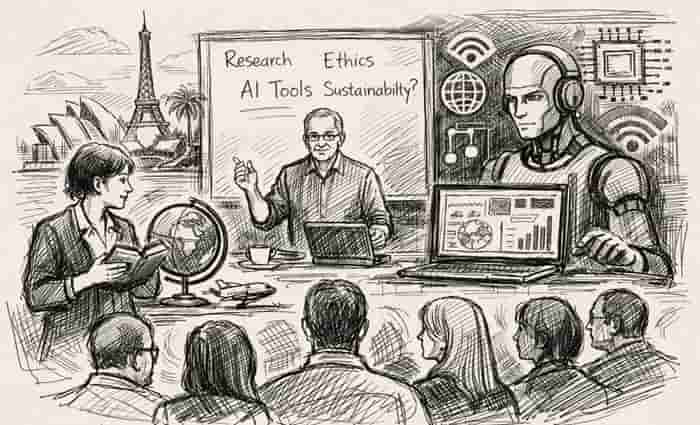
AI Enters the Room But Not the Driver’s Seat
Now to the part everyone is watching.
Artificial intelligence was not treated as a silver bullet. Nor was it dismissed. Instead, it was placed exactly where it belongs: as a tool.
The forum recognised its usefulness, speed, aggregation, and efficiency, but stopped well short of handing it the keys. Human oversight, verification and professional accountability remain non-negotiable.
It’s a sensible position. Because while AI can assemble an itinerary in seconds, it still can’t sit across from a client and understand what really matters to them.
And in travel, that still counts for everything.
A Broader Lens on the Industry’s Future
Beyond technology, there was a clear push to embed sustainability, inclusivity and equity into the training framework, not as add-ons, but as expectations.
This aligns neatly with global thinking from bodies such as the World Travel & Tourism Council and UN Tourism, but more importantly, it reflects what clients are already asking for.
The modern traveller is more aware, more curious and, occasionally, more demanding. Training needs to keep up.
The Work Isn’t Finished Yet
With two forums to go, the process is entering its final stretch. The next session, scheduled for 1 April, will turn its attention to elective units, the areas where the qualification can either stay relevant or quietly fall behind.
Rick Myatt put it plainly:
“This next forum will evaluate the relevance, quality, and quantity of the five elective competency units and will mark a significant step in ensuring our national training standards keep pace with rapid technology shifts. By balancing AI literacy with rigorous research requirements, we will be preparing the next generation of travel professionals for a complex, global marketplace.”
It’s a measured statement, but behind it sits a larger truth. The industry is changing, whether it likes it or not.
An Open Door for Industry Voices

Australian Travel Careers Council CEO Rick Myatt
Importantly, the ATCC hasn’t shut the door on input. If anything, it’s doing the opposite, inviting those on the ground to help shape what comes next.
That’s how this industry has always worked best: practical people, solving practical problems, without too much fuss.
Those interested in contributing to the next forum can contact Rick Myatt at [email protected] or Kellie Stanbury at [email protected].
A Quiet Reset But an Important One
There’s no grand reinvention here. No glossy slogans or sweeping declarations.
What the ATCC is doing is more subtle and arguably more valuable. It’s tightening the screws, raising expectations, and ensuring that, as technology evolves, the standards don’t slip.
Because at the end of the day, this industry still runs on trust.
And no amount of artificial intelligence can replace that.
And in travel, that balance has always been the difference between noise and know-how.
by Alison Jenkins – (c) 2026.
Read Time: 3 minutes.
About the Writer.
 Alison Jenkins has lived most of her working life in the slipstream of aviation, where timetables matter, and people matter more. In airline sales, she built a reputation the old-fashioned way: by knowing her clients, her routes, and never missing the human detail.
Quick with a smile, quicker with a solution, she made deals with warmth and kept her edge intact.
Trade shows, FAMILS, airport lounges and hotel lobbies became her second address. And somewhere along the way, notebook in hand, she began writing the journeys rather than selling them. Her reports grew lively, observant, full of the small truths only travellers notice.
That was the moment it dawned on her: she wasn’t simply travelling. She belonged in its stories.











