


There’s a particular moment in travel when a destination stops being “promising” and starts being inevitable.
Vietnam, it seems, has just crossed that line.
And Marriott International, never one to arrive late to the party, has quietly, but very deliberately, doubled down.
The numbers alone tell part of the story. Ten new hotels. Close to 4,500 keys. Eight brands. Two destinations that, until recently, sat somewhere between “emerging” and “aspiring.”
Now? They’re being recast as centre stage.
This latest agreement with Sun Group, Vietnam’s heavyweight developer with a flair for scale, isn’t just another expansion. It’s a signal. And in this business, signals matter.
A Deal That Reads Like a Statement
Marriott could have added a property or two and called it growth. Instead, it has gone for breadth and depth.
From the playful edge of Moxy to the polished calm of Westin, and right through to the high-energy theatrics of W Hotels (making its Vietnam debut), the brand mix is telling. This isn’t a one-size-fits-all approach. It’s a portfolio designed to catch every traveller passing through, from backpack-adjacent millennials to conference delegates with expense accounts.
Rajeev Menon, Marriott International’s President for Asia Pacific excluding China, put it plainly enough:
“Vietnam is one of the world’s most dynamic markets for travel and tourism.”
He’s not wrong. And more importantly, he’s not early either.
Phu Quoc: No Longer a Secret Worth Keeping
Phu Quoc has spent the better part of a decade flirting with global attention. White sand, warm water, and just enough infrastructure to suggest ambition.
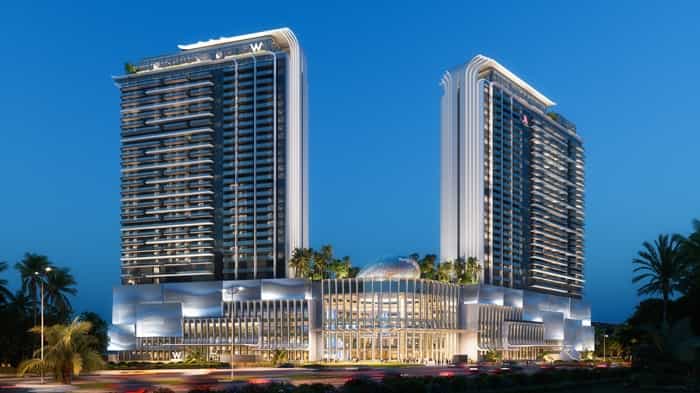
W Phu Quoc and Phu Quoc Marriott Rendering
Now, the flirtation is over.
Five of the new Marriott properties will sit within a sprawling mixed-use development at Ruby Beach timed, not coincidentally, for APEC 2027. When global leaders arrive, the island intends to look the part.
And if you’ve been watching Sun Group’s playbook, this will come as no surprise.
Cable cars stretching improbably across the sea. Theme parks that feel imported from a different scale altogether. Nightly fireworks, yes, nightly because subtlety, frankly, isn’t the brief.
What Marriott brings is something different: consistency, distribution power, and a brand promise travellers recognise before they’ve even packed a bag.
The Hon Thom Equation: Access Meets Experience
A short cable car ride away, arguably the most scenic commute in Southeast Asia, Hon Thom Island will host the more relaxed end of the spectrum, with Moxy and Fairfield stepping in.
It’s a neat piece of planning. High-energy, design-forward brands on one side; accessible, dependable comfort on the other.
In other words, something for everyone, without saying it out loud.
Vung Tau’s Quiet Rise
While Phu Quoc grabs the headlines, Vung Tau is playing a more understated game.
Just down the coast from Ho Chi Minh City, it has long been the city’s weekend escape, functional, familiar, and largely overlooked by international visitors.
That may not last.
With the Long Thanh International Airport now in the mix, accessibility improves overnight. And where access goes, investment tends to follow.
Marriott’s three planned properties here, spanning Marriott Hotels, Moxy, and Four Points, suggest confidence that Vung Tau is about to step out of the domestic shadow.
Not explode, perhaps. But evolve.
Sun Group’s Bigger Ambition
If Marriott is the global operator, Sun Group is the architect of the experience.
Chairman Dang Minh Truong framed it with admirable clarity:
“This agreement represents the strategic alignment of two leading companies to elevate the scale… of destination development in Vietnam.”
There’s that word again, scale.
What Sun Group has consistently done is remove friction. Build the airport links. Create the attractions. Add the spectacle. Then bring in global brands to complete the picture.
It’s not organic growth. It’s engineered.
And in a region where competition is fierce, think Bali, Phuket, even parts of Malaysia, that level of orchestration is increasingly necessary.
Marriott’s Expanding Footprint and Confidence
This deal doesn’t sit in isolation.
Marriott already operates 32 properties across Vietnam, with more than 50 in the pipeline. That’s not a tentative expansion; it’s a full-scale commitment.
And it reflects a broader truth: Vietnam is no longer competing on price alone. It’s moving up the value chain: better hotels, better infrastructure, better experiences.
The arrival of W Hotels is perhaps the clearest signal of that shift. Lifestyle luxury doesn’t follow demand; it anticipates it.
Timing, As Always, Is Everything
There’s an old rule in travel: build too early, and you wait; build too late, and you miss it.
This feels like neither.
International travel into Asia is rebounding with purpose. Airline capacity is returning. Travellers are venturing further, staying longer, and, crucially, spending more.
Vietnam sits in a sweet spot. Competitive, accessible, and increasingly sophisticated.
Marriott and Sun Group haven’t discovered that. They’ve simply acted on it.
Final Boarding Call
Strip away the press release gloss, and what you’re left with is something refreshingly straightforward.
Two companies. One fast-growing market. A very clear bet.
Ten hotels may sound like a lot. In the context of Vietnam’s trajectory, it may end up looking conservative.
Either way, the message is unmistakable: the next chapter of Asia-Pacific travel isn’t being written it’s already underway.
And Vietnam has picked up the pen.
by Kanda Limw – (c) 2026.
Read Time: 6 minutes.
About the Writer.
 Kanda Limw is one of those rare people every office quietly depends on. She doesn’t fuss or fanfare her way through the day; she simply notices what needs doing and gets on with it, often before anyone else has drawn breath.
Years behind the scenes have taught her that good administration isn’t about control; it’s about care. Diaries align, tensions soften, loose ends disappear. When the day threatens to tilt, Kanda steadies it without drama.
There’s something reassuringly old-fashioned about her reliability. She listens properly, remembers the small things, and does what she says she will.
Kanda has no appetite for the spotlight. Yet ask anyone who works alongside her, and they’ll tell you that when she’s there, everything runs just a little smoother.











