

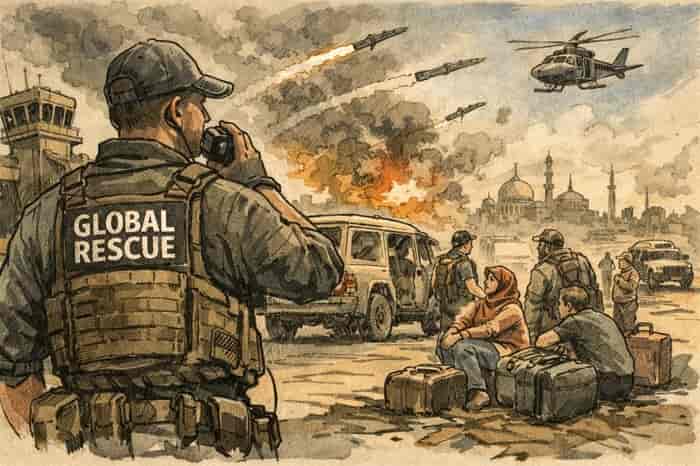
There are moments in global travel when the industry pauses, collectively inhales, and waits to see what the world will do next.
This is one of those moments.
Across the Middle East this week, commercial aviation has been thrown into sudden disarray as military confrontation involving the United States, Israel and Iran escalates sharply. Missile launches, retaliatory drone strikes and tightening airspace restrictions have disrupted flight corridors that, until very recently, carried millions of travellers between Europe, Asia and Africa.
And when the skies close, people inevitably find themselves stranded beneath them.
That is where organisations like Global Rescue quietly step into view.
The travel risk management specialist has deployed security teams across the region to assist international travellers caught in the disruption, many of whom suddenly found themselves in cities where flights vanished from departure boards almost overnight.
It is not glamorous work. But it is essential.
“Our security teams are working in a highly dynamic operational environment to relocate travellers from high-risk areas when safe corridors become available,” said Fernando Lopez Medina, security operations supervisor at Global Rescue and a former U.S. Army Special Forces Green Beret.
“These operations require close coordination with regional partners, secure transportation resources and constant reassessment of the threat environment to ensure movements are conducted safely.”
In practical terms, that means Global Rescue teams are juggling a complex logistical puzzle. Ground transport, private aviation, maritime options and regional security intelligence all come into play when traditional airline routes collapse.
And collapse they have.
The Middle East is one of the world’s most critical aviation crossroads. Flights linking Europe, Asia and Africa routinely traverse the region’s airspace, and major hubs such as Dubai, Doha and Abu Dhabi act as global connecting points.
When instability strikes there, the consequences stretch far beyond the region itself.
“Travel to or through the Middle East right now carries elevated and unpredictable risk,” said Kent Webber, senior manager of Intelligence Services at Global Rescue and a former senior intelligence operations officer within the Office of the Under Secretary of Defence for Intelligence at the U.S. Pentagon.
“Our intelligence teams are continuously gathering and analysing information from multiple sources across the region to provide members with real-time threat assessments and operational guidance as conditions change.”
For airlines and travellers alike, the ripple effects are already being felt.
Flights have been diverted, schedules rewritten, and airspace closures introduced with little warning. Travellers heading to Europe from Asia, or vice versa, have discovered that routes that normally take hours to plan suddenly require significant detours.
“These disruptions are cascading well beyond the Middle East and affecting international flight networks globally,” Webber said.
“Travellers transiting the region for Europe, Asia or Africa may encounter extensive delays, rerouting and cancellations.”
Behind the scenes, Global Rescue’s operational network is working continuously to keep pace with those developments.
The organisation maintains international operations centres that monitor travel risk 24 hours a day, 365 days a year. Its global infrastructure includes nearly 4,000 operational assets in more than 150 countries, ranging from security specialists and medical teams to logistics hubs and aviation partners.
It is an apparatus designed for exactly these kinds of moments.
“With rapidly shifting threats and restricted airspace across multiple countries, our teams have leveraged every available capability to assist travellers caught in the crisis,” said Dan Richards, CEO of The Global Rescue Companies.
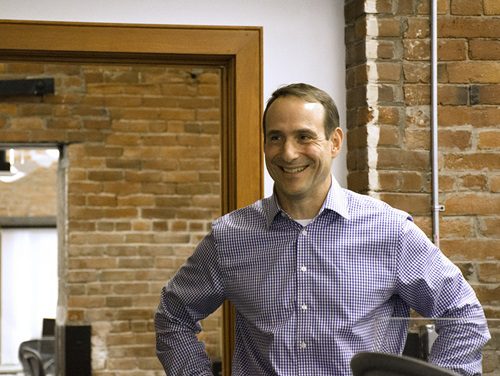
Dan Richards is standing in the operations room.
Richards, who also serves on the U.S. Travel and Tourism Advisory Board at the U.S. Department of Commerce, said the organisation’s priority remains straightforward.
“Our mission is to protect our members wherever they are in the world,” he said.
“Through our global operations centres, intelligence analysts and deployed security teams, we are coordinating complex response efforts to help people navigate this extremely volatile environment.”
For travellers still within the region, however, the safest advice is often the least satisfying: patience.
In conflict zones where missile and drone activity continues, immediate movement can sometimes increase rather than reduce risk. In many areas, Global Rescue officials say sheltering in place remains the safest option until secure travel corridors can be established.
It is a sober reminder that the travel industry, for all its innovation, technology and resilience, ultimately remains tied to the stability of the world it moves through.
For now, the skies above the Middle East remain unsettled.
And while airlines redraw their maps and travellers rethink their routes, a small army of security professionals continues its work quietly on the ground, helping stranded passengers find a safe way home.
For more information, visit https://www.globalrescue.com.
by Jill Walsh – (c) 2026.
Read Time: 4 minutes.
About the Writer.
 Jill Walsh has always kept a pen close and a suitcase closer. She started out on media releases, then learned the trade properly by escorting press trips around the world, discovering which stories travel well and which need a sharper edit.
Before long, she wasn’t just promoting destinations, she was representing them, translating civic ambition and local pride into words people actually wanted to read. These days, semi-retired and happily so, Jill has traded departure boards for deadlines, joining old friend and colleague Stephen at Global Travel Media on a casual basis.
Her patch is the business end of wanderlust: balance sheets, route maps, tender wins and the numbers that quietly decide where travellers go. She writes with dry humour, clean prose and an old-school respect for facts, a steady voice when the market starts shouting.











