

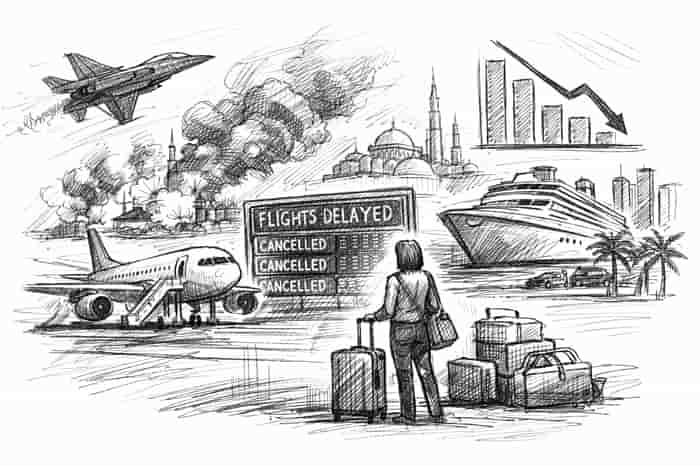
The global travel industry has weathered its fair share of storms over the years, but the latest tensions involving Iran are already starting to sting.
Fresh analysis from the World Travel & Tourism Council (WTTC) suggests the escalating situation is costing the travel and tourism sector around US$600 million a day in lost international visitor spending across the Middle East.
For an industry that depends heavily on confidence and connectivity, that’s not pocket change.
The Middle East plays a pivotal role in global aviation. The region accounts for roughly five per cent of the world’s international arrivals but punches well above its weight in air traffic, handling about 14 per cent of global international transit passengers.
In other words, when the Middle East sneezes, global aviation tends to catch a cold.
Major aviation hubs, including Dubai, Abu Dhabi, Doha, and Bahrain, which normally handle more than half a million passengers every day, have already seen closures, delays, and operational headaches as the conflict rattles the region.
The result is a familiar domino effect. Flights rerouted. Schedules stretched. Travellers are thinking twice about long-haul itineraries that pass through the Gulf.
WTTC’s calculations are based on a particularly strong outlook for the region. Prior to the latest tensions, the organisation projected US$207 billion in international visitor spending across the Middle East in 2026.
That’s a sizeable tourism economy, and even a short-lived disruption can send some serious dollars skittering out the door.
Still, if there’s one lesson the travel industry has learned over decades of geopolitical flare-ups, economic downturns and pandemics, it’s that tourism has an almost stubborn ability to bounce back.
Gloria Guevara, President and CEO of the WTTC, says the sector’s track record speaks for itself.
“Travel & Tourism is the most resilient of sectors. The impact of international visitor spending across the Middle East is significant and averages around US$600 million per day, but history shows that the sector can recover quickly, especially when governments support travellers through hotel support or repatriation.”
She added that past crises demonstrate how quickly travel demand can return once stability is restored.
“Our analysis of previous crises demonstrates that security-related incidents often see the fastest tourism recovery times, in some cases as quickly as two months, when governments and industry work together to restore traveller confidence. WTTC commends governments who have worked tirelessly in recent days to support recovery efforts.”
For airlines, airports and the broader tourism ecosystem, that recovery can’t come soon enough.
The Middle East sits at the crossroads of global aviation routes linking Europe, Asia and Africa. Disruption here doesn’t just affect local tourism; it ripples across long-haul networks worldwide.
Guevara says the priority now is simple: clarity, cooperation and reassurance.
“Clear communication, strong coordination between the public and private sectors, and measures that reinforce safety and stability are critical to rebuilding trust with travellers and supporting the sector’s recovery.”
For the moment, the industry is watching developments closely.
The WTTC says it remains in close contact with governments and travel leaders while monitoring the situation on behalf of its members.
Because if history has taught the travel trade anything, it’s this: turbulence may shake the aircraft for a while, but travellers rarely stay grounded forever.
More information and WTTC industry research are available at https://wttc.org.
by Jason Smith – (c) 2026.
Read Time: 3 minutes.
About the Writer.
 Jason Smith was educated in terminals, taxis and hotel corridors, the sort of schooling no classroom could hope to provide. Half American, half Asian, he grew up inside the quiet machinery of tourism, watching his family send strangers into the world long before he travelled himself.
Bangkok came first, then the Asian Institute of Hospitality & Management, followed by a career stitched together across Singapore, Malaysia and Vietnam. Each city left a mark. Thailand eventually claimed him, along with a corner office, as Director of Sales for one of the country’s leading hotel groups.
Then the world paused. Borders closed, skies emptied, and Jason returned to America carrying time, memory and a lifetime of stories.
Now at Global Travel Media, he writes about the human side of travel check-ins, departures, and everything in between with warmth, clarity, and an instinct for connection.











