

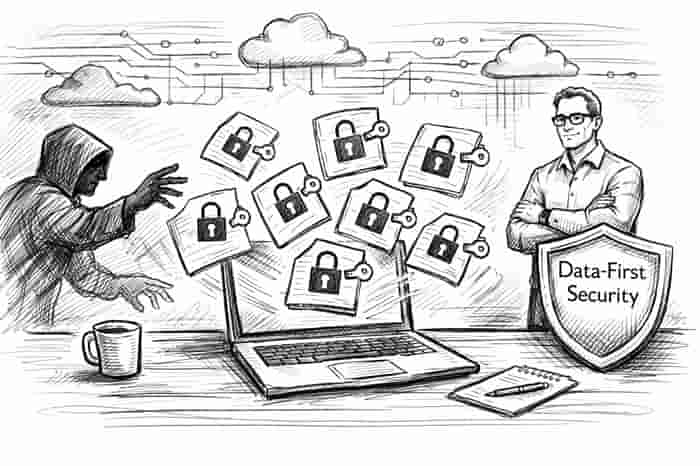
For years, the cybersecurity industry has been chasing the same elusive prize: stopping breaches before they happen. Firewalls grow taller, monitoring systems grow louder, and security dashboards multiply like rabbits. Yet despite the noise and investment, breaches continue to occur.
In Australia alone, the average cost of a data breach has climbed to AU$4.26 million, according to IBM research. When investigators arrive on the scene after an incident, the questions are almost always the same. What information was taken? Where was it stored? Who had access to it?
More often than organisations would care to admit, the answers are either painfully slow or worryingly incomplete.
GuardWare believes the problem has been approached the wrong way. Rather than endlessly trying to prevent breaches, the company argues the smarter strategy is to ensure that stolen data is worthless from the outset.
This week, the cybersecurity firm unveiled its Data-First Security Suite, a platform designed around a deceptively simple principle: sensitive data should remain protected even when everything else fails.
Turning the Tables on Data Breaches
The newly launched platform brings together three integrated capabilities: DISCOVER, INSIGHT and PROTECT, forming what GuardWare calls a practical roadmap for modern data security.
At the centre of the strategy lies a blunt but compelling premise: if criminals steal data, they should not be able to read, use, or sell it.
“Most organisations don’t have a tooling problem. They have a visibility problem,” said Rizwan Mahmood, Co-Founder and CEO of GuardWare.
“Sensitive data spreads across M365, file shares, endpoints, project folders, and supplier hand-offs, then AI and automation increase the speed at which it can be found, copied, and shared. The question security leaders keep being asked, and cannot always answer, is: what data do we have, where is it, and what happens if it is taken?”
It is a question that has become increasingly urgent as the pace of digital transformation accelerates across Australian organisations.
Remote work, cloud storage, AI tools and automated workflows have dramatically increased the number of places sensitive information can live. The result is a sprawling digital ecosystem where critical data often travels far beyond traditional security boundaries.
GuardWare’s response is to track the entire lifecycle of that information.
Step One: Find the Data
The first component, DISCOVER, does exactly what its name suggests. It scans an organisation’s digital environment, file shares, endpoints and Microsoft 365 to identify where sensitive data actually resides.
Importantly, the process happens without moving the data or relying on manual sampling, which often misses hidden repositories.
The result is a ranked inventory showing what information is sensitive, where it sits and which areas pose the greatest risk.
For many companies, this stage alone can be a revelation.
Alan Rankins OAM, Executive Chairman of GuardWare, says organisations are often surprised by what they uncover.
“When a organisations runs the GuardWare Suite, they are absolutely startled by who in their company is accessing what data,” Rankins said.
But discovery alone is only half the story.
Step Two: Watch Where It Goes
The second layer, INSIGHT, introduces continuous monitoring across the channels where data leaks most commonly occur.
These include USB drives, cloud platforms, email, web uploads, AI tools and remote working environments.
The system delivers real-time alerts while also triggering automated user education, a subtle but important element, given that human error accounts for 37 per cent of Australian data breach notifications, according to the Office of the Australian Information Commissioner.
In other words, not every breach begins with a sophisticated hacker. Sometimes it starts with a misplaced file or an accidental upload.
INSIGHT aims to catch those moments before they escalate.
Step Three: Make Stolen Data Worthless
The final stage is where GuardWare’s strategy takes a distinctive turn.
PROTECT encrypts sensitive files at the individual file level and keeps them encrypted even while they are being actively used.
This means that if a file is stolen, copied or shared without permission, it remains completely unreadable.
Access can also be revoked instantly from anywhere in the world.
Rankins believes that capability fundamentally shifts the balance in cybersecurity.
“If you can encrypt data and still work on it, that is a game changer,” he said.
“The commercially sensitive and classified information is protected. And if you haven’t got the key, you can try and decrypt it for a thousand years and you won’t be able to open that document.”
Preparing for the Inevitable
Cybersecurity professionals increasingly accept that breaches are not always preventable.
Supply-chain attacks continue to rise, and a single compromise can cascade across multiple organisations.
GuardWare’s Mahmood says that reality informed the company’s approach.
“Most security tools are built to stop the breach. We built PROTECT for the moment after, when the data is already gone,” Mahmood said.
“If the file is encrypted and only you hold the key, it doesn’t matter who has it or where it ends up. It makes stolen data useless.”
It is a refreshingly pragmatic philosophy in an industry that often promises perfect prevention.
Instead, GuardWare’s message is simpler and arguably more realistic.
Find your data. Watch where it goes. And make sure that even if it falls into the wrong hands, it cannot be used against you.
In a digital economy where information is often the most valuable asset a company holds, that might prove to be the most important line of defence of all.
by Octavia Koo – (c) 2026.
Read Time: 4 minutes.
About the Writer.
 Octavia Koo arrived in Australia from Indonesia in the early eighties, drawn by Sydney’s creative pull and a place at UNSW. Studying Arts, she quickly developed an eye for visual storytelling, starting in graphic design before naturally moving into web development and crafting copy that invited people in and kept them there.
Singapore came next. There, she ran blogs for tourism platforms and developed an instinct for SEO well before it had a name, working the corridors of ITB Asia and learning how stories travel online. There, she met Stephen, who suggested Global Travel Media.
A few years later, she joined.
Today, Octavia is part of GTM’s editorial family, bringing a quiet brilliance to every piece, blending art, technology, and intuition to make travel stories both charming and effective, much like their author.











