

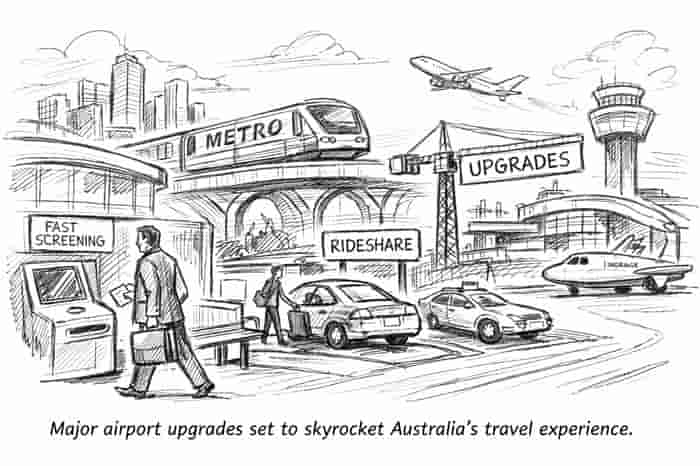
Australia’s airports are entering something of a golden age of reinvention. Across the country, cranes, concrete and clever engineering are quietly reshaping the passenger experience, promising faster journeys, smarter terminals and a far less stressful sprint from taxi to take-off.
According to the latest Airport Monitoring Report from the Australian Competition and Consumer Commission (ACCC), the nation’s four largest airports poured $1.5 billion into aeronautical infrastructure during 2024-25 alone, with a further $20 billion in major projects planned over the coming decade.
For travellers, particularly the harried corporate variety who treat airport terminals like extended offices, that investment may soon translate into shorter queues, smoother security and a blessed reduction in the number of times one must unpack a laptop at the screening belt.
The aviation industry likes to call these improvements “passenger enhancements”. Frequent flyers simply call them sanity.
Business travellers want speed, not spectacle
Fresh research from Corporate Traveller, the SME-focused division of Flight Centre Travel Group, sheds light on how Australia’s road warriors move through airports and what they value when time is scarce.
The survey found:
-
Sydney Airport leads the country for ground transport convenience (53.7%).
-
Monday remains the most popular travel day for business trips (54.2%).
-
Two-day trips dominate domestic corporate travel schedules.
Brisbane Airport topped the list for rideshare accessibility, reflecting the growing preference for door-to-door flexibility over traditional taxis.
As Corporate Traveller Global Managing Director Tom Walley neatly summed up:
“People travelling for business want to get from the plane to their meeting, conference, or event as quickly as possible – there’s no room for delays when most trips are scheduled around weekday commitments.”
He added that the data reinforces a clear trend.
“The strong preference for rideshare tells us flexibility and door-to-door convenience really matter. The inbound upgrades will genuinely remove friction from the entire journey.”
For the time-poor executive racing between cities, friction is the enemy.
Fortunately, airports across the country appear to have taken the hint.
Brisbane Airport raises the bar for seamless screening
At Brisbane Airport, the transformation is already well underway.
In December 2025, the airport unveiled a new domestic terminal entry via the Skywalk, allowing passengers travelling with carry-on luggage to proceed directly into a mezzanine screening zone featuring 10 advanced security lanes.
The technology allows travellers to keep laptops, liquids and aerosols inside their bags, a small but glorious victory for anyone who has ever performed the awkward airport ballet of unpacking electronics into plastic trays.
A separate northern screening point for Qantas passengers adds five more lanes, reducing wait times during peak hours.
Brisbane Airport CEO Gert-Jan de Graaff described the change as a milestone moment for passenger experience.
“We’re incredibly excited to have opened our new entry to our Domestic Terminal, which sets a benchmark for a smoother passenger experience at Brisbane Airport.”
The upgrade forms part of the $5 billion Future BNE transformation, which also includes a redesigned Skywalk linking the terminal to parking zones and vehicle pick-up points.
For rideshare users, already Brisbane’s preferred ground transport option, that means shorter walks, faster pick-ups and fewer awkward conversations with impatient drivers circling the car park.
De Graaff acknowledged the inevitable construction disruption but insisted the long-term payoff would be worth it.
“We know construction can be disruptive, and I want to thank passengers for their patience. Every upgrade we’re delivering through our $5 billion Future BNE transformation is about building a better airport, today and into the future.”
Sydney Airport targets a 15-minute kerb-to-gate sprint
Over in Australia’s busiest aviation hub, Sydney Airport is pursuing a similarly ambitious goal: moving 95% of domestic passengers from kerb to gate within 15 minutes.
To achieve that rather punchy target, the airport is investing $200 million to transform terminals T2 and T3, introducing new self-service kiosks and advanced bag-drop technology, supported by seven CT-equipped screening lanes.
The improvements aim to remove bottlenecks in the check-in and security process, two traditional pain points for travellers on tight schedules.
Sydney is also experimenting with a refreshingly simple idea: fixed taxi fares to the CBD.
Under a trial currently underway, standard taxis charge a flat $60, while maxi taxis are capped at $80, eliminating the unpredictable combination of tolls, traffic and nervous glances at the meter.
Meanwhile, a fleet of seven electric apron buses will begin operating at Terminal 1 in early 2026, quietly ferrying passengers between aircraft and terminal while trimming emissions.
Not glamorous perhaps, but undeniably practical.
Western Sydney Airport reshapes the aviation map
If the upgrades at existing airports are impressive, the arrival of Western Sydney International Airport promises to redraw the aviation landscape entirely.
Scheduled to open in late 2026, the new airport will feature integrated metro connectivity via the Sydney Metro Western Sydney Airport line, including two stations within the terminal precinct.
Bus connections from Penrith, Liverpool and Campbelltown will be ready from day one, while rail services are expected to commence by April 2027.
For business travellers accustomed to unpredictable road journeys across Sydney, predictable rail travel times may prove the airport’s most valuable feature.
Melbourne Airport expands for global demand
Down south, Melbourne Airport is expanding its international terminal after recording a record January with more than 1.26 million international passengers.
The project includes:
-
New check-in facilities
-
Five additional aircraft gates
-
Five new aircraft stands capable of handling widebody jets
-
Expanded waiting areas and lounges
The airport is also completing the final stages of a $500 million tote-based baggage handling system, capable of processing 4,000 bags per hour and allowing passengers to check luggage earlier in the day.
Combined with Melbourne’s planned third runway opening in 2031, the investment positions the airport to handle continued growth as international travel rebounds.
Adelaide, Perth and Canberra step forward
Across the rest of the country, smaller but no less significant projects are also underway.
At Adelaide Airport, the $600 million Project Flight will expand check-in space by 25%, introduce six CT screening lanes and add new lounges, gates and aerobridges.
Perth Airport is building a six-level multi-modal transport hub as part of its One Airport Central development, complete with rideshare zones, EV charging areas and a weather-protected Skybridge to Terminal 1.
And in the nation’s capital, Canberra Airport has completed a $350 million terminal redevelopment, including a new concourse, upgraded baggage systems and improved road access.
Even Gold Coast Airport is thinking long-term. Its recently approved 2024 Master Plan envisions rail integration, on-site hotels and a conference precinct capable of hosting meetings without travellers leaving the airport campus.
The goal: grow passenger capacity from six million to 13 million by 2044.
A new era for Australia’s airports
For years, airport development often felt like a slow march punctuated by occasional terminal expansions.
Today, however, the scale of change is unmistakable.
Across Australia, airports are embracing automation, sustainability and smarter transport integration to keep pace with growing passenger demand and the expectations of modern travellers.
For the business community, those frequent flyers who measure time in boarding calls and lounge coffees, the benefits will be immediate.
Shorter queues. Faster screening. More predictable journeys.
In short, the sort of efficiency that turns an airport from an obstacle into what it was always meant to be: a gateway.
And for an industry built on movement, that’s a welcome development indeed.
by Octavia Koo – (c) 2026.
Read Time: 6 minutes.
About the Writer.
 Octavia Koo arrived in Australia from Indonesia in the early eighties, drawn by Sydney’s creative pull and a place at UNSW. Studying Arts, she quickly developed an eye for visual storytelling, starting in graphic design before naturally moving into web development and crafting copy that invited people in and kept them there.
Singapore came next. There, she ran blogs for tourism platforms and developed an instinct for SEO well before it had a name, working the corridors of ITB Asia and learning how stories travel online. There, she met Stephen, who suggested Global Travel Media.
A few years later, she joined.
Today, Octavia is part of GTM’s editorial family, bringing a quiet brilliance to every piece, blending art, technology, and intuition to make travel stories both charming and effective, much like their author.











