

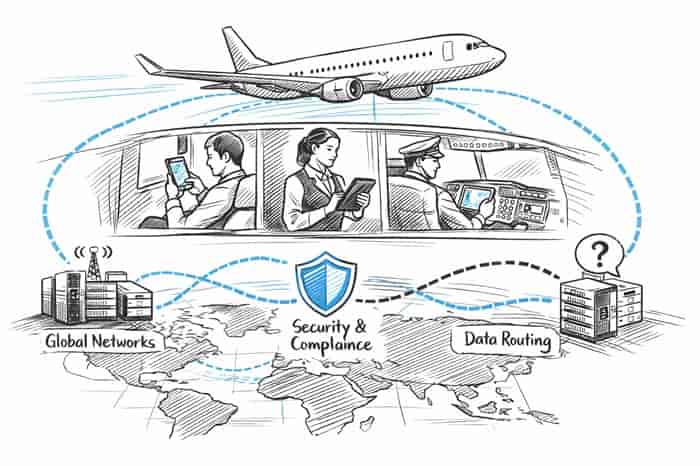
For airlines, eSIMs have quietly moved from passenger convenience to operational dependency.
What began as a way to help travellers avoid roaming charges is now embedded across the airline ecosystem, powering passenger apps, crew communications, inflight services, loyalty engagement, payments, and real-time operational workflows. As adoption accelerates, eSIMs are no longer a peripheral technology. They are part of an airline’s digital backbone. That shift demands a different level of scrutiny.
The innovation eSIM enables is transformative. But as with any technology that scales into critical infrastructure, governance must evolve alongside adoption.
Recent independent research into the eSIM ecosystem has highlighted concerns around how user traffic is routed and which jurisdictions ultimately govern that data. The findings do not undermine the value of eSIM technology, but they underscore a reality that airline leaders cannot ignore: connectivity decisions now carry regulatory, security, and reputational risks.
Why Airline Executives Should Care About Data Routing
At a high level, eSIMs enable devices to download network profiles remotely, eliminating the need for physical SIM cards. For airlines, this flexibility supports seamless passenger journeys and globally connected operations.
However, one of the most under-discussed aspects of digital connectivity is jurisdiction. Data does not exist in a vacuum. It is subject to the laws of the countries through which it passes and those of the country where it is processed. Beneath the simplicity lies a complex chain of roaming agreements, network partners, and backend infrastructure. In some cases identified by recent studies, data traffic has been routed through jurisdictions that airlines and their passengers would not reasonably expect. This can cause a device to appear, from a network perspective, as if it is operating in an entirely different country. For the average consumer, this is invisible, but from an airline perspective, this matters because network routing directly affects how systems interpret risk, compliance, and legitimacy.
The Real-World Impact on Airline Operations
According to SITA’s Air Transport IT Insights, 94% of airlines now invest in mobile passenger applications, increasing dependency on secure mobile connectivity.
Airlines increasingly rely on location-aware security systems to protect customer accounts, manage fraud, and safeguard digital services.
If a passenger checks in, accesses a loyalty account, or makes an in-flight purchase while physically in one country, but their data session appears to originate elsewhere due to routing, automated systems may flag the activity as anomalous.
The result can be:
- Failed check-ins or disrupted mobile app experiences
- Loyalty account restrictions triggered mid-journey
- Payment declines during in-flight or airport transactions
- Increased customer service escalation at critical travel moments
For passengers, this creates friction. For airlines, it creates operational noise, higher support costs, and brand damage — often without a clear root cause visible to frontline teams.
The implications extend beyond passengers.
Many airlines now issue eSIM-enabled devices to flight and ground crews for duty rosters, safety reporting, operational messaging, and secure access to internal systems. If traffic from these devices is routed through unapproved jurisdictions, airlines may inadvertently breach internal security policies or aviation compliance frameworks not because of a cyberattack, but because of opaque routing decisions outside their direct control.
Jurisdiction Is a Board-Level Issue, Not a Technical Detail
Airlines operate in one of the most heavily regulated industries in the world. Data sovereignty, lawful access, and compliance obligations vary significantly by region.
When traffic is routed through unexpected jurisdictions, airlines may expose sensitive operational or passenger data to legal frameworks they did not explicitly approve. This has implications for:

Arif Reza, CEO & Founder, WorldSIM
- GDPR and international data protection compliance
- Internal audit and risk assurance processes
- Partner and alliance data-sharing agreements
- Regulatory reporting and incident response
Crucially, “not knowing” where data is processed is no longer a defensible position.
Convenience Cannot Override Governance
The success of eSIMs has been driven by speed and simplicity. But for airlines operating at a global scale, convenience without governance is a liability.
Connectivity providers are no longer just vendors; they are implicit custodians of airline data flows. That responsibility requires transparency, control, and accountability.
Airlines should expect clear answers to fundamental questions about routing, jurisdiction, and safeguards, not after an incident, but before deployment.
What Airline Leaders Should Ask Their eSIM Partners?
Before approving or expanding eSIM use, airline executives should be asking:
- Which mobile networks do our passenger and crew traffic traverse?
- In which countries is data terminated, processed, or logged?
- How does routing change dynamically across regions or congestion events?
- Are routing paths aligned with our regulatory and security requirements?
- Can routing be restricted to approved jurisdictions if required?
- What independent audits or certifications validate these claims?
If a provider cannot answer these questions clearly, the risk sits with the airline — not the supplier.
Security as a Competitive Advantage for Airlines
The eSIM ecosystem is still maturing, and that presents an opportunity. Unlike legacy telecom infrastructure, which evolved over decades, eSIM standards can now be deliberately and responsibly shaped.
This means stricter network-selection policies, clear disclosure to users and enterprise partners, independent security audits, and alignment with global data protection regulations, not just minimum compliance, but best practice.
Airlines are under unprecedented pressure to deliver seamless digital experiences while meeting rising regulatory and security expectations. In this environment, trust is a differentiator.
Airlines that proactively assess eSIM security standards will reduce operational disruption, strengthen regulatory posture, and protect brand credibility. Equally, eSIM providers that prioritise transparent routing and robust governance will become strategic partners rather than interchangeable suppliers.
Connectivity is Critical Infrastructure
As adoption accelerates across travel and aviation, scrutiny will only increase. Providers that invest early in security and governance will thrive.
eSIM technology will play an increasingly central role in aviation’s digital future. That future must be built on more than speed and scale; it must be built on trust.
For airlines, this means treating connectivity as critical infrastructure. For the eSIM industry, it means recognising that growth brings responsibility.
Security is not an optional feature. It is the foundation of sustainable global connectivity, and the airlines that recognise this early will be best positioned to lead.
by Arif Reza, CEO & Founder, WorldSIM – (c) 2026.
Read Time: 6 minutes.











