
Every airport has a personality.
Some are grand and sprawling, built to impress with scale and spectacle. Others are more modest, quietly efficient, getting passengers from kerb to gate without fuss.
For years, Kobe Airport belonged firmly in the second category. It was dependable, practical and, in the nicest possible way, unassuming — a domestic airport doing its job without demanding attention.
But things are changing.
Quite quickly, in fact.
What was once a purely domestic gateway is now preparing to step confidently into the international arena, linking the port city of Kobe with some of Asia’s most dynamic aviation markets.
And the transformation, while measured, is already reshaping how travellers move through Japan’s busy Kansai region.
A City Airport With Big Ambitions
Kobe’s location has always been its quiet advantage.
Just 20 minutes from the city centre, it is arguably one of Japan’s most convenient airports — a rare thing in a country where many international gateways require lengthy rail journeys before travellers even reach their hotels.
As international tourism rebounds across Japan, that convenience is proving increasingly valuable.
Instead of funnelling every visitor through the ever-busy Kansai International Airport, regional planners have begun spreading the load. Kobe, sitting neatly between Osaka and the broader Hyogo region, has emerged as an obvious candidate.
The airport’s new international terminal is the centrepiece of that strategy.
Flights connecting the city with Seoul, Shanghai, Nanjing, Taipei and Taichung have already begun operating through charter services, with scheduled routes expected to follow as demand grows.
For travellers, the appeal is obvious.
Less congestion.
Shorter travel times.
And a gateway that feels refreshingly manageable.
For the region’s tourism economy, however, the implications are far larger.
Local officials believe the expanded air links could attract hundreds of thousands of additional international visitors each year, bringing new energy to hotels, restaurants and regional attractions across Hyogo Prefecture.
Designing an Airport That Actually Works
Turning a domestic airport into an international one isn’t simply a matter of adding immigration desks and hoping for the best.
It requires rethinking the entire passenger journey.
From the moment travellers arrive at the terminal to the point they step onto an aircraft, every movement has to make sense — especially when the airport itself operates within a relatively compact footprint.
Unlike the vast mega-hubs scattered across Asia, Kobe doesn’t have endless space to play with.
Which, oddly enough, has turned out to be an advantage.
Instead of building something oversized and complicated, planners focused on creating something smarter.
A terminal that feels calm.
Clear.
And — perhaps most importantly — easy to navigate.
The aim was to make the journey largely self-directed. Travellers shouldn’t need to ask where to go next. The airport should simply guide them there.
Technology Doing the Heavy Lifting
Behind the scenes, much of this efficiency is powered by technology developed by SITA, one of the aviation sector’s most established IT providers.
At the heart of the system sits SITA Flex Essentials, a platform that allows multiple airlines to share the same operational infrastructure.
It’s known as a common-use model, and it has become increasingly popular with airports that want flexibility without building endless rows of dedicated airline counters.
In practical terms, this means airlines launching services to Kobe can simply plug into the system rather than constructing their own facilities.
For passengers, the result is subtle but important: the airport experience remains consistent regardless of the airline they’re flying.
Less confusion.
Less queueing.
Less friction.
Self-Service With a Human Touch
One of the most visible changes inside the terminal is the arrival of TS6 self-service kiosks, which allow travellers to check in quickly without waiting in traditional lines.
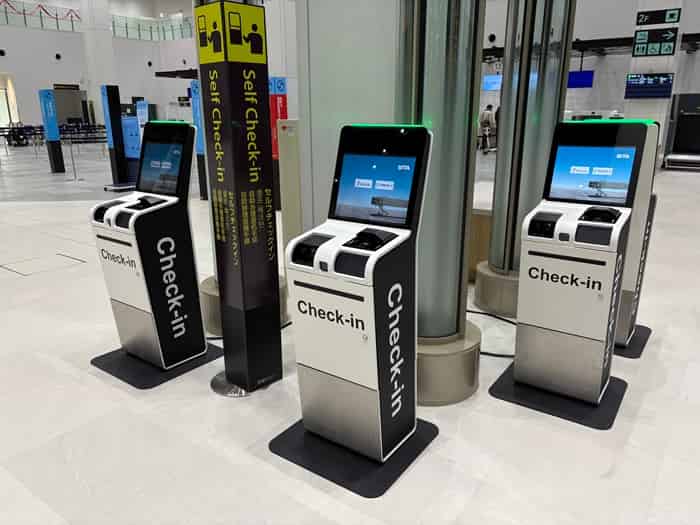
Kobe Airport’s new kiosks quietly usher passengers into a faster international era
Frequent flyers will recognise the process immediately.
Scan passport.
Confirm booking.
Print boarding pass.
Done.
Looking ahead, the airport also plans to introduce Scan & Go Self Bag Drop, allowing passengers to tag and drop their own luggage without assistance.
It’s part of a broader shift across the aviation industry towards automation — not to remove staff, but to free them from routine tasks and focus on helping passengers when they genuinely need assistance.
The result is an airport environment that feels efficient rather than rushed.
And that, in today’s travel landscape, is no small achievement.
A Strategic Alternative in Kansai
The timing of Kobe Airport’s international expansion is hardly accidental.
Japan’s tourism sector is booming again, with visitor numbers climbing sharply as travellers rediscover the country’s food, culture and famously reliable transport networks.
But success brings its own challenges.
Overcrowding at major airports has become an increasingly familiar complaint, particularly in regions where tourism growth has been rapid.
By expanding Kobe’s capabilities, authorities are effectively creating a second international entry point into the Kansai region.
And for many travellers, particularly business visitors, it may prove the smarter option.
With direct connections to Japan’s shinkansen high-speed rail network, arriving in Kobe can mean reaching Osaka, Kyoto or Hiroshima faster than if they had landed elsewhere.
It’s a small logistical detail that makes a very big difference.
A Model for Mid-Sized Airports
Perhaps the most interesting aspect of Kobe’s evolution is what it says about the future of aviation infrastructure.
For decades, airports competed largely on size.
Bigger terminals.
More gates.
More aircraft movements.
But the industry is beginning to recognise that scale alone doesn’t guarantee efficiency.
Kobe Airport offers a different blueprint.
Instead of expanding endlessly, it has focused on digital readiness, operational flexibility and passenger-centric design — a combination that allows it to grow without losing the calm, easy-to-navigate atmosphere travellers appreciate.
In many ways, it represents a new generation of city airports.
Smaller than the mega-hubs.
But smarter in how they operate.
A Quiet Success Story
For now, Kobe’s transformation remains relatively understated.
There have been no dramatic announcements or flashy grand openings.
Just careful planning.
Steady implementation.
And technology is quietly doing its job in the background.
Yet as new international routes gradually appear on departure boards, one thing is becoming clear.
Kobe Airport is no longer simply a domestic convenience.
It is becoming something far more significant, a regional aviation gateway that connects one of Japan’s most vibrant cities with the wider world.
And it has done so without losing the efficiency and simplicity that made it popular in the first place.
Not bad for an airport that once kept such a low profile.