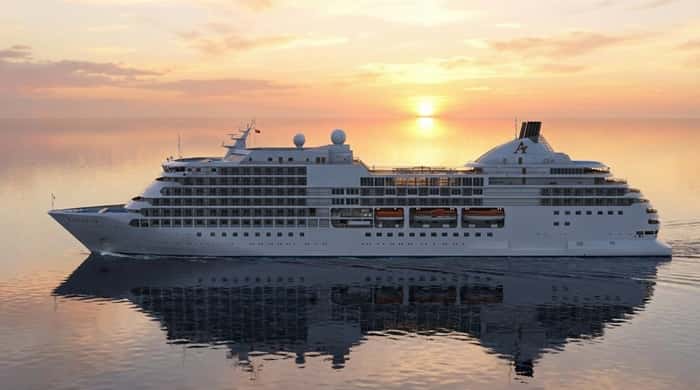
The cruise industry has rarely been short of bold ideas, but every so often, one surfaces that quietly shifts the conversation. The acquisition of Seven Seas Navigator by Avora Residences may well be one of those moments.
The vessel, purchased from Regent Seven Seas Cruises, will re-emerge in January 2028 under a new name, Avora Lumina, and with a rather different purpose. Instead of hosting travellers for a fortnight’s holiday, the ship is being redesigned for something far more ambitious: long-term residential living at sea.
In simple terms, it’s less cruise and more neighbourhood one that just happens to circle the globe.
“Residential cruising has proven its viability,” said Mikael Petterson, Founder of Avora Residences. “Avora Lumina represents the next evolution purpose-built for long-duration global living, expedition capability, and a more refined residential experience.”
Petterson is not new to the concept. As the founder of Villa Vie Residences, he was responsible for launching one of the few modern residential cruise programs to gain meaningful traction. That experience appears to have shaped Avora’s strategy, positioning the company between Villa Vie’s contemporary residential cruise model and the rarefied world of The World, the ultra-exclusive ship often described as the pinnacle of maritime real estate.
Avora’s proposition sits somewhere in the middle: high-end, certainly, but with a slightly broader reach.
Respecting a ship with history
Rather than stripping the vessel down to its bones, Avora plans a gentler approach.
The deal includes a nine-year charter agreement with Norwegian Cruise Line, maintaining operational continuity with one of the cruise sector’s most experienced maritime operators. The aim, according to the company, is to preserve the ship’s long-established operational DNA while gradually transforming the onboard experience into something suited to permanent residents.
In an industry where ships often develop personalities of their own, that continuity matters.
“Our philosophy is evolution, not disruption,” said Kathy Villalba, Co-Founder and CEO of Avora Residences.
“Navigator has a soul built through years of disciplined operations, experienced crews, and trusted relationships. We intend to honour that legacy while transforming the ship into a true long-term residential platform.”
It is a sentiment that will resonate with many cruise veterans who understand that ships, like hotels, often derive their character from the people who run them.
Not cabins homes
Ahead of its 2028 launch, the ship will undergo a comprehensive residential refit.
Residences will range from approximately 300 to 1,173 square feet, each designed with the expectation that owners will remain on board not for days or weeks, but potentially for years.
Petterson is careful to draw a line between cruise accommodation and what Avora intends to offer.
“These are not cruise cabins,” he said. “They are designed as floating homes, primary residences that travel with their owners for years at a time.”
That philosophy will extend beyond the private apartments themselves. Shared spaces are being redesigned with longer stays in mind, including expanded communal areas and a dedicated business and connectivity centre for residents who intend to work while travelling.
In the age of remote employment, the idea of logging into a meeting while sailing between continents is perhaps less fanciful than it once seemed.
A ship built for exploration
Size also plays a role in the concept.
While modern cruise ships increasingly resemble floating cities, Avora Lumina remains relatively compact. That smaller footprint allows access to ports and waterways unavailable to larger vessels, an advantage that becomes significant on extended global voyages.
The ship is also polar-certified, opening the door to itineraries that include destinations such as Antarctica and the Northeast Passage, regions still beyond the reach of many cruise vessels.
For residents planning years of travel, such flexibility could prove a major attraction.
A three-year journey around the world
Avora Lumina’s inaugural itinerary reflects that ambition.
The ship will depart Lisbon on what the company describes as a three-year continuous global circumnavigation, visiting more than 140 countries and over 400 destinations across all seven continents.
Unlike traditional cruise schedules, where ships may spend only a few hours in port, Lumina intends to linger. Some ports will see the ship remain docked for up to five days, allowing residents to explore destinations more deeply.
After the first circumnavigation concludes, residents themselves will have a say in where the ship sails next.
“We are building a resident-driven global platform,” said Chris Cox, President of Avora Residences.
“After the first circumnavigation, owners will help shape where Lumina sails next. That fundamentally changes the residential cruise model.”
Property prices with an ocean view
Ownership will be structured in two ways.
The Life-of-Ship Ownership option allows residents to purchase their home aboard Lumina for the vessel’s operational lifespan, with pricing ranging from approximately US$545,000 to US$4.2 million across 242 residences.
A second five-year ownership program begins at around US$219,600, offering long-term access with a lower financial commitment.
Avora argues that the pricing is competitive with property ownership in major global cities, albeit with the rather unusual bonus of waking up in a new country every few weeks.
Dining that travels with the ship
Food, naturally, remains central to life at sea.
Avora plans a culinary program shaped by the ship’s itinerary, featuring destination-inspired dining concepts, seasonal menus, and locally sourced ingredients that reflect the regions visited.
Extended port stays will allow chefs to procure fresh produce and regional specialties ashore, adding authenticity to the onboard experience.
Expect wine programs, chef-led tastings and the occasional culinary nod to the destinations appearing on the horizon.
A niche quietly gaining momentum
Residential cruising still occupies a relatively small corner of the wider cruise sector, but its appeal appears to be growing.
For retirees, entrepreneurs, and location-independent professionals, the notion of a floating residence that circles the globe has a certain romance, particularly in an era where work is increasingly detached from geography.
With Avora Lumina, that concept gains another serious contender.
Whether the idea proves visionary or simply adventurous will ultimately depend on how many people decide that their next home should come with an ever-changing view.
For now, the horizon looks promising.
Sales for Avora Lumina residences are now open, with further details available at www.AvoraResidences.com.
by Sandra Jones – (c) 2026.
Read Time: 5 minutes.
About the Writer.
 Sandra has spent a working lifetime quietly rescuing journeys, one itinerary, one anxious caller, one impossible connection at a time. Years in Australia’s finest travel agencies taught her the art of calm, how to find a flight in a fog of cancellations, how to soothe a traveller when luggage wanders, how to turn nine frantic days in Europe into something resembling sense. Qualified, seasoned, endlessly patient, she learned that good travel advice is part logistics, part listening.
But the storyteller in her was always waiting its turn. Writing offered a new map, a way to turn experience into reflection, detail into delight. At Global Travel Media, Sandra now writes the truths only insiders know: the mishaps, the laughter, the grace found between gates and goodbyes. She reminds us that travel, for all its fuss, is still one of life’s better ideas.