

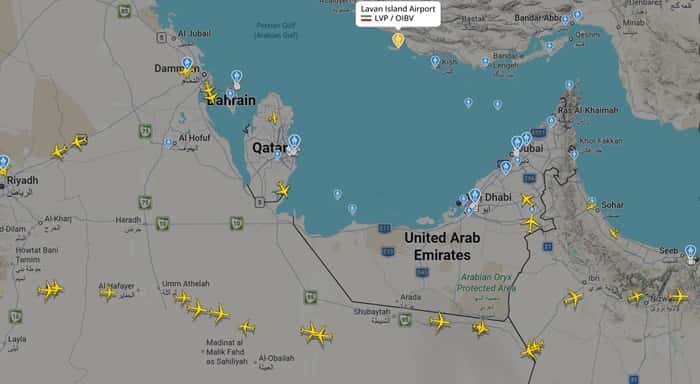
If you want to understand how fragile global aviation really is, don’t look at spreadsheets. Watch what happens when the Middle East sneezes.
On Sunday morning, the world’s busiest transit corridor did more than sneeze; it staggered.
Explosions over Gulf skies, sudden airspace closures, and airlines scrambling to rewrite schedules mid-flight sent a familiar shiver through the industry. And, as always, Australians were among the first to feel it.
Because for travellers from this corner of the map, the Middle East isn’t just a region. It’s the great airborne roundabout between here and everywhere else.
Take a lane out of that roundabout, and things get messy fast.
Dubai rattled, but was still standing
The flashpoint was Dubai, the city that aviation built a personality around.
Airport authorities confirmed that a concourse at Dubai International Airport (DXB) sustained minor damage during an overnight incident, which was quickly contained. Emergency teams were deployed immediately, and four staff members received medical treatment.
Most passengers had already been cleared from terminals under contingency planning, a line that reads procedural, but in aviation terms signals just how seriously the situation was being treated.
Dubai Airports said further updates would follow as more details emerge.
In practical terms, the airport continued to function. Symbolically, though, the moment mattered.
Because when Dubai looks vulnerable, even briefly, the entire long-haul ecosystem takes notice.
Doha pauses the machine
Over in Qatar, the reaction was more immediate.
Qatar Airways confirmed its operations remain temporarily suspended following the closure of Qatari airspace, with flights expected to resume only once authorities give the all-clear.
A further update was promised for mid-morning Doha time, though seasoned travellers know these moments rarely run on tidy timelines.
For Australians transiting between Europe and Asia, the pause landed heavily. Doha has quietly become one of the most reliable connectors on the map. Remove it, even briefly, and the dominoes start to fall.
Abu Dhabi joins the slowdown
Etihad Airways soon followed with its own operational reset.
Departures from Abu Dhabi were suspended until early afternoon UAE time, while arrivals scheduled before that window were cancelled outright. Flights later in the day remain subject to operational conditions, aviation shorthand for “watch this space”.
The airline confirmed affected passengers are being contacted directly and offered rebooking or accommodation, though heavy call volumes were expected.
Etihad stressed safety remains its top priority, adding that operations will resume when conditions allow.
It’s a line airlines use often, but in moments like this, it carries real weight.
European ripple effects begin
The shockwaves didn’t stop at the Gulf.
SWISS confirmed it is suspending flights to Tel Aviv until 7 March, affecting 14 services, and has cancelled Zurich–Dubai rotations due to airspace complications.
Passengers are being rebooked or refunded, while the airline maintains close contact with crews in the region.
It’s a reminder that modern aviation isn’t built on routes, it’s built on networks. Tug one thread and the web shifts.
ATIA steps in with a calm head
Back home, the Australian Travel Industry Association (ATIA) moved quickly to inject some perspective into what could easily become panic season.
CEO Dean Long urged travellers not to cancel bookings prematurely, noting the situation is evolving rapidly but remains manageable with the right advice.
“The situation across the Middle East is evolving rapidly and is already disrupting international flight operations for Australians travelling via major hubs including Dubai, Abu Dhabi and Doha,” Long said.
“Emirates, Etihad Airways and Qatar Airways are the most directly impacted at this stage, but European and other international carriers routing through Gulf airspace are also experiencing delays and rerouting. The impact is broader than many travellers may expect.”
It’s a classic aviation truth: disruption rarely stays in its lane.
Insurance and Smartraveller in the spotlight
ATIA also pointed travellers toward updated government advice, urging Australians to check Smartraveller guidance and understand potential insurance implications.
“Smartraveller has updated its advice for the UAE and Qatar at https://www.smartraveller.gov.au/news-and-updates/middle-east-conflict and travellers should be aware this may affect travel insurance provisions. We strongly encourage Australians to check DFAT’s Middle East conflict page and speak with their insurer if they have concerns.”
It’s the kind of practical reminder that cuts through the noise, especially in an era where headlines move faster than fine print.
A plea for patience
Behind the scenes, travel advisors are doing what they’ve always done best, quietly solving problems before most travellers realise they have one.
Long acknowledged the pressure on the system but urged calm.
“Our members are actively supporting impacted clients, managing rebookings, securing alternative routes and providing up-to-date advice in what is a highly fluid environment.”
He also delivered a message many agents will appreciate.
“Our message to travellers is simple: do not cancel arrangements without first seeking professional advice. Unless you are travelling in the next 48 hours and have not been contacted, hold off contacting your travel agent right now to allow them to support those currently caught up in, and who are stranded, delayed and dealing with cancellations.”
It’s measured, sensible and very much in line with how the trade prefers to handle turbulence.
Reports from the ground
While airlines juggled schedules, reports emerging from the UAE painted a more human picture.
Explosions and interception activity over parts of the country left residents sheltering indoors, with uncertainty spreading quickly across expat communities.
Radha Stirling, CEO of Detained in Dubai and Due Process International, urged calm but acknowledged the seriousness of the moment.
“This is a serious moment, but it is unlikely to be prolonged. Regional actors have strong incentives to contain and conclude hostilities swiftly.”
She added that residents should rely on verified information and take sensible precautions while the situation stabilises.
Yet her organisations are already hearing distressing accounts, including vulnerable individuals struggling to move due to airspace restrictions.
It’s a sobering layer beneath the aviation headlines, a reminder that disruption is never purely logistical.
UN calls for de-escalation
The broader geopolitical context is equally stark.
The United Nations Secretary-General condemned the escalation and called for an immediate cessation of hostilities, warning that continued conflict risks wider regional instability.
For aviation watchers, such statements carry practical implications. When diplomacy falters, airspace closures tend to follow.
And when airspace closes, global travel feels it.
What Smartraveller is telling Australians
Australia’s Department of Foreign Affairs and Trade has updated its advice accordingly, warning that Middle East tensions could disrupt flights globally even for travellers not bound for the region.
Airspace closures around major transit hubs may cause delays or cancellations on routes to Europe and beyond.
DFAT also cautioned that travellers transiting the Middle East could face difficulties leaving if conditions worsen, with flights subject to sudden changes.
The guidance is familiar but worth repeating: monitor events, follow local authorities and ensure insurance coverage is adequate.
Why does this matter more for Australians
For Australian travellers, Gulf stability isn’t abstract; it’s structural.
The nation’s long-haul travel habits have been built around Middle Eastern hubs for decades. Dubai, Doha and Abu Dhabi serve as the great connectors, linking Australia to Europe, Africa and, increasingly, North America.
When those connectors wobble, the consequences ripple outward quickly: longer routes, higher fares and fewer options.
Even travellers heading nowhere near the Middle East can find themselves affected.
Aircraft need repositioning. Crews run out of hours. Schedules bend.
Aviation is a finely tuned machine, and right now it’s adjusting on the fly.
The quiet return of the travel advisor
If there’s a familiar storyline emerging, it’s the reassertion of the travel professional.
Moments like this tend to remind travellers why experienced agents remain invaluable not as booking intermediaries, but as crisis navigators.
Rerouting passengers, interpreting insurance terms, managing expectations, these are skills built over years, not coded overnight.
And as ATIA pointed out, those skills are now in high demand.
A situation still in motion
Where things go from here remains an open question.
Airspace disruptions can be resolved quickly if tensions cool, or linger unpredictably if instability persists. Much depends on developments well beyond the control of airlines or airports.
What is clear is that aviation’s sensitivity to geopolitical tremors remains as acute as ever.
From volcanic ash clouds to pandemics, the industry has endured plenty. Each crisis arrives differently, but the lesson is consistent: resilience is built in real time.
The takeaway
For travellers, the message isn’t dramatic; it’s practical.
Stay informed. Stay flexible. Stay connected to reliable advice.
Flights will resume. Routes will reopen. Aviation always finds a way forward.
But this weekend’s events serve as a timely reminder that in a hyper-connected travel landscape, disruptions rarely stay local.
And for Australians watching the departure board flicker between “Delayed” and “TBC”, the Middle East suddenly feels a lot closer than it does on the map.
by Stephen Morton – (c) 2026.
Read time: 11 minutes.













excllent article and advice by Stephen , especially about the benefit of having a qualified travel advisor on travelers side.