

There are places travellers visit for the spectacle, Angkor at sunrise, Kyoto in cherry blossom, and Venice at dusk. And then there are places that don’t look like much at all but quietly underpin the way the world works.
Greenwich is one of those.
Stand outside the Royal Observatory on a mild London afternoon, and you’ll see tourists queuing politely to straddle a thin metal strip in the pavement. Cameras flash. Someone inevitably asks which foot belongs in which hemisphere. It feels faintly theatrical.
Yet that unassuming line marks the Prime Meridian, the point from which the modern world agreed to measure time. Not a bad legacy for a patch of suburban hilltop overlooking the Thames.
For travellers, especially those threading routes across continents and time zones, the story behind that line is more than historical trivia. It explains why aviation runs on precision, why jet lag feels so democratic, and why your phone never quite argues with itself when you land somewhere new.
When time was local and messy
Before railways and steamships began compressing distance, time was a local affair. Noon was whenever the sun decided it was noon. Each town kept its own version, and nobody minded terribly because nobody was in that much of a hurry.
Then came industrialisation, and suddenly schedules mattered. Rail timetables, shipping departures and later telegraph communications demanded something less poetic and far more predictable.
In 1884, the world did what it occasionally does best: it agreed on something. Delegates met in Washington, DC, and selected Greenwich as the global reference point for timekeeping. The choice was practical rather than political. British sea charts were already widely used, and standardisation tends to follow utility.
Greenwich Mean Time, or GMT, became the planet’s reference clock.
For decades, it served admirably, guiding navigation and quietly enabling the first era of globalisation. But like many Victorian solutions, it carried a flaw that only became obvious once technology caught up.
The Earth isn’t the best timekeeper
GMT relies on astronomy, specifically, the Earth’s rotation relative to the sun. Romantic, certainly. Reliable, not entirely.
Our planet does not spin perfectly consistently. It wobbles, slows fractionally, then speeds up again, influenced by gravitational pulls and geological shifts that most of us would rather not think about mid-flight.
For everyday life, the difference is negligible. For scientists, satellite operators and eventually aviation systems, it became problematic. Precision was no longer a luxury; it was infrastructure.
The answer arrived not from the heavens but from physics.
Atomic clocks, measuring the vibration of atoms with extraordinary accuracy, offered a level of consistency the spinning Earth simply couldn’t match. They don’t drift, don’t wobble and don’t particularly care about sunrise.
From that came Coordinated Universal Time (UTC).
GMT vs UTC: A quiet evolution
To most travellers, GMT vs UTC sounds like a debate best left to pub quizzes. In conversation, the terms are often used interchangeably, particularly in Britain, where GMT retains cultural affection.
But there’s a subtle distinction worth noting.
GMT is anchored in the movement of the sun. UTC is anchored in atomic precision.
UTC is calculated from a global network of atomic clocks, synchronised and monitored with near-obsessive attention. Yet the system retains a gentle nod to astronomy. When atomic time drifts too far from Earth’s actual rotation, a leap second is introduced, a small adjustment that keeps our clocks broadly aligned with the natural day.
It’s a compromise that feels almost philosophical: science setting the tempo, nature keeping the beat.
Who controls the world’s clock?
No single country owns global time. The measurement of UTC is coordinated internationally and overseen by scientific bodies that monitor Earth’s rotation with forensic precision.
Time zones, however, remain delightfully political.
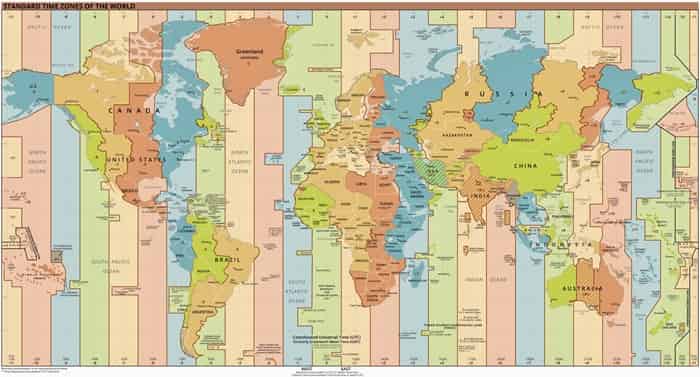
Governments decide their own offsets from UTC, and logic doesn’t always prevail. China spans five time zones but keeps a single national clock. India runs on UTC+5:30, a pragmatic midpoint that confounds tidy arithmetic but suits reality well enough.
Time, like borders, often follows human decisions more than geographical ones.
The traveller’s relationship with time
Anyone who travels frequently develops a mildly adversarial relationship with time zones. Eastward journeys compress sleep. Westward ones stretch evenings into curious elastic shapes.
Moving from London to continental Europe, you gain an hour. Push on to Southeast Asia and you’re suddenly several hours ahead of your internal clock. Cross the Pacific, and eventually you meet the International Date Line, the closest commercial aviation comes to time travel.
Cross it one way and tomorrow arrives early. Cross it the other way and yesterday lingers unexpectedly. It’s the sort of experience that leaves even seasoned travellers double-checking departure cards.
The quirks we live with
Time zones are rarely neat. Some countries opt for half-hour offsets, others for 45 minutes, cheerfully ignoring the mathematical elegance of whole numbers. Daylight saving time comes and goes depending on local appetite, leaving travellers to recalibrate twice a year.
Through it all, UTC remains steady, the quiet metronome beneath the noise.
Aviation, in particular, depends on it. Pilots, air traffic controllers and meteorological systems all rely on a single universal standard. Without it, international travel would quickly unravel into a logistical farce.
A system most of us never notice
What’s striking about global timekeeping is how little attention it attracts. It rarely makes headlines, never trends on social media and is largely taken for granted.
Yet every long-haul departure, every digital boarding pass and every cross-border financial transaction depends on this shared agreement about time.
It’s a reminder that not all infrastructure is visible. Some of it is conceptually built on consensus rather than concrete.
The next time you land somewhere far from home and your phone updates the time without fuss, spare a thought for that thin line in Greenwich. It’s a modest landmark carrying a disproportionate burden.
Not many places can claim to anchor the rhythm of the modern world with quite so little ceremony.
by Andrew Wood & edited by Stephen Morton – (c) 2026.
Read Time: 6 minutes.
About the Writer.
 Andrew J. Wood has lived in Thailand since 1991. He is a former Director of Skål International and a Past President of Skål International Asia, Past President of Skål International Thailand, and a two-time Past President of Skål International Bangkok.
A former hotelier with senior management experience at leading hospitality groups, including Shangri-La, Minor International, Landmark and Royal Cliff, he writes regularly for international travel and hospitality publications.
His work focuses on tourism trends across Asia, sustainable tourism development, and the future of travel and hospitality in the Asia-Pacific region.











