

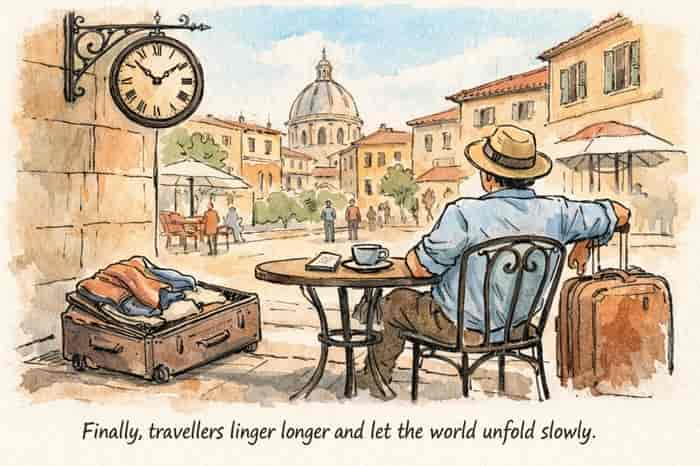
There’s a quiet shift underway in global travel, not a bang, not a boom, but something far more interesting. Travellers aren’t necessarily going further in 2026. They’re simply staying longer once they arrive.
New research from Global Rescue suggests the age of the whirlwind itinerary may finally be catching its breath. According to its Winter 2026 Traveller Sentiment and Safety Survey, one in five experienced travellers plans to take more trips with longer stays, hinting at a deeper rethink of what a “holiday” should actually feel like.
Not a stampede, mind you. Nearly half of the respondents say their travel habits won’t change. But the directional signal is unmistakable: less rushing, more lingering.
“These findings suggest travelers are increasingly prioritizing quality and duration over sheer volume,” said Dan Richards, CEO of The Global Rescue Companies and a member of the US Travel and Tourism Advisory Board at the US Department of Commerce. “Longer stays can reduce travel friction, help manage costs and provide greater flexibility in an unpredictable global environment.”
It’s a sentiment many in the industry will recognise. After years of compressed travel windows and bucket-list urgency, the pendulum appears to be easing back toward something more civilised.
The survey’s regional splits add another layer of intrigue. A slim majority of US travellers 52% expect their travel patterns to hold steady. Outside the US, however, attitudes tilt toward longer, fewer trips, with 16% opting to stretch stays compared with just 10% of Americans.
Even gender tells a story. Men are slightly more likely to extend their time away, with 22% planning longer stays compared with 16% of women. Not a dramatic divide, but enough to suggest travel planning is becoming more individualistic than ever.
And why the shift? The reasons are refreshingly practical. Longer stays mean less jet lag, deeper cultural immersion, and, increasingly, better value through weekly or monthly rates.
“Travelers shifting to longer stays are seeking deeper cultural immersion, more time to adjust to jetlag, a less rushed overall experience and cost savings through weekly or monthly rates,” Richards said.
For suppliers, the implications are subtle but significant. The winners in a slower travel cycle won’t just be airlines chasing volume, but destinations and operators capable of holding attention longer, think apartment hotels, rail journeys and experience-rich itineraries.
It also marks a return to something travel once did rather well: letting the journey breathe.
And perhaps that’s the real story here. Not that people are travelling more, but that they’re travelling better.
For further details, visit https://www.globalrescue.com.
by Jason Smith – (c) 2026.
Read time: 2 minutes.
About the Writer.
 Jason Smith was educated in terminals, taxis and hotel corridors, the sort of schooling no classroom could hope to provide. Half American, half Asian, he grew up inside the quiet machinery of tourism, watching his family send strangers into the world long before he travelled himself.
Bangkok came first, then the Asian Institute of Hospitality & Management, followed by a career stitched together across Singapore, Malaysia and Vietnam. Each city left a mark. Thailand eventually claimed him, along with a corner office, as Director of Sales for one of the country’s leading hotel groups.
Then the world paused. Borders closed, skies emptied, and Jason returned to America carrying time, memory and a lifetime of stories.
Now at Global Travel Media, he writes the human side of travel check-ins, departures and everything between with warmth, clarity and an instinct for connection.











